EP: 90
Through the Customer Journey and Beyond
With Alex Akel
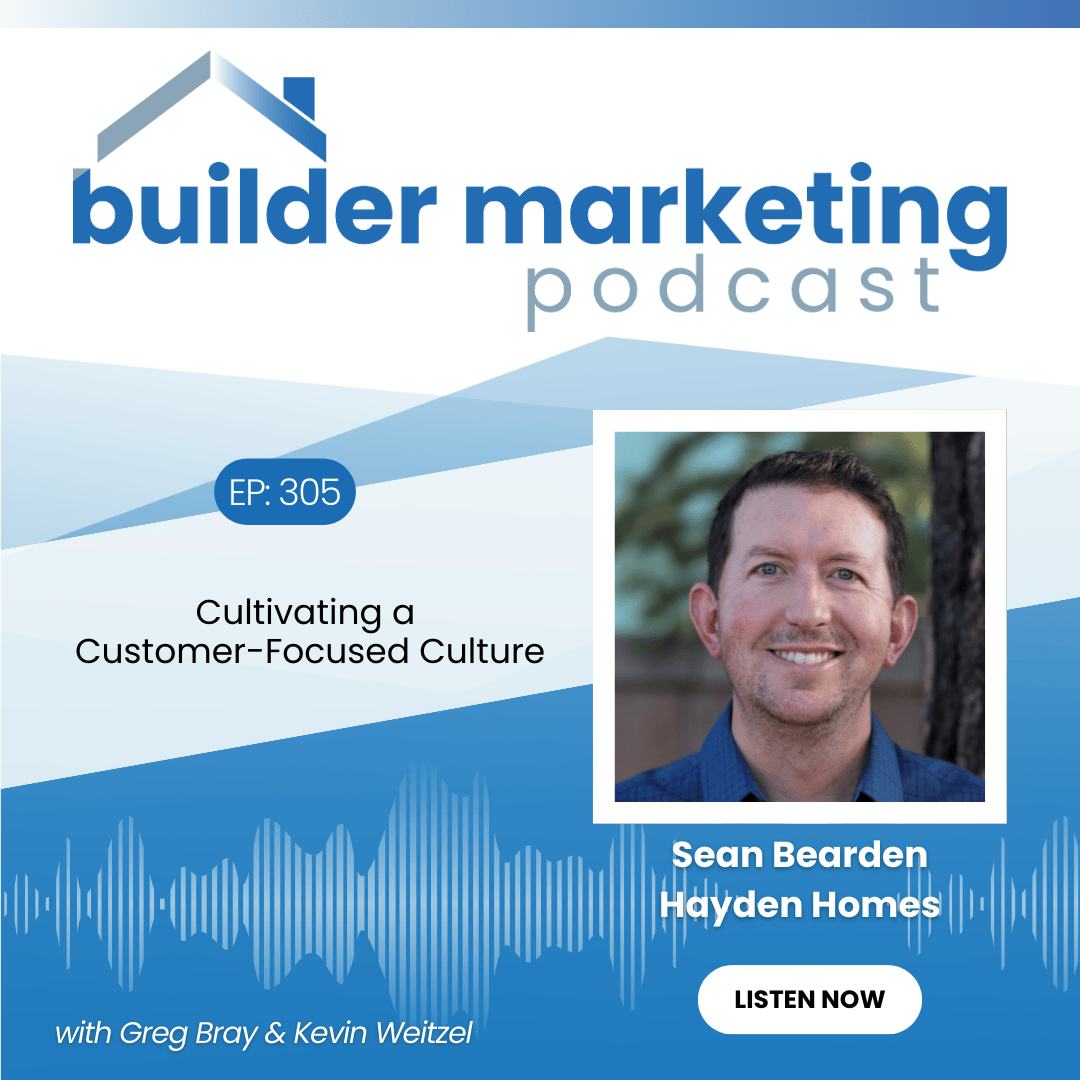
This week on the Builder Marketing Podcast, Sean Bearden of Hayden Homes joins Greg and Kevin to discuss how home builders can cultivate a customer-focused culture that fosters strong relationships with home buyers.
The quality of the customer experience a home builder provides is a deliberate, everyday choice. Sean says, “I think customer experience, at the end of the day, is a choice. It's a choice we all get to make. Are we going to be the builder that just gets the job done and onto the next? Or are we going to be the builder that shows up for our customers in meaningful ways? And that's the difference. That's what we're trying to put out there, is that it's not just a home building experience, it's a full immersive experience.”
Every team member, regardless of their role, actively shapes the customer’s overall experience. Sean explains, “I think it's just one of those things that, it sounds obvious when you say it out loud, but a lot of companies still miss it. I think sales might be the front door, but the whole house is built by everybody else, too. So, customer experience is not owned by sales. They’re a huge part of it for sure, but they're not the only part. Customers don't separate departments in their heads. So, if there's an issue with accounting, that's the builder. If construction misses something, that's the builder. If a trade partner's careless on-site, they're going to associate that with the builder.”
A customer-focused culture moves beyond task completion to truly stepping into the customer's shoes. Sean says, “I mean, I think what we're focused on is, what can we do to go above and beyond? How do we create that culture of customer experience, so everybody gets excited about it? That starts with ownership, ownership rooted in empathy. Teams aren't thinking, Did I finish my part? They're thinking, How is the customer experiencing this moment right now, and what do they need from us? I think that shift matters because empathy makes the work personal and it's fulfilling. So, it keeps us connected on a human level.”
Listen to this week’s episode to learn more about how home builders can establish a customer-centric company designed to forge stronger relationships and loyalty with home buyers.
About the Guest:
Sean is a customer experience leader committed to delivering memorable, meaningful, and consistent moments across every step of the homebuilding journey. With a focus on both strategy and heart, he helps shape a culture that puts the customer first while inspiring teams to lead with empathy, trust, and excellence. Sean partners across sales, construction, service, and marketing to turn customer insight into simple, repeatable practices that elevate the end-to-end experience for every homeowner.
Greg Bray: [00:00:00] Hello everybody, and welcome to today's episode of the Builder Marketing Podcast. I'm Greg Bray with Blue Tangerine.
Kevin Weitzel: And I'm Kevin Weitzel with OutHouse.
Greg Bray: And we are excited to have joining us today, Sean Bearden. Sean is the Customer Experience Director at Hayden Homes. Welcome, Sean. Thanks for spending time with us today.
Sean Bearden: Yeah, totally. Thanks for having me.
Greg Bray: Well, Sean, let's start off by just getting to know you a little bit. Give us that quick background and overview about yourself.
Sean Bearden: Yeah, so I'm Sean Bearden. [00:01:00] I'm the Custom Experience Director at Hayden Homes and Simplicity by Hayden Homes based here in Bend, Oregon, with my wife Katie and our two girls, Ruby and Alice. We're a pretty active family. I'd say if we're not running from a soccer game or volleyball tournament, we're probably up on the mountain. Mount Bachelor is only 30 minutes from town, so a lot of skiing and playing in the snow. And then in the summer, we're out hiking, mountain biking, playing on the river, or out golfing, just trying to find a reason to get outside. Bend has no shortage of outdoor activities, so it's been an incredible place to raise our kids. They're 11 and eight, so they definitely keep us on our toes.
Kevin Weitzel: A lot of parents, what they'll do is they will have active lifestyles and until they have kids. Then when they have kids, they concentrate into all the kids' stuff, and then they put on weight. See, I did that. But the problem is, is that my kids were both bookworm nerds. So, I'm pretty sure that I just put on weight for the sake of putting on weight. I don't know. Sounds like you're still active, though.
Greg Bray: Is that a question, Kevin?
Kevin Weitzel: We're coming up to it.
Sean Bearden: It is tough to get them up to the mountain. I will admit that it's quite a process to get [00:02:00] them up to the mountain. But once we're there, I think they have fun.
Kevin Weitzel: There we go. Plus, you're up there in the mecca of outdoor activities. It's a beautiful place up there in Bend. If you've never been to Bend, tourism association here says go visit Bend, Oregon. Before we get started into the nuts and bolts of Hayden Homes and what you do and some of the content that you're bringing to us today, tell us one interesting factoid about yourself that has nothing to do with work, the home building industry, or family.
Sean Bearden: Okay. So, this one, I guess, is cheating a little bit. It's industry adjacent, but this will make sense. So, when I was in fourth grade, my parents built a new custom home, and part of that process was they had all these floor plan books spread out everywhere. The ones you flip through, and you start circling stuff you like and argue about the stuff you don't like. Somewhere in that process, I got completely obsessed with floor plans. I was geeking out. I was like, not normal level interested, just full on obsessed.
To be fair, this was, you know, right around the time that movie Rich came out. Remember that one? I watched that, and I was like, yep. That's the life I'm going for. While my parents were looking through these books and for ideas, I started just drawing [00:03:00] my own floor plans. To be clear, my wants and needs were a little different than my parents'. They were like, Should we do a formal dining room? And I was like, no, we need an arcade room or like a pool table or a swimming pool. So, I'm just sketching out these totally over-the-top houses and bowling alleys and secret hallways. My brother's out there shooting BB guns and riding dirt bikes, and I'm sitting at the kitchen table drawing floor plans in fourth grade. Just being really cool.
Kevin Weitzel: Alright. Now in fourth grade, were you using a ruler or were you using a formal scale?
Sean Bearden: Using a ruler, graph paper. These were mostly to scale, I feel like. I still have all of them. So, if you guys ever need a floor plan, you know, with the trampoline in the living room or water slide coming off the roof, let me know.
Greg Bray: And you did say secret passages, too, right?
Sean Bearden: Yeah, absolutely. Yeah. You gotta have that.
Greg Bray: Yeah, for sure. Well, so how did you go from fourth grade, floor plan drawer, to actually being in the home building industry?
Sean Bearden: Yeah, so besides that experience, I didn't have any experience in home building. When I started at Hayden Homes, I started in construction. Shifted over to customer service and [00:04:00] warranty. Spent a ton of time in the fields, meeting with our customers every day, solving problems. But with my new role in customer experience, it's funny, when I look back, it kind of feels like my path was always headed toward CX even before I knew there was a name for it.
Going all the way back, I mean, six, seven years old, I used to help out at my grandma's restaurant. She had this little restaurant called the Bearden's House of Pancakes. It was glorious. Her customers absolutely loved her. I got to see her in action and how she took care of her customers, and that was just ingrained in me at such a young age. But it was all regulars at her restaurant. I mean, it was like, Cheers.
So, I didn't have a job description, but my two job functions were, I would walk around with a pot of coffee just trying not to spill, topping off coffee cups. But then, the second one was just literally walking around, smiling, and saying hi to people. And the servers love that. I mean, it helped with tips. But I did not get paid. I got paid in pancakes and hot chocolate, so I was winning.
More recently, I guess, the summers during college, I worked as a fishing guide in Alaska. So, for four summers, I was at this premier fishing lodge, completely [00:05:00] remote. People are flying in on float planes and paying top dollar to come up there and experience Alaska, right? Out there, you learn really fast that customer experience is everything. People are not just there to catch fish. They're paying for a trip that they might talk about for the rest of their lives.
So, you learn how to anticipate needs, how to read the room, how to make things feel easy and special. I mean, we're there to help create these memories, and the conditions were pretty tough sometimes. So, we'd be out there on the ocean, getting pelted in the face with sideways rain. I'd be like, Hey, do you guys need anything? And that fishing lodge is actually where I met the leadership team at Hayden Homes. So, this is all connecting, I promise.
Kevin Weitzel: That's cool.
Sean Bearden: Yeah, I got to know them out on the ocean of all places, you know, fishing for king salmon and halibut and hearing all about the company and how they think and what they care about. And the more I learned, I was like, I don't know how filet and fish translates into home building, but I want to be a part of that. We're going to figure it out. So, I started a week after graduation, and that was 18 years ago. So, basically, I've [00:06:00] been on this mission ever since to just help us keep raising the bar on how we serve our customers.
Kevin Weitzel: There is so much book-worthy stuff just in what you just said in that little paragraph. Number one, how was being a tour guide in Alaska not your interesting factoid? That's ridiculous. Number two, is Granny's freaking pancake world or the world of pancakes, the pancake mecca still in business, and how do I get a job there bussing tables? I will work for pancakes.
Sean Bearden: Yeah, sadly, it is not in operation anymore. I know, it's sad. But that was a great, great spot to hang out as a kid.
Kevin Weitzel: Alright, so the number three was, is that we have an odd occurrence here, Greg? I don't think we've ever had anybody on the podcast that has, oh no, I take that back. Kristi Allen was on the construction side and worked everything in her family business. But very rarely do we get people that have come from the construction side that then migrate over to the sales and marketing, and especially the marketing side. Do you feel that gave you any kind of insight or advantage to allow you to [00:07:00] be better at your job than say somebody that just comes outta college and, oh, I'm a marketer. I took communications, blah, blah, blah. Do you have any kinda leg up there, or there's an advantage?
Sean Bearden: Certainly, I think, spending so much time in the field and meeting with our customers every single day, I mean, handling those service requests, those are some of the tougher parts of the job. You're always responding to a concern or an issue. So, learning how to navigate that and just knowing what makes our customers happy, that was just really important experience for my job today because it was almost 15 years out there meeting with our customers every day and helping build homes, so.
Greg Bray: So, Sean, before we get too far into this, tell us just a little bit more about Hayden Homes, where you guys build, and the type of homes you're doing and the kind of customers you're working with.
Sean Bearden: Yeah. So, Hay Homes has been building in the Pacific Northwest for over 35 years. We build across Oregon, Washington, Idaho, and Montana, mostly in underserved secondary markets where the housing supply is a little tight, and people need some more options. We also have Simplicity, I mentioned that earlier, which is [00:08:00] our on your land option. So, for families who already have land, want to build on their own property, we could serve them as well.
And the thing that I think makes Hayden Homes different is our purpose, our why. Like our whole reason for existing, besides building homes, is this idea of give as you go. So, give as you go, so together we build a strong community and lead fulfilled lives. So, what does that mean? Everywhere we build, we're also looking for ways to give in that community. So, we help support local nonprofits. We partner with incredible organizations to help make home ownership a reality for people.
We also started a nonprofit called First Story, which has helped more than 120 families become homeowners who otherwise might not have had that chance. Every time a Hayden Home is sold, a portion of that sale goes back into First Story and helps support these local charities. So, as we grow, so does the opportunity to give more and more, and the spirit of generosity has just been ingrained in us, going all the way back to our founders, Bob and Virginia. All of our team members have volunteer time off. We [00:09:00] match donations. So, it's not just this corporate tagline; it is fully part of our culture. You'll see our people out there building beds, packing food, supporting youth programs, cooking meals, just quietly showing up to wherever help is needed.
And as far as our buyers go, they're everyday people with real budgets, teachers, firefighters, nurses, a lot of first-time home buyers. So, a lot of families looking for more stability, retirees who want a simpler next chapter, and we're not trying to be everything to everyone. We want to be the builder that helps make home ownership attainable, truly attainable. Then we make that journey feel human and easy and memorable. So, not only do you get a high-quality home for a great price, you get a thoughtful experience, and at the same time, the community around you gets stronger too.
I'd say just being around this for so long now, like I remember being at a key turnover on closing day, and this family who had just been renting for forever, 10 or 11 years, the dad just stood there quietly. He [00:10:00] had his young kids with him, he just broke down in tears. He said, I did not think this day was ever going to happen. That's the kind of stuff that stays with you. It reminds you that, you know, what we do is about way more than building homes. It's about changing someone's story.
Greg Bray: I love that. Love that. So, Sean, that leads right into my core question. You know, one of the reasons that I wanted to talk to you today and to learn more is because we don't see a lot of builders that have a job title called customer experience director. So, where does that come from within the Hayden Homes? What made that something that's its own, you know, position and role at the company? What does customer experience mean in the larger context of Hayden Homes and your mission?
Sean Bearden: I'll start with just customer experience at Hayden Homes in general. So, for us, customer experience is the full story. It's basically the difference between a transaction and a relationship, from the first time they see us online to closing day, all the way through their warranty. It's the whole journey. So, [00:11:00] the way we talk about customer experience at Hayden is really through the lens of how our customers actually feel.
We boiled it down to three core feelings that we're aiming for on every single interaction. Trust. These people did what they said they're going to do, and they've got my back. Pride, just meaning as a buyer, I'm proud of this home. I'm proud to pull into the community and tell all my friends about it. Third one, this sense of feeling cared for. So, meaning at the end of the day, people just want to feel heard and feel supported from start to finish, and not feel like they're just another number in the system.
So, if we hit all those feelings consistently, the experience is strong even when bumps happen, because we all know bumps are going to happen in home building. It's construction. So, when the trust is there, when they're proud of their purchase, countless moments of care throughout the whole journey, we can weather those bumps no problem.
This role of customer service director, it was created a few years ago. I think the simplest explanation is I get to help our company design and deliver a journey that people want to talk about in a really good way. I just help make sure the home buying [00:12:00] journey feels really effortless for people, not just that we build a great house, but that the whole experience feels clear and we're building trust, and honestly, just making it fun too. I mean, that's part of my job.
Building a home is stressful enough; let's make it easy, let's make it fun along the way. So, I spend a lot of time in my role listening to customers, you know, surveys, focus groups, job site visits. I want to know what's working and where are we potentially causing some stress. And then I partner with our teams across the company to remove friction, fix pain points, and tighten up the communication, just make sure those experience principles I mentioned show up consistently. No matter what community someone's buying it, it's got to stay consistent. A really big part of my role is just focusing on how people feel. We can build a beautiful, high-quality home, but if we don't make people feel trust and that respect and help them feel supported, then we miss the mark.
Kevin Weitzel: Now, are you doing things like the fun, you know, like having them sign a beam in a home or having them, you know, for their on [00:13:00] lot product, maybe having them put family hand prints in the foundation? Anything like that?
Sean Bearden: Yeah, there's so many moments like that. Those are opportunities to engage the whole family. I mean, bring the kids along, let's turn what would normally be just a lot of information thrown at them through a pre-drywall experience to, Hey, let's bring the whole family along. Let's make it fun. We put together this little kid kits with exactly what you said: finger paint, markers, coloring books, and there's little hard hats. It's intentionally designed that way to make it feel special. They're expecting to show up and just learn about their home, but then, when they show up to their lot for the first time before the foundation goes in, there's these golden shovels, and we do this groundbreaking ceremony together. So, we definitely have some fun with it.
Kevin Weitzel: That's cool.
Greg Bray: So, Sean, it sounds to me that you've embraced that customer experience is not a sales and marketing department, it is an everybody department, that involves the whole company. How does that go over with the people that don't like interacting with customers and don't want to and just want to do their job? How do you get that [00:14:00] message out throughout your company and get everybody on board with this idea that we all impact the customer journey?
Sean Bearden: Yeah, that's a great question. I'm glad you asked that. I think it's just one of those things that, it sounds obvious when you say it out loud, but a lot of companies still miss it. I think sales might be the front door, but the whole house is built by everybody else, too. So, customer experience is not owned by sales. They're a huge part of it for sure, but they're not the only part. Customers don't separate departments in their heads. So, if there's an issue with accounting, that's the builder. If construction misses something, that's the builder. If a trade partner's careless on-site, they're going to associate that with the builder.
So, I think that's the key point, that the customer is having one experience with one company, not a bunch of separate experiences with separate departments. And when everybody understands the experience we're trying to create and the feelings we want our customers to have, that's when everything starts to click, and it's really, really strong. So yeah, we send everybody through customer experience training. It takes the whole company.
Greg Bray: So, that's a formal training program that you guys have to help [00:15:00] everybody get better?
Sean Bearden: Yeah, and they're first introduced to it at new team member orientation, and then there's some follow up trainings, for sure.
Greg Bray: So, when you look at other builders and some of your competitors and things that you're trying to differentiate, what do you see them not doing on a customer experience level? Mistakes that you're like, oh, guys, you're just totally blowing it. You really just missed the mark there.
Sean Bearden: That's a good question. I mean, I think what we're focused on is what can we do to go above and beyond. How do we create that culture of customer experience, so everybody gets excited about it? That starts with ownership, ownership rooted in empathy. Teams aren't thinking, Did I finish my part? They're thinking, How is the customer experiencing this moment right now, and what do they need from us? I think that shift matters because empathy makes the work personal and it's fulfilling. So, it keeps us connected on a human level.
In a strong customer experience culture, people talk about buyers with respect even when they're not around. That's a real tell of what you believe. If [00:16:00] we're empathetic in the room and dismissive in the hallway, that's not culture. Respect is when no one's watching. That's culture. We look for solutions instead of blame. You know, we're not defending ourselves, we're protecting the experience. When we celebrate the wins, like really celebrate them, that's how you reinforce what great actually looks like.
But aside from the wins, I think we also talk about the misses quite a bit, too. No finger pointing, but more like, okay, well that didn't land the way we wanted, but what did we learn? How do we fix this moving forward? And that's really empowering for our teams. I think people feel safe to say, Hey, I made a mistake, and then they feel trusted to do something about it.
Kevin Weitzel: I want to applaud your answer, and I'm going to tell you why, Sean. I've known Greg for almost 10 years now, and I know for a fact that his question wasn't, Let's point fingers at somebody. Let's throw some shame, some shade out towards somebody else. That wasn't his question. But his question was, you know, what are your competitors doing that they're missing the mark? You internalized it and literally said, Here's what we are doing. That is the takeaway on that, is [00:17:00] that it's not about what your competitor's doing. It doesn't matter what Billy Bob and Chuck with the Truck and Carl are doing when they're building homes. It matters what we are doing when we're building homes and constantly seeking excellence. Is that a fair assessment of what your statement basically was?
Sean Bearden: Yeah, absolutely. That's a big part of it. I think a strong culture really empowers everyone to own the experience. Not just customer-facing roles, too. I mean, we want every team member to feel like they have permission and the responsibility to make the moment better. We encourage people to think outside the box, bring ideas forward. If someone sees a better way, they don't need to wait for permission to act. They just need to take action and do what's right for the customer.
And it all comes down to who you bring in, too. Having a strong customer experience culture starts with hiring. We hire customer-centric people who share our values and add to our culture. We used to say culture fit, but now we say, Are they going to add to our culture? And then we coach them on what customer experience means to us. And then there's this healthy energy where everyone wants to get better together, because they care about the people we serve and about each other. I keep saying this, but it is [00:18:00] fulfilling, delivering that great experience feels good, and at the end of the day, it's just a bunch of team members saying, you know, we're in this together, and we're not going to let the customer down.
Greg Bray: So, Sean, as you are trying to move that forward, get better with the customer experience, do you guys have some metrics that you use to measure? Is it like customer surveys? Is it number of times things go sideways? How do you kind of say, Oh, we're getting better, or, Hey, maybe here's a spot that we need to take a deeper look at?
Sean Bearden: Yeah, for sure. I think you definitely need a mix of numbers and stories. First, I think, look at solid customer satisfaction measure. For us, that's Avid CX through ECI. We look at overall scores for sure, but I probably spend most of my time in the comments. That's where you really hear what's going on. The numbers are going to tell you where to look, but the comments will tell you what to fix.
Second, I'd say track the moments that matter, not just the overall average. But how are people feeling about the preconstruction stage, for example, or how was the communication [00:19:00] during the build? If you break it out by stage, you can see really clearly, okay, this is where stress starts to spike. So, I'd say definitely map out the entire journey if you haven't already, and validate those moments and those touch points with real data, whether it's through focus groups or surveys.
And then third, pay attention to loyalty. Are people referring their friends and family? Are they coming back as repeat buyers? What do the online reviews say? And then I'd say lastly, underneath all of that, we try and stay really close to the voice of the customer in real time, too. So, calling buyers right after key milestones, using tools to gather feedback along the way. Doing proactive calls after closing. So, throughout that first year, not just when warranty items come up, but check-in calls that you know the customer isn't expecting.
How we treat our customers and how they feel about us post-close, I think, is way more important. You know, when the warranty items do come up, handle those quickly. We implemented an one hour response time goal. As soon as we receive a request, our team is calling right away. So, yeah, I think, you know, definitely numbers, but I think it's the comments and the [00:20:00] stories. You need both really help keep yourselves leveling up.
Greg Bray: Is it hard to get the feedback, or do you find that people are pretty willing to share when you ask?
Sean Bearden: If we've done our jobs correctly and built those connections early and built that relationship, our customers are happy to fill out a survey. Even if it takes 20 or 30 minutes to fill that out, they're happy to jump in and give us that feedback. Yeah.
Greg Bray: As customer experience improves, it becomes a competitive advantage, you versus the other builder. But yet it's not something that a buyer can like do two homes at once and compare as they go, and then finally switch at the last minute, right? And say, okay, I'm going to build the house halfway and then see who's got the best experience, and then I'll finish with them. They have to choose early. How do you communicate to the prospective buyer that, hey, working with us is different? What are some of the ways that you get that message out there in that early-stage marketing message?
Sean Bearden: Yeah, I mean, I [00:21:00] think we're really big on delight. The first thing to remember, delight doesn't have to be fancy or expensive. We call those wow moments. Most of the time it's just small, thoughtful moments that says to the buyer, we see you, and you matter to us. So, on a simple level, it can look like this, taking the time to acknowledge milestones that might otherwise fly by. Just sending a quick update with a photo when something exciting happens on-site. Remembering a detail that they shared the first day you met them and bringing it back up so they know that you were really listening. None of that costs very much, if anything, and that's those little small things add up over the course of the journey. And then every once in a while, you get a chance to do something that's still simple, but incredibly meaningful. If we've got time, I can share a quick story.
Greg Bray: Yeah, go for it.
Sean Bearden: We had a homeowner couple, John and Gladys, who our team got to know very well during the build. They had just celebrated their 50th wedding anniversary. Not long before closing, John sadly passed away. It was heartbreaking. Of course, our whole team was there to support Gladys through that time and help her navigate everything that came with finishing the home. Our project manager had built a [00:22:00] strong relationship with her, and he reached out to their kids after that happened and was able to get some photos from John and Gladys's wedding anniversary celebration.
And he took one of those photos and put together a plaque for her new home. On the plaque, it said, Because someone we love is in heaven, there's a little bit of heaven in our home. I mean, that's pretty powerful, right? That's not a big, expensive thing. It was super simple. It was a super simple gesture, but it meant the world to Gladys, and it turned that house into something even more meaningful for her. And that's the heart of it for me.
I think customer experience, at the end of the day, it's a choice. It's a choice we all get to make. Are we going to be the builder that just gets the job done and onto the next? Or are we going to be the builder that shows up for our customers in meaningful ways? And that's the difference. That's what we're trying to put out there, is that it's not just a home building experience, it's a full immersive experience. So, for us, yeah, the answer's easy. We're going to be that builder,
Greg Bray: That was the touching. And the fact [00:23:00] that you have created a culture where someone would even think to do that is amazing. Kudos to you and the team, Sean. That's fantastic. Fantastic.
Sean Bearden: Yeah. Thank you.
Greg Bray: It sounds like, honestly, your best marketing is your past customers and what they tell everybody. Is that true? I mean that they're telling their friends, this is the builder to build with.
Sean Bearden: Yeah, I think so. I mean, I think, that's ultimately the goal. I think that's a really important measure is how do our customers feel at the end of that first year. I think during the construction phase, absolutely, there's moments where it is difficult, but for the most part, when you move in, you're pretty happy. That's the honeymoon period. But a truer measure is how do they feel at the end of that first year. And that's really the difference for us, is we have an in-house customer service team that is fully ready and able to jump in and help those customers. And we want them to come back and buy their second and third homes from us and tell all of their friends. So, yeah, that's a big part of it.
Greg Bray: So, Sean, somebody who's listening to this conversation today and they're sitting there going, man, we could do [00:24:00] better. Where do they start in that process? Is it about going to management and asking for some resources? Is it about creating a new position of customer experience director? Is it something smaller and simpler? What are your recommendations on where somebody could start to improve their customer experience?
Sean Bearden: Yeah, I mean, I say that the simplest thing that you could do tomorrow, well, maybe not tomorrow, but next week, pick up the phone and just call five recent buyers. Not a huge fancy thing. Just five quick conversations. When you call them, just keep it simple. Ask two questions, you know, what was the best part of the journey with us, and what was the hardest part, or where could we have improved? You know, after those five calls, you might start to see some patterns, and then fix one of those things fast. Just one, even if it's small. Because magic isn't in doing 50 improvements at once. The magic is proving that you heard them and that you actually made a change. So, once your team feels that, and your customer feels that, that connection can change pretty quickly. It's a tiny step, but it will give you some clarity on [00:25:00] where to go next.
Kevin Weitzel: And if that feedback says their only regret is that their home didn't include an Alaskan excursion, brother, you can help them out with that.
Sean Bearden: Absolutely. I know a guy
Kevin Weitzel: Implementation today.
Sean Bearden: Done.
Greg Bray: Sean, I love the fact that you said five because there's actually a thing in website usability where if you get five people to look at your website, you'll find some of the immediate issues right away, too. It doesn't take very many people to see the pattern and to find at least the first thing to work on. It may not be everything, but the first thing that you can work on. I think that's great.
Sean Bearden: Yeah, exactly. Thank you.
Greg Bray: Sean, this has been really interesting. What is something that you have learned now with your customer experience that you wish you had known five, 10 years ago, that would've made a difference for you?
Sean Bearden: Gosh, that's a great question. You know, I'll keep this simple. I think, you know, I love that Maya Angelou quote. We've all heard this one, "People will forget what you said. They'll forget what you did, but they'll never forget how you made them [00:26:00] feel." I mean, how true is that, especially in home building? It's easy to check boxes. It's easy to say, okay, onto the next. We're busy. It might be our fifth orientation that week, but for them, it's the first time they're experiencing this. So, because it's such an emotional purchase, those feelings stick.
My advice, I guess, to my past self would be focus on delivering an experience that's memorable. Make those connections early. Build trust early. Confidence is one of the biggest drivers of overall satisfaction. The faster a buyer feels like, okay, this home builder has my back, the smoother everything gets after that. And then just make sure people feel cared for all the way through. Even when there are bumps, even when you're busy, if they feel cared for, that's what people will remember long after the keys are handed over.
Greg Bray: Well, Sean, I love the reminder today that this business is special because homes are special purchases for people. It is something that goes well beyond the typical transaction because of what a home represents to everybody, especially that first-time buyer like you were describing [00:27:00] earlier, what it truly represents. So, thank you for that reminder and thank you for sharing so freely today. If somebody wants to connect with you and get in touch, what's the best way for them to reach out?
Sean Bearden: Yeah, absolutely. Check us out on our website. It's hayden-homes.com. You can find me on LinkedIn. Shoot me an email. It's sbearden@haydenhomes.com. I'm always happy to connect with other builders, swap ideas, chat through a CX problem together. Absolutely.
Greg Bray: Well, thanks again, Sean, and thank you, everybody, for listening today to the Builder Marketing Podcast. I'm Greg Bray with Blue Tangerine.
Kevin Weitzel: And I'm Kevin Weitzel with OutHouse. Thank you. [00:28:00]