
EP: 87
Is It Time to Bulldoze Your Website?
With Cory Dotson
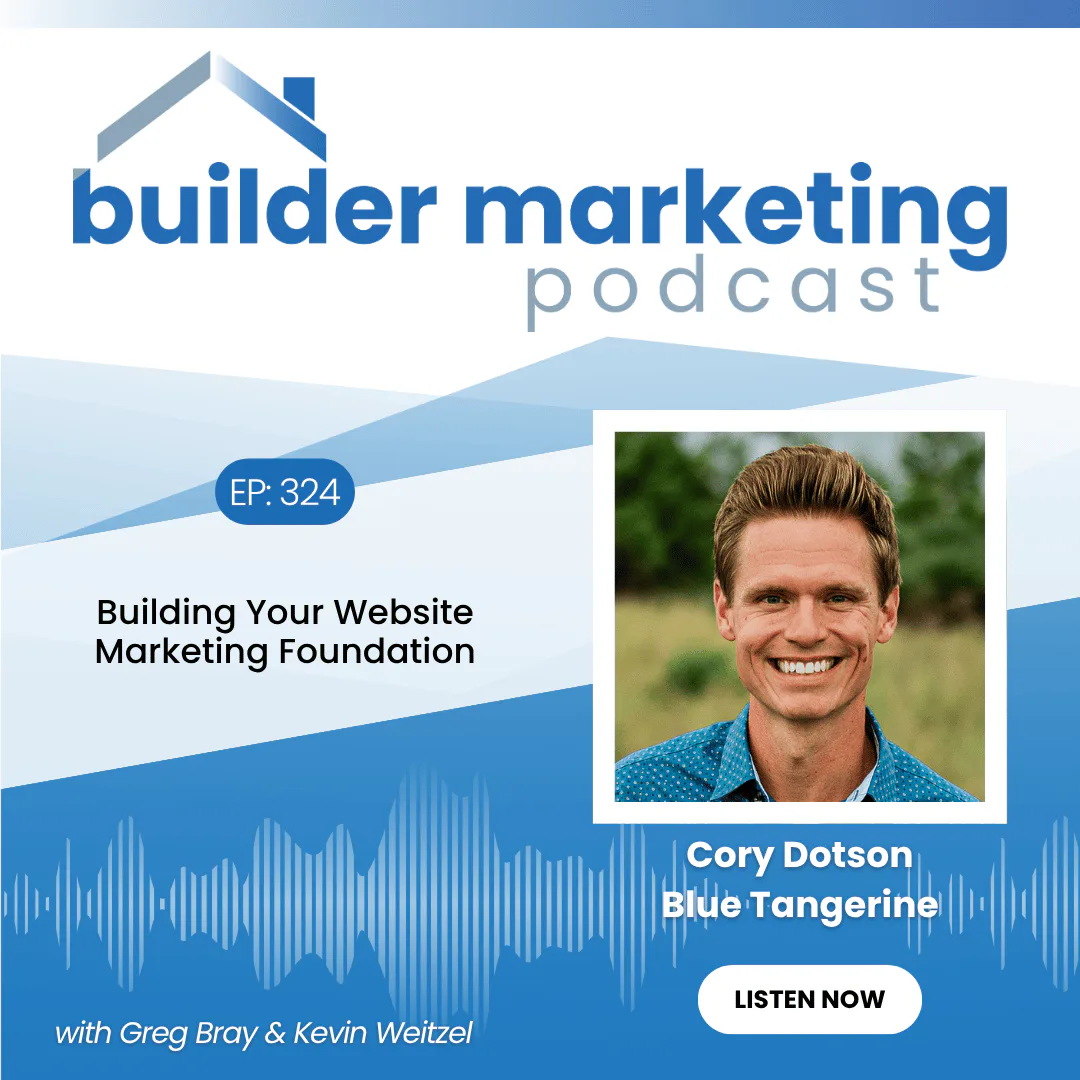
Your marketing only works if your website converts. This week on The Builder Marketing Podcast, Cory Dotson of Blue Tangerine joins Greg and Kevin to reveal why an efficient, data-driven website is the absolute foundation of every home builder's success.
Home builders miss massive opportunities because they set the bar too low for their websites. Cory says, “For me, the piece that I see all the time, when I'm talking to different builders and just in my experience with communicating with builders, is that I believe that today still most builders have too low of expectations for their website. They're not really setting their bar high enough for what the website can and should do for their business. They're still thinking of it as just this brochure piece that sits out there. They're not connecting all the dots to really see what it could be and what it should be for them.”
Websites require constant updates. Content and data must remain fresh, especially for home builders. Cory explains, “And there's things changing every day. Obviously, there is the maintenance and upkeep of the data and the content itself that needs to be there and needs to be fresh, especially on a home builder site. But then, technology is evolving constantly. You know, there used to be this kind of cycle that you could try and put, like, a timeline on that every however many years you should probably look at maybe redoing the website, and maybe that's still the case for branding facelifts on the site. But from a technology standpoint, things are changing so fast all the time that you need to have a site that can continue to evolve with you.”
A home builder's website should generate measurable results. Cory says, “So, my advice to builders would be that your website should sell homes, and if it isn't, then you're leaving money on the table. You shouldn't just settle for a website that just exists. You should demand one that performs.”
Listen to this week’s episode to learn how to transform your home builder website into your strongest marketing tool.
About the Guest:
Cory Dotson has spent the past 20 years working across every layer of the website development process, from design to development to leading large-scale digital initiatives. Today, he serves as Sr. Director of Development Operations at Blue Tangerine, a leading website and digital marketing agency for home builders, where he has helped hundreds of builders plan, launch, and optimize their online presence.
What sets Cory apart is his focus beyond the front-end experience. While great design and user experience are critical, he is deeply focused on how websites function behind the scenes, specifically how data is structured, managed, and leveraged to support smarter marketing and better business decisions. He believes a home builder’s website should be more than just a marketing tool. It should be a powerful, flexible platform that empowers teams to operate more efficiently and effectively.
With decades of hands-on experience in the home building industry, Cory brings a practical, results-driven perspective on what it really takes to build websites that perform. He was recognized as a member of the Pro Builder 40 Under 40 Class of 2023.
Greg Bray: [00:00:00] Hello everybody, and welcome to today's episode of the Builder Marketing Podcast. I'm Greg Bray with Blue Tangerine.
Kevin Weitzel: And I'm Kevin Weitzel with OutHouse.
Greg Bray: And we are pleased today to have joining us Cory Dotson, who is the senior director of development operations, also at Blue Tangerine. Welcome, Cory. Thanks for joining us today.
Cory Dotson: Thanks for having me.
Greg Bray: Well, Cory, I know this is not your first time with us, but since people may not remember, why don't you give us that quick [00:01:00] introduction, just share a little bit about yourself?
Cory Dotson: Sure, yeah. I know this is my second time, but it's been a while. My name is Cory Dotson. I'm the director of web development here at Blue Tangerine. I oversee our development team, all the builder website projects that we do and ongoing maintenance. I also lead all of our discovery phase projects, which is a lot of fun, being able to work directly with our builders and map out the best way to develop these sites, in a way that works really well for them. I've been here now for, it's going on 20 years this year, so been working with builders for a long time.
Kevin Weitzel: Now, Cory, before we get into this next phase here, I need to ask Greg. Greg, was that accurate, or do you and Cory need to have a nice little, sit-down session after this?
Greg Bray: I think that was accurate.
Kevin Weitzel: Oh, okay.
Greg Bray: There's nothing there that I would disagree with.
Kevin Weitzel: All right, so Cory, you've been on before, and obviously we are friends as well, but could you tell our listeners something interesting about yourself that has nothing to do with the home building industry, work, or [00:02:00] family?
Cory Dotson: All right. So, something interesting that a lot of people don't know is that I am a singer. So, I do enjoy singing and do it often. I am the music director at our church. I also headline an annual live Christmas special concert every year, which is really cool. We do it for a local foundation, and over the last five years, we've raised over $350,000 for that organization, during that live stream Christmas concert. So, I get to do some good and have fun with my talents at the same time, so. Enjoy singing.
Kevin Weitzel: And yet I've never received an invite to come dress up as Fat Elvis and do, like, Blue Christmas or anything like that?
Cory Dotson: I don't know that it fits.
Kevin Weitzel: Does't fit the theme?
Cory Dotson: No.
Kevin Weitzel: All right.
Greg Bray: But it might sell more tickets, Cory. It might sell more tickets.
Kevin Weitzel: It could. You're gonna get that one weirdo that's like, "I gotta see this fat guy. I like Elvis, man." All right.
Greg Bray: Well, Cory, I know a lot of people are familiar with Blue Tangerine. You mentioned our websites, but just for those who aren't, give us that [00:03:00] overview of kind of the types of websites that you typically work on.
Cory Dotson: Yeah, I mean, at Blue Tangerine, we're working on websites for builders of all different sizes. So, we've worked with large production builders, you know, multi-divisional builders that build across many states, to small custom builders that are building a handful of homes in one very tight metro area. It's really cool to work with builders of different sizes. We've, over the years, learned so much about how builders manage their data and what they need on their websites to make their business run.
Greg Bray: So, I think what's really interesting, Cory, is that you are the one that is sitting there talking to a builder at the beginning of this, "We need a new website," conversation. And when they are at that point, there's obviously something they're unhappy about with their current one. There's something that wasn't working, something that has pushed them to finally say it's time to do something different. What are [00:04:00] you seeing that are some of the drivers of that decision of it's time for a new website or we're sick and tired of dealing with the XYZ issue?
Cory Dotson: There's multiple answers there, but I think there's two key buckets that those answers fall in. The first would be just the overall performance of the site and this idea of isn't working, what does that mean? And for a lot, it means that they just don't think it's selling more homes. They're not getting conversions. It's not turning into leads, and the numbers just aren't there to speak for the website actually doing something for them.
The other part would be just the limitations of the system itself. Either they have a site that they feel isn't working for them because they can't update it effectively. It's not grown with them. Over time, they've kind of outgrown what their static system was set up to do. They have new initiatives, new features that they need to add, and they're not able to do it themselves through the system because of some lack of capability there.
Related, it [00:05:00] could be that they're just with the wrong partner. There's the limitations within the website itself, but then oftentimes builders want to go beyond that. We want to build additional tools. We want to keep evolving the site, and if they don't have the right partner that's willing to do that and sit down with them and make a plan to build out those tools, then they're just hitting a roadblock. So, I think most of it falls within those two categories.
Kevin Weitzel: All right, so you said something that kind of struck a chord with me. Number one, that they come to you with just, "Hey, it isn't working." And obviously you need to dive more deeply into that. But let me ask you this. For the very limited budget builder out there that is just like, "All right, I'm going to go ahead and pony up. I'm going to get this website done. Let's go ahead and do it. You're my partner. This is my partner. That's my partner." Whoever they decide to partner with, how often should they look at what they've paid money to have built and assess, number one, how it's working, number two, do they need [00:06:00] to update it and make those changes? How often should they be assessing that type of scenario? Or is it a set it and forget it? Build it and it's done.
Cory Dotson: Yeah, it's every day. The website, I think for a lot of builders and the ones that we talk to that don't quite quote "get it," they see the website as only being this marketing tool, this brochure piece that just sits out there, and if someone happens to be looking for homes in their area, they come find that site and, you know, fill out a form and contact them. But what they're failing to do is use the website as a key piece of their marketing efforts, both externally and internally. Their sales team should be using that site daily to help during the sales process.
We know that as potential home buyers visit the website, they're visiting it at different times within their home buyer journey, and many of those times are after they've already come and met with a sales agent. If the website is working effectively and data [00:07:00] is up kept on the website and it is all current, and everyone on the team is using it and eyes are on it every day, then it should be part of their daily efforts. They should be using it in every step of the sales process.
Greg Bray: It sounds like, Cory, from what you're saying, is that there isn't, like, a hard date that says, "Oh, website's expired. Time for a new one. We've hit our expiration date." But the reality is, is that it's a constant living and breathing thing. That's kind of scary in this AI world.
Cory Dotson: It really is. Yeah. And there's things changing every day. Obviously, there is the maintenance and upkeep of the data and the content itself that needs to be there and needs to be fresh, especially on a home builder site. But then, technology is evolving constantly. You know, there used to be this kind of cycle that you could try and put, like, a timeline on that every however many years you should probably look at maybe redoing the website, and maybe that's still the case for, branding facelifts on the site. But from a technology standpoint, things are changing [00:08:00] so fast all the time that you need to have a site that can continue to evolve with you.
And more importantly, like I was mentioning a moment ago, a partner that can help evolve the site with you. Because you're never going to be able to do everything through the back end of the website. You're always going to need that resource that's going to help walk you through, okay, we want to implement this new technology. What's the best way to do it? And someone who's going to step up and help you solve that problem for your company.
Kevin Weitzel: So, when you say back end, you're saying that, like, a builder just is going to put pictures of their kitchens and stuff on their website? They have access to do that?
Cory Dotson: Yeah, within the admin of the website, all the sites that we build on our platform, you have the ability to edit all of that content. It's one of the differences between what we build and what a lot of builders come to us with that they're trying to get off of. We build our sites on a data structure that's built for builders. There's a big distinction out there between [00:09:00] these different types of CMSs.
When someone hears CMS, they just think of something like WordPress. I think for most people who aren't, like, just really into the weeds of different types of CMS tools out there, they might hear CMS and the first thing they think of is WordPress, and that's understandable. It's big. It's a tool that's been out there for a long time. There's a lot of sites on the internet running on WordPress today.
To kind of draw a parallel between what we do and what a WordPress website does is WordPress was built originally to be a blogging tool. It was to build online blogs and manage all of the articles and all of that. And the crazy thing is, at its core, today is still foundationally built on that same foundation as it originally was. Part of that is the open source nature of it and how it's evolved.
But, when it comes to website CMSs and what companies need to be able to do and edit within the back end of the [00:10:00] website through the admin, it's very unique when it comes to home builders. Because unlike a traditional what we would call brochure style site, let's say for like your local dentist office that might have five, 10 pages that live on the site, we need to give them the ability to manage that data on the site, but that data usually only lives very siloed within different pages on the site. So, you know, there's the About page that's going to have the information about the dentist on it. It's only ever going to live there. It gets managed right there in that location.
Home builders are completely different because home builder data is structured on these different layers of sets of assets that get reused throughout the site. So, everything from location data from states and cities down to communities and plans and inventory, all of these are unique data sets that need to be managed in their own unique way. When they're not [00:11:00] managed in that way, they become almost impossible to manage and reuse effectively.
Our tool is built to manage each of those data layers separately, effectively, and efficiently to allow builders to be able to rapidly upload new plans, update pricing, all of those things that they would need to do, without having to kind of dig within static pages and make those updates individually.
Greg Bray: So, drill down into that a little bit more, Cory. Let's make sure we understand what you're saying. Let's just take inventory, for example. What is it about inventory that is harder to manage in, say, a WordPress or other type of CMS, that kind of gets in the way for a lot of builders?
Cory Dotson: Yeah, I think inventory's a good example because it helps to highlight how important that is because it's changing so often. Be it inventory pricing or statuses and availabilities are changing daily, sometimes multiple times a day for some [00:12:00] builders. An example would be if I had a site that was not data-driven in the way that I'm explaining, and it was more so coded like a traditional WordPress website where you just have pages of content, anywhere where that home was listed, so it would be on a listing page where it shows all your available inventory, on the community page where it lists the inventory, and then on the inventory detail page itself, the price would live in three different places. So, to change that price on any given day, I'd have to go everywhere on the site where that price shows up and update that price.
But on a data-driven site, that price is in one place. It lives in one location with that inventory home. It's updated once, and then it updates throughout the whole site. This also highlights the importance of business rules within the home builder themselves as well. Because we can build tools to be as efficient as possible, but when it comes to [00:13:00] something like inventory updates, what we've heard oftentimes over the years from different builders is there's not a clear process developed internally on how pricing gets updated across all the different places it needs to get updated.
Oftentimes, these are agents that are updating prices within the MLS, and then they pass along that info to someone else, and they log into the admin and update that pricing, and it just seems to be a big hole for a lot of builders. Just a note to point out that no matter how efficient we build these, we try and train our builders through discovery and through the development process as we're working through these projects that they need to develop their processes internally to make sure that they use these tools effectively.
Greg Bray: Hey, everybody. This is Greg Bray from Blue Tangerine, and I am so excited to let you know that the registration is now open for the 2026 Builder Marketing Summit. We're gonna be in Dallas, Texas this year on September 23rd and 24th, and we are working on an amazing lineup of marketing, OSC, and leadership content for you.
Please check it out at buildermarketingsummit.com and get your registration in today. Remember, there's limited seats available, so don't miss out. Again, buildermarketingsummit.com. Can't wait to see you there.
Kevin Weitzel: [00:14:00] So, you take someone like Arcadia Dental Arts, and they have their About Us page and all the little things that really don't connect to anything. Then you take somebody like Disneyland, where they might have some sort of integration where you could order your tickets online, and that could be internally, it could be all based on their website.
But home builders also have to push this information to, like, homes.com and Zillow, realtor.com, Redfin, and places like that. You're saying that with the CMS, that can be a central data point to push that information to all those platforms?
Cory Dotson: Yeah.
Kevin Weitzel: Yes? Okay.
Cory Dotson: Absolutely, yes. That's a big part of once we have the data in that proper structure, then it's ours to reuse however we need. So, we can structure [00:15:00] XML files, feeds that go out to the listing sites, out to Zillow, out to realtor.com, to help to make that pricing update, that availability update seamless, where we're updating in one location. We do have some builders that have integrations with MLS, and that can absolutely work effectively in the right circumstances. Where pricing is updated within the MLS, we're then syncing that price to the website and then that all gets syndicated out from the website to all the listings. So, in reality, pricing is getting updated in one location and feeding to all of those sources.
The other cool thing that we can do once we have all of this data in the proper format and managed appropriately, is that we can do other things. We can run reports on that data. We can build tools within the back end of the website that are not necessarily built for the home buyer coming to the front end, but that help to support the [00:16:00] sales team and help to support the management of plans and inventory data just within their business. That's something that we really try and push a lot during discovery is not only how do we make this the coolest, most awesome website on the front end, but how can we help solve some of your business needs internally by giving you the tools on the back end to do so?
Greg Bray: Cory, you mention this syncing of data and keeping it consistent and in the past, that's been an interesting challenge, right? It's just a management challenge. Right now, it's becoming an even bigger issue when you start thinking about the AI visibility when someone asks a ChatGPT or Gemini about the builder, and it suddenly goes and it looks at Zillow and Realtor and Homes.com and the builder website, and if it finds inconsistencies, it's going to impact its ability to answer because it's looking at these multiple sites all at once in that moment of answering the question.
It's just kind of interesting to me as I think about [00:17:00] that it used to be just a data management problem, and now it's becoming a trust issue. Because when things are inconsistent, the AI isn't going to trust the data as well. Just a different thought there that just kind of come into mind in real time.
When you talk to builders who have been struggling with this data management before they've come to you and they're starting to talk about it, have they shared what happens when the sales team doesn't trust the website because it's out of date or nobody's sending buyers there saying, "Oh, don't look at the website, just call me" You know? Like, have they any of those kinds of conversations?
Cory Dotson: Yeah, I mean, that is a problem. When the website gets out of date and everyone just stops trusting it, it can absolutely cause issues, especially on the sales front. There's nothing worse than that negative first impression when someone calls the sales agent and is interested in a home that is clearly available on the website, but is actually now under contract and has been for a couple days and [00:18:00] hasn't been updated on the website. It's not the type of first impression that you want, and as a sales agent, not something that you want to have to deal with.
So, it kind of goes back to getting the sales agents, the whole marketing team, everyone with the builder to use the site daily as their marketing tool. And in doing so, keeping it up to date and making sure that all of that data stays in sync. But again, there are challenges where some are just hands tied and not able to keep everything up to date efficiently because they're having to manage it in so many different places.
Greg Bray: So, you start talking to builders about, "Okay, we can have this data managed for you. We can integrate it. We can push and pull and talk to all these systems." Do marketers think that that's their job, or do they feel like there should be somebody else, like, the IT person or some other role that should be managing data? How do they typically view this in your experience?
Cory Dotson: Yeah, I think that there is a tendency for some [00:19:00] to lean on their IT department for this. You see it more when there are ERPs involved or internal databases of data that's being managed internally. But yeah, I think it's commonly has always fell on marketers thinking that this whole data integration piece and pushing data back and forth is something that is an IT project. But I think that's starting to shift and change a bit, where we're talking to marketing directors at builders who are starting to understand this more. I think it's just becoming more commonplace that we need to get this data moving around, and it needs to not just be stuck in one database. I do think that there's a shift happening there.
Greg Bray: So, as we are managing all this information, moving it, and of course, the larger the builder, the more communities, more plans, more inventory, there's just more moving parts to all of it. How do we give folks control but not allow them to break it, and kind of make people [00:20:00] comfortable that it's not going to get broken when you share it with your team to get in there?
Kevin Weitzel: To our listeners, Greg looked directly at me when he said people were going to break it. Come on. Come on. I know I look like a caveman, but please... All right, Corey, go ahead. Sorry.
Cory Dotson: This has been a challenge over the years of trying to determine this idea of flexibility, customization, but at the same time, not going too far. Because the further you go down that road, you start to impede on the efficiency of the site and the updates as well. Also, you start going down the road of just making things more complicated than necessary to manage. So, we've tried to find this balance of flexible but efficient. What that means is that different parts of the website are built slightly different. Not every page is equal.
For instance, a page like a community detail page or a plan detail page that, you know, needs to have a consistent [00:21:00] layout from community to community, plan to plan. All of the content within that framework of that page is completely manageable within the admin. Everything can be swapped out and edited and kept up to date. But the overall structure of that page, the design of the page, is set within the template, and part of that is to make it easier to manage, but also just to force the consistency going forward. But it doesn't mean that the marketer can't have flexibility in creating custom pages.
So, we also have custom page options, where a page can be generated for a specific marketing initiative, and there's full control over the design and layout of that page. So, depending on the section, we've kind of tried to find the best balance to make them the most efficient to update, the easiest to upkeep, and not introduce too many areas where things could go wrong, I guess.
Greg Bray: Kevin, have you ever broken [00:22:00] anything on the website?
Kevin Weitzel: Well, no. I'm smart enough to know that when it comes to the website side, my team knows that, hey, Kevin knows how to integrate the stuff and he knows the technology behind it, but only enough to just give him crayons. So, they give me crayons to work with because using a computer to where I can get into code is not the right method. It's just not.
Greg Bray: Well, Cory, this has been some great insights. For someone who is in this decision moment right now of trying to decide, is it time for a new site, how do I want to build it, should I have, you know, X platform or Y platform, what are some of the things they may not think of initially that could make a difference in how they make that decision? What are some of the features that don't necessarily rise to the top but could be overlooked if they're not paying attention?
Cory Dotson: Sure. At its core, it is the data management piece that we've been talking about. It's vital that data is managed in a way, your plans, your inventory, that you can reuse it and get it out into [00:23:00] feeds, be able to use it more effectively and efficiently. Image management is a huge piece that is not unique to builders, but builders do have a lot of imagery to manage so making it as efficient as possible.
Image management from tool to tool can vary significantly. Our tool uses a CDN, so you upload one image one time, high res, and then everywhere that image gets used, it generates that image on the fly, not only at the correct size, but optimized to the most efficient file type for the browser that you're viewing it in. There's a lot of really cool things that can be done now with image management.
So, it's not all about how shiny and pretty it is on the front end. You got to really think about the amount of time that it's going to take you to manage that content on the back end. So, you don't want to be hand-tied with what you can do with your content, but you also don't want to get into a mess to where it's taking you three days a week to update the content on your website. It needs to be [00:24:00] efficient and quick.
I would look for flexibility. That's the big thing. I mean, there's a lot of different tools out there. There's some that are built specifically for builders that solve a lot of the basic problems with data management. Some do have limitations. The thing that I've learned over the years is that builders do things differently. There are a lot of similarities between builders, but every day I'm talking to a builder and I'm always amazed at some new thing that I learn that they're doing, the way that they're managing elevations or the way that they want to calculate pricing on the website. There's always something different like, "Well, I've never heard that one before."
Having a partner and a platform that can handle that level of customization, I think is vitally important because if there's no flexibility at all, you will run into a limitation at some point. So, having a mix of best practices, foundation of a good builder data system, but [00:25:00] with the ability to build customization on top of that, that would be and is the best of both worlds.
Greg Bray: I would just add to that, the ability to integrate some of the visual assets that are so critical to the emotional engagement that really make a difference, you know, beyond photography, the interactive tools that really help people connect with the home. Sometimes people get stuck being able to include those easily, or they get buried and hidden too far down the line. Want to make sure that those are always front and center because it makes such a powerful impact.
Kevin Weitzel: Wait, you're saying that seven clicks to get to, like, an interactive site map is not efficient?
Greg Bray: I mean, if you're trying to work your mouse hand and burn a couple more calories on your click finger, so.
Kevin Weitzel: I love it.
Greg Bray: Well, Cory, before we wrap up, do you have any last thoughts or words of website advice you'd like to leave with our audience today?
Cory Dotson: For me, the piece that I see all the time, when I'm talking to different builders and just in my experience with communicating with builders, [00:26:00] is that I believe that today still most builders have too low of expectations for their website. They're not really setting their bar high enough for what the website can and should do for their business. They're still thinking of it as just this brochure piece that sits out there. They're not connecting all the dots to really see what it could be and what it should be for them. So, my advice to builders would be that your website should sell homes, and if it isn't, then you're leaving money on the table. You shouldn't just settle for a website that just exists. You should demand one that performs.
Greg Bray: Awesome. Thanks for that. Kevin, guess what? If people want toa hang out with Cory, he's going to be with us at the Digital Marketing Summit in September in Dallas on the 23rd and 24th. So, just be aware that it's not just me and Kevin that are going to be there. You can meet Cory, too. In the meantime, Cory, if somebody wants to reach out and [00:27:00] connect with you, what's the best way for them to get in touch?
Cory Dotson: Oh, yeah, I'd love to connect with anyone who wants to talk. We can connect on LinkedIn. Also, you can shoot me an email anytime at Cory, C-O-R-Y, @bluetangerine.com.
Greg Bray: Well, thank you, Cory, and thank you everybody for listening today to the Builder Marketing Podcast. I'm Greg Bray with Blue Tangerine.
Kevin Weitzel: And I'm Kevin Weitzel with OutHouse. Thank you.
Greg Bray: Hey, everybody. This is Greg Bray from Blue Tangerine, and I am so excited to let you know that the registration [00:28:00] is now open for the 2026 Builder Marketing Summit. We're gonna be in Dallas, Texas this year on September 23rd and 24th, and we are working on an amazing lineup of marketing, OSC, and leadership content for you.
Please check it out at buildermarketingsummit.com and get your registration in today. Remember, there's limited seats available, so don't miss out. Again, buildermarketingsummit.com. Can't wait to see you there.
Hey, everybody. This is Greg Bray from Blue Tangerine, and I am so excited to let you know that the registration is now open for the 2026 Builder Marketing Summit. We're gonna be in Dallas, Texas this year on September 23rd and 24th, and we are working on an amazing lineup of marketing, OSC, and leadership content for you.
Please check it out at buildermarketingsummit.com and get your registration in today. Remember, there's limited seats available, so don't miss out. Again, buildermarketingsummit.com. Can't wait to see you [00:29:00] there.