
EP: 243
Driving More Qualified Home Buyer Traffic
With Erin Yarbrough
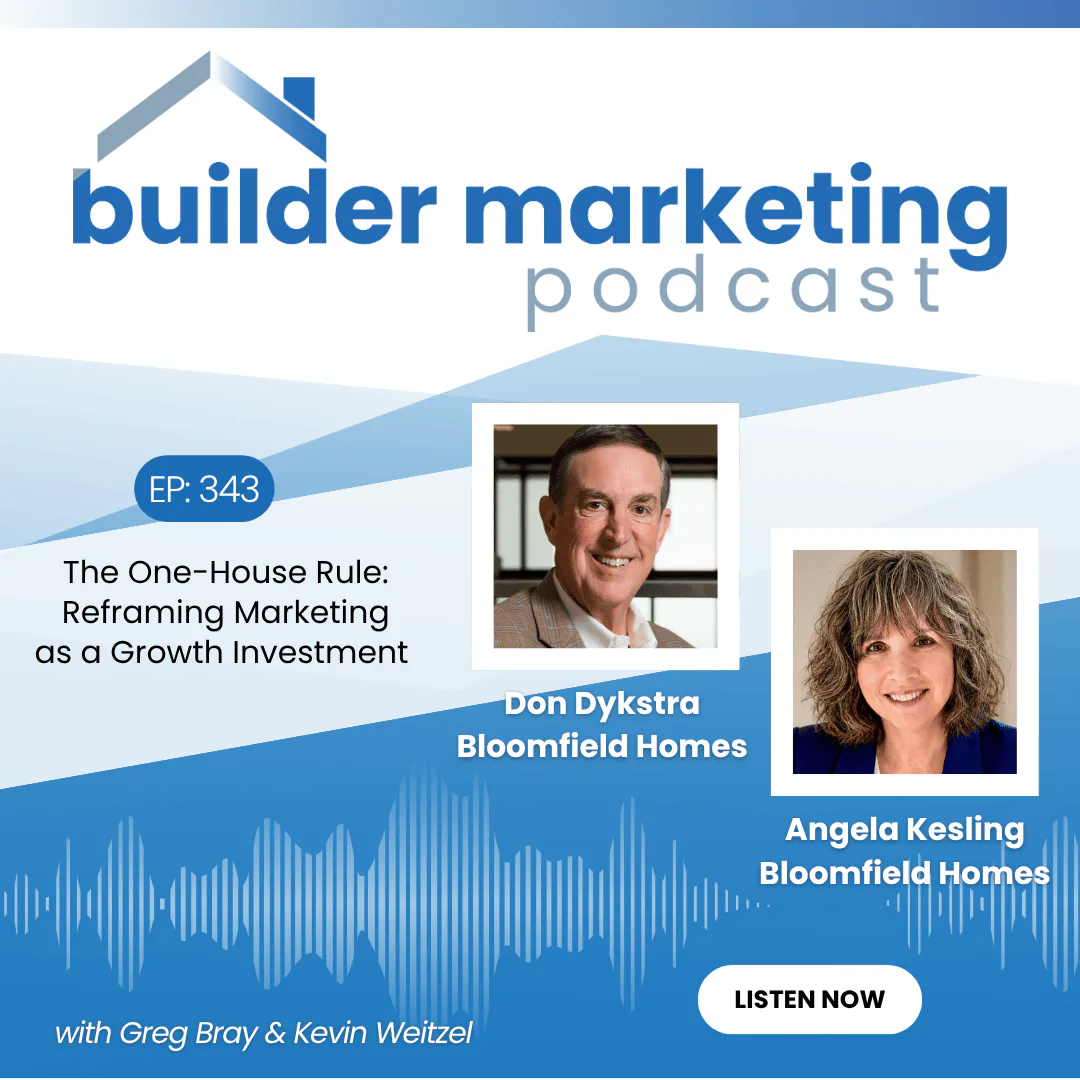
In this episode of the Builder Marketing Podcast, Greg and Kevin share an exclusive chat from the 2026 Builder Marketing Summit. Don Dykstra, founder and chairman of Bloomfield Homes, and Angela Kesling, Bloomfield’s Marketing Manager, sit down for a candid conversation about how a high-growth builder organization views, funds, tests, and supports marketing.
Don brings the unique perspective of an owner who views marketing as a strategic investment rather than an expense. His "one-house rule" completely reframes the budget conversation: if selling just one additional home flips the ROI picture, marketing should never be judged solely by its cost. Instead, it must be evaluated by what it helps the business learn, improve, and sell. Don explains how Bloomfield leverages this rule to safely test new ideas and analyze marketing through an investment and payback lens.
Angela shares the marketing team’s perspective on what executive-level support truly unlocks. She breaks down how trust allows them to pilot new technology, tightly connect campaigns to sales activity, support online sales, and move forward with greater speed and confidence.
Together, Don and Angela explore how marketers can bring sharper business logic to executive conversations, tie activity directly to outcomes, and build the internal alignment needed to move an organization forward. Tune in now to gain the practical language, leadership insights, and real-world examples you need to transform marketing investment conversations inside your own company.
About the Guests:
Don Dykstra
Don cofounded Bloomfield Homes in 2004. Bloomfield Homes has grown rapidly since formation to consistently over $1Billion in annual sales. Approximately 2000 homes in 60 neighborhoods will be delivered throughout the Dallas / Fort Worth Metroplex this year. Builder Magazine twice named Bloomfield Homes the “Most Productive Big Builder in the Country” and once the “Fastest Growing Private Builder in the U.S.”.
Don, along with wife Debbie was the Greater Fort Worth Homebuilders Association Developer of the Year in 2018 and Builder of the Year in 2021. Don was also a Finalist in 2018 for EY Entrepreneur of the Year.
In 2013 and 2017 Sumitomo Forestry Group purchased 65% of Bloomfield Homes and the Company is now a consolidated subsidiary of this publicly traded (Tokyo Exchange) 300-year-old forestry and homebuilding company.
Don currently serves as Chairman and spends most of his time on land acquisition and community development. Bloomfield has accumulated a portfolio of approximately 20,000 lots to support future expansion.
Previously, Don worked for Pulte Homes for 16 years in California and Texas, and as a CPA with EY & Co in Southern California for 6 years. Don is a graduate of California Polytechnic University with a degree in accounting.
Angela Kesling
Angela Kesling is a marketing leader specializing in builder branding, marketing strategy and consumer engagement for the homebuilding industry. As Marketing Manager for Bloomfield Homes, she develops innovative campaigns that strengthen brand awareness, drive traffic and support sales growth throughout the Dallas/Fort Worth market.Kevin Weitzel: [00:00:00] I'm Kevin Weitzel with OutHouse, and welcome to this special edition of the Builder Marketing Podcast. Today we have actually a reprisal from the Builder Marketing Summit where Greg Bray interviews, a panel about the one house rule and reframing marketing as a growth investment.
Greg Bray: Well, I am so excited that Don and Angela agreed to be with us today. We're going to do this where I just get to [00:01:00] ask them all their secrets, and they can't say no once they're on the stage. So, that's how that works. I am so appreciative of their willingness to come spend some time with us today. We had a great introduction, but I'd like to go ahead and give you guys a minute just to make sure everybody understands Bloomfield Homes.
Angela Kesling: Bloomfield Homes is the largest home builder that is privately owned, I would say, right?Was that pretty close?
Don Dykstra: Yeah, so I would say we're the largest single market builder in the country. We're a rifle shot in Dallas 'cause we like to operate, and we don't like to travel, and we don't like corporate offices. So we fancy ourselves as just a really big division.
Angela Kesling: But it's getting bigger around Dallas-Fort Worth.
Don Dykstra: Yeah.
Greg Bray: All right. And I know you've got a few slides to talk a little bit more about what you guys have been doing.
Angela Kesling: All right. This is the products that we developed. This our Classic Series, and we have 40-foot product, a 60-foot product, and 30-foot product.
Don Dykstra: Yeah, we build, everything's at the same [00:02:00] specification. I have a saying, we buy lots and develop lots that fit our plans, instead of designing plans for other people's lots. That lets us be extremely efficient, as you might imagine, especially for website and marketing. We have the largest market share in the top 40% of the Dallas-Fort Worth market. So, bottom 60% is really dominated by Horton, Lennar, and we let them do their thing, and we do our thing.
Angela Kesling: And then these are our 60 communities across the Dallas-Fort Worth metroplex. As I was saying earlier, it goes all the way to Commerce and as far as east and north as Commerce and Anna, but then as far south as Granbury, Texas. And then this is the quintile. You can explain that, right?
Don Dykstra: Yeah. So, this is what I was mentioning earlier. So this takes Dallas, which is 40,000 starts, basically 8,000 in each price quintile. You can see the bottom 60% is dominated Horton and Lennar, a little bit of Green Brick, Meritage. But once you get up into those top prices, we have by far the largest market share up in that segment. So, as I [00:03:00] say, we really know who we are. Typically, we'll have the nicest or one of the nicest neighborhoods in an outlying suburb. So, cities like us, which makes my job doing land acquisition and zoning a whole lot easier.
Greg Bray: Awesome. Well, we appreciate that introduction. So today, one of the reasons I was so excited is Don introduced me to something when we had a chance to meet a couple of years ago, that they have at Bloomfield Homes, and it's called the one-house rule. Would you guys explain to us what the one-house rule is?
Don Dykstra: Well, the one-house rule is, I mean, it may be some crazy idea, but we'll sell at least one house off it, so that's how we rationalize it. If you say, you know, our typical house conservatively is gonna bottom line about 50,000 bucks. So, that sort of gives Angela and team a lot of room to play below that if they can convince us that this idea, no matter how crazy it is, we'll sell at least one house off it.
Greg Bray: Is that something that has evolved over time [00:04:00] or have you always kind of had that attitude, Don?
Don Dykstra: Well, I can remember stumbling on it at my private employer, my previous employer. We were down in Austin, and IBM was doing a big relocation for the OS/2. This is a long time ago. There were like 2,000 people moving to Austin, and we were trying to figure out, well, how are we going to communicate with these people before they get to their relocation realtor?
And someone said, "Well, these techie people, they use something called the World Wide Web." Well, we barely knew what it was then. This is like '96, '97. And over the weekend, we wrote a $20,000 website, and we sold two houses off it the following week. And at the time, people were like, "This is crazy. What are you doing?" For me, it was really dumb 'cause this was a Friday afternoon, and I basically agreed to stay in Austin for the weekend and help put this website together.
Greg Bray: I didn't know you were a web developer.
Don Dykstra: I know. This is back when you needed, like, real programming to write a website. I mean, this is 20 grand for a piece of crap [00:05:00] website, and it was basically PDFs loaded. But it was, I think, one of the first builder websites ever done in the country. It was the first by Pulte. They wouldn't even let us use pulte.com. We used our own logo, and it annoyed the crap out of them for decades because it showed up at the top of search engines for a long time because they used to give you a lot of credit for how old your website was and then your views. So, that was the original one-house-rule test, and since then, we've done it on all kinds of crazy stuff.
Greg Bray: I think that it's something that a lot of marketers that I talk to, they struggle to justify budgets, especially for something that feels different, that you maybe want to experiment with. For you guys to have it so formal, I mean, Angela, tell us what that's like from a marketing director type perspective, that you know you've got an opportunity to try new things.
Angela Kesling: Yeah. I mean, it is great because it's probably a high value, low risk [00:06:00] opportunity, let's just say. Maybe an example would've been in the pandemic times when we were in between websites and we picked up Novi Homes as an app. It was right in that wheelhouse of affordable and all of that. Seemed kind of crazy, you know, but we've continued to use Novi Homes, so it's one of the ones that really worked out.
Greg Bray: Yeah. That's awesome example. Do you find that everything gets approved on that they bring to you? Or do you feel like there's still some other things besides just the raw budget and, "Oh, I promise we'll sell one more."
Don Dykstra: I don't think they've ever, like, kept a chart of approved, not approved, but it's pretty high. What I would say is the second-best answer is a quick no, and I'm a very quick answer. Because I think a lot of times people, they'll send you to go get more information, right? Prove it up. You know, how much is this going to cost? Can you renegotiate it? Go get with some other department. A lot of time gets wasted on stuff that a quick no would've let you just [00:07:00] move on to the next thing.
Greg Bray: How hard is it to provide the data he's looking for?
Angela Kesling: I mean, it's not because, typically you know kind of what his expectations are because it is kind of the rule, the formula that we use. So, you know, we just do the due diligence as far as, like, what the cost is, maybe what it costs resource-wise internally. And then, like you said, he's a really quick yes or no, and if he says no the first time, sometimes we bring it back, repackaged some other way or whatever. But it's really great 'cause we bring them up at the marketing meetings, and then we can just walk next door and offer something as well.
Don Dykstra: And we hate meetings in our company. We have no weekly sales meetings, no production meetings. We have one company meeting a year, but we do do a monthly or bi-monthly- marketing meeting. And typically, I mean, there's probably two, three, four of these ideas in every one.
Greg Bray: So, you hate meetings, but you still make marketing do meetings. Is that what I'm hearing?
Don Dykstra: It's amazing how marketing is the only group in our company that successfully was able to do a recurring [00:08:00] meeting. And more and more people join because it's so much fun.
Greg Bray: So much fun. Because marketing are the happy, fun people.
Angela Kesling: Yeah. It is. The party people.
Greg Bray: Okay. There we go. Yeah. That's great. That's great. Don, you talked about the fast no. What do you see happen if people drag out those decisions?
Don Dykstra: I think there's just a beat down on the people who are being asked for more analysis on something that doesn't want to happen anyway. tThere's an excitement to having an idea. I mean, I could tell you, I'm an idea guy. You know, I'll go walk around the off- I'm looking for somebody who's going to buy in on this, right? 'Cause you want someone excited about it. You don't want to tell them, "Hey, I need you to go do this." You want to say, "Hey, what if we did this?"Or, "What if we did..."
I mean, we're doing an event next week. I'm going to put in a plug for the X Tex, which is a 1,500-mile trail across Texas. With seed money for last year, the inaugural hike happened, and we're doing an event that they don't have to do. It's not part of their job. This is kind of my thing. But yet, a couple of people in the office [00:09:00] are pretty interested in this.
Angela Kesling: Go for it.
Greg Bray: Now, Angela, Don, he says he's an idea guy. That means to me that he's bringing ideas, not just reviewing ideas, right? How do you get to a quick no when Don walks in with the idea?
Angela Kesling: Well, it's funny you say that, 'cause we brought an idea at the beginning of the year. We wanted to increase cold call follow-up and things like that, and how could we do that? And the idea wasn't quite the one-house rule, but he had a great idea, one that was actually the one-house rule. And that was that we would use our assistants that are already in the model homes, and we would train them up to do this cold calling for us and to follow up and set appointments for our salespeople. We've already had two trainings, we set a lot of appointments, and I think it was a big success and we could continue to do that year after year if we want to.
Don Dykstra: And it was kind of interesting because, and again, I love it because they did it, and it turned out the sales assistant saw it as a huge positive that we were investing in them. We used Sales Solve Everything, who some of you probably know Ralph. He [00:10:00] came super energetic, had prizes, you know, food. The salespeople, if we'd made them come to a smile and dial party, they would've hated us.
The sales assistants thought, "Wow, you're investing in us," and they were excited to come. And few salespeople, I mean, we didn't prevent salespeople from coming, and a few of them came anyway, and it was pretty good. And we also learned a lot about sales assistants and which ones probably have no business making cold calls. And some were really good. Most of them were really good.
Greg Bray: There were two exit doors, right? Awesome. Well, when you guys are running these tests, because you've created this rule to help you try new things, not the standard things that, you know, kinda have to do to stay out there. How do you decide when the test has passed or failed? Does that measurement criteria come into play consistently or different ways you do that?
Angela Kesling: Well, I can tell you about a [00:11:00] chatbot we flopped on once. We originally had the idea, of course, you want to speak to your buyers 24/7, and this was really affordable. It was applicable to the one house rule. But we did not pick the best partner, or the best partner for Bloomfield, I will say. So, what was promised wasn't delivered. So, we quickly pivoted, and we're with Builder Chat now. They have delivered, I can tell you, and we've got eight sales this year that we can attribute to them.
Greg Bray: All right. Well, that's more than one.
Angela Kesling: Yeah.
Don Dykstra: Events are the hardest, right? So, you have events, and sometimes they really work, sometimes they don't, usually depending on how much attendance you got, which a lot of times is, you know, how many phone calls we made or emails and we personally got involved. And we did an event at Toys and Cars, which I was really excited about, but our attendance was sorta disappointing, but we got high quality. But I know they came, and they brought me, "Hey, one of the realtor bonus things we came and got redeemed this week," right?
Angela Kesling: It sure did.
Don Dykstra: So, we sold our house, so we at least paid for our event.
Angela Kesling: Paid for itself.
Don Dykstra: We'll get [00:12:00] some more. But yeah, I would say events are probably the one that you sometimes go, "Eh, that wasn't that great."
Greg Bray: So, obviously Bloomfield Homes is now a big builder, right? Couple thousand homes a year, right? Did I get that number right? Not everybody in here is doing quite that many, okay? And some people are sitting there going, "Well, does this really apply to me?" What do you think, Don, is different from your perspective for someone who's maybe in the 100 homes a year range as compared to 2,000?
Don Dykstra: Well, so remember we started in the garage making, like, Costco lasagna in the oven for our realtor events and, you know, like, grandma's garlic spread. I mean, we sold it. But I think when you're small, you want to pick things that your dollar has the same value as the big guys.
So that might be realtor bonuses, it might be an event, you know, directional signage for a particular subdivision. I think there's other dollars that don't have the same value, 'cause you saw our map, right? If we do some kind of broad campaign, we're [00:13:00] advertising 60 neighborhoods. That's a real advantage over someone who's only advertising 10 and it costs them the same.
So, I think small builders, like when we were small, you sometimes fall into a trap of you want to emulate them and things like, I don't know, expensive software. I think branding campaigns can be very inefficient for small builders 'cause there's just not enough spread. So, we try to pick things different, and I think you can compete. For instance, in a lot of ways, I still grieve for our original $300 website because it was so easy to navigate, and people would tell us how easy it is to use. So, I think those are places where you can really compete as a small.
The other thing I think, I used to, and I still do 'cause there's still people that call me on it. For instance, for principals, you know, managers, somebody sells a house for you, you take them out, round of golf at a nice course or something. The big builder can't do that. They don't have the time to build those personal relationships. But I [00:14:00] can tell you, I still got realtors that show up at our title company with a closing, and they, like, have the receptionist buzz me so they could schedule their round of golf. 'Cause 20 years ago, they s- still got that in their head, they get a round of golf.
Greg Bray: Angela, anything to add to that from that difference between kind of the smaller versus larger perspective?
Angela Kesling: Bloomfield Homes has the advantage of being the bigger builder, and that has worked for us, for sure. But we still do things a lot of times like a smaller builder does. I mean, we're not completely that full-on big builder, you know, as far as our marketing goes. We actually do sort of still feel like a small builder in many ways.
Greg Bray: Well, and tell us about your team because we're not talking about a 50-person team, right?
Angela Kesling: That's a good point. Yeah, that's a great point. No, we have a very lean and mean team. tThere's only four of us. Five when Cassius is Internet sales manager. So, the nice thing, too, is that we all cross-trained. So, nobody is dead end except for one person who happens to be the MLS person. And so really anyone can do anything in our [00:15:00] team, which is really nice. So, if you have an interest in doing social media, you're going to get to do social media. But if you don't have an interest in doing something, you're still going to get to do that because we're small.
Don Dykstra: The other thing I would say, Angela, and we might talk about it, I think you have really leveraged off using interns.
Angela Kesling: Mm-hmm. Yeah.
Don Dykstra: Especially during the summer, but even year-round.
Angela Kesling: Yeah. This year we had three, actually, which was great. So, we had one that was for graphic design. We have three brochures that we actually put out, and she's focused on that, so that was a huge time savings for us. And then we had two others, one was focused on internet sales and the other one was general marketing. But, I mean, we couldn't have done it without those team members this summer. Those interns were fantastic.
Greg Bray: That's one thing when I was getting to know both of you that really stuck with me is often I talk to some big builders and they've got like 30, 35, 40 people on these marketing, like they're bigger than some of the agencies out there. And I'm like, "Wow, that's very different from when you guys are talking about a handful of people on the team doing as much as you're getting done."
Don Dykstra: Well, and also a lot of in-house production. So, we do all our own MLS listings, and [00:16:00] we typically are running around, what, probably 4 or 500 specs at any point in time. I brought it to show off, but we do our own in-house brochure, which because we have limited plans, we can do like a magazine that people actually keep. I mean, that's created in-house completely. So, they're not coordinating agencies, we're actually creating content.
Greg Bray: Interesting. So right now, some builders are struggling a bit in this market. Unfortunately, for some reason, marketing seems to be the thing that goes on the chopping block when that happens. What are your thoughts on where that should be from a financial management perspective of, do we cut the marketing budget or do we invest more?Because there's an argument to be said, "Hey, now's the time to market harder."
Don Dykstra: Well, we just went through marketing budget for next year.
Angela Kesling: Sure did.
Don Dykstra: We try to do what's called a zero-based budgeting, which basically start with [00:17:00] none of it, and you basically think about and justify, at least in your head, everything you're spending. And one of the things that we really cut on was, 'cause our subdivision count's going to drop, and honestly, we were over 2,000 houses four years in a row. We're not going to get there this year, and our subdivision count's going to run off 'cause I quit buying a lot of land three years ago, which is a good and a bad thing. One of the things we really are focusing on is this model startup, which is a huge expense, and we're reusing furniture almost 100% next year, right?
Angela Kesling: Yeah.
Don Dykstra: And so that created, what? 500, 700,000 of savings, maybe more.
Angela Kesling: Sure did. Yep, sure did.
Don Dykstra: Which then can be deployed in more tactical marketing that we need to generate traffic and create sales.
Greg Bray: Oh, that's a great example. So Angela, there's some people in here that are going, "Man, can I, like, get my boss to talk to [00:18:00] Don?" What are your suggestions or advice for someone who's working for the person who controls the budget who's not quite as enlightened as Don is on the power of marketing?
Angela Kesling: Yeah, well, I mean, he is great, no doubt about that, because I think it's a good formula for anybody to use,. You're basically halfway there because this is a bridge between marketing and sales or marketing and leadership. 'Cause now we're talking about the same conversation. We're having the same vocabulary. Our goal is to sell more homes. But, you know, we might come at it from a different angle, but like I said, you're halfway there when you have that same conversation, you have the same goal, and I think that is a huge advantage, you know, you can use for yourself when you're presenting to your leadership.
Greg Bray: Do you think it would resonate, Don, with the financial person, this idea that I only have to sell one house to pay for this? Or do your peers not even think that way?
Don Dykstra: Don't focus on the finance person, focus on the owner or the president, because at some point, [00:19:00] especially if you're a smaller company, they probably were involved in founding it, starting it up. They probably did some of this marketing stuff themselves at some point in their life, or, you know, maybe their spouse did. Focus on at the top, not the finance person. Now, I'm a recovering accountant.
Greg Bray: That's a good thing. Yeah. Well, Don, I want to give you a second because you have just recently released a book. Tell us why you wanted to write that and what's it about?
Don Dykstra: Well, my wife always says, "God, why do you give all our secrets away? Why do you give all our information away?" I say, "Well, you know, we give some stuff out, but most of it's sorta street knowledge anyway. People kinda know." But I'm now, hate to admit it, but I'm 67, you know, and I really say, life is more than it used to be. I used to say life is more than filling up file cabinets with paper. Now, it's filling up, you know, servers on the cloud. But, you know, it's really people we touch and help. I [00:20:00] teach at BizOwnerEd, which I'll put a plug in for them if you're in Dallas. It's a free mentoring program for entrepreneurs.
I wrote the book. The other thing is, 'cause we have no meetings, so some people kinda grieve still for when we were what I call the garage band era, when we literally were in the garage ourselves. And they sometimes say there's not a lot of communication. So, in a moment of weakness on New Year's Eve a couple of years ago, I whipped out a chapter that's so bad it's not even in the book.
I sent it to a Bloomfield global email saying, like a lot of you, I do resolutions or goals for the year. My goal was to write this book, and I commit to send you a chapter every week, and if you want to come along for the journey, feel free, and I need your edits and ideas, and I sent that out. I don't know if it was good or bad, but it committed me to get it done.
And then with Angela and Chandler here, I gotta give them a lot of credit, 'cause it wouldn't have got to the finish line without their help with all the [00:21:00] illustrations. It's written more like blog style, so each chapter is more like three or four pages with an illustration. It reads fast and you can kinda skip around.
The first half is all kinds of home building stuff. The second half is nothing but land stories, 'cause when land people get together, all they want to do is tell land stories. But if you ever wanted to do land acquisition, there's some really good stuff in there. So anyway, and then, 'cause I know he's going to solicit some questions, so I brought gifts too. Anybody who asks a question gets a free book, so.
Greg Bray: All right.
Don Dykstra: Until they're gone, and there aren't that many.
Greg Bray: There aren't that many. Well, we now open up for questions. If you have a question for Don or Angela, this is your chance. All right, we got a couple over here.
Audience Member: Hello. Andrew with Cut Your Breaks. I wanted to ask, you recently said you had success with a realtor bonus, and I've noticed a lot of builders been trying to stray away from those because they haven't had [00:22:00] success with those. So, I'm wondering, what would you attribute to the success of that, and is it a normal thing, or was that just a one-off in that case?
Don Dykstra: Well, I have a saying that if a realtor calls up and says what your bonus program is, the right answer is, what does it need to be? Because if we know the rules, we'll play the game, right? You know, realtors, there's probably some in this room. It's sort of a love-hate relationship, right? We love them 'cause they generate a lot of our traffic and a lot of our sales. In Dallas, it's, like, almost 70%. But it's also a big cost, right? So, you want value.
The great thing with the realtor bonus is you only pay it if you actually get a closing, right? So, that's a good thing. I would say we've had sort of mixed. I think we have an advantage because we're so spread out with 60 neighborhoods. So, any realtor who comes to any of our event, we have neighborhoods that are in their area, in their target zone. So, they can [00:23:00] actually use them. I also think they're a reminder 'cause we use kind of numbered a certificate.
Angela Kesling: Very memorable ...
Don Dykstra: Memorable, impossible to copy. They probably left it on their car or on their desk, so it serves as a reminder of Bloomfield Homes is looking at them with, you know, dollars. So, I think it works in a number of ways for us.
Greg Bray: Another question? Please.
Audience Member: What is your benchmark timeframe for pass-fail for your new thing? How much time do you give?
Angela Kesling: So it might depend. So, I'm going to give you an example. We're going to try this responsive direct mail shortly, which has only been delayed because of my schedule. But we've actually put it in the budget potentially for 2027. So if it works, we will continue to do it. If it doesn't work, we're going to just experiment with it, see how it works. It could be one, two months. You know, it just depends on what it might be. So, maybe for direct mail, you might need a couple of opportunities, but [00:24:00] something bigger might take a longer time period, like maybe up to a year. Like that chatbot, we were committed actually for a whole year.
Greg Bray: All right. Awesome. We got time maybe for one more.
Audience Member: Justin Croxton. My question's around the chatbot that you implemented on your website. You know, anytime you can have a chatbot on a website, it's a big deal, and I know AI has really been taking over, so the information you can put into it really makes a difference as far as, you know, new home acquisition. Just curious, what has led to the success of the chatbot that you currently have on your website? Was it information you fed into it? Is it the fact that you just have a chatbot? What was it that you did that made the difference?
Angela Kesling: Great question, because in fact, that was part of the flop for the first one. We did actually think it was AI, so we had to feed all the data points in there, which ended up being extremely time-consuming. And I told you, you know, we're a small group, so our resources are smaller. So, I hope you will talk to Builder Chat AI, 'cause they are fantastic, and it was a complete game [00:25:00] changer. It is a lot of AI, but they have perfected it, so to speak, and it's not as, you know, scary as it was. Maybe even when we would've actually had the AI with the first iteration, I don't think it would've been successful anyway. But anyway, I would recommend you talk to them.
Greg Bray: All right. Well, Don, Angela, thank you so much for your time, for sharing. And if Don's got a couple more books and you tackle him in the hallway, he might share those. All right? Hopefully you guys can stick around for a little bit and through the break maybe if somebody can chat with you. But everybody, please join me in thanking Don and Angela for spending some time with us this morning.
[00:26:00]


