EP: 74
Innovation and Preparing for the Future
With Laura Ownbey
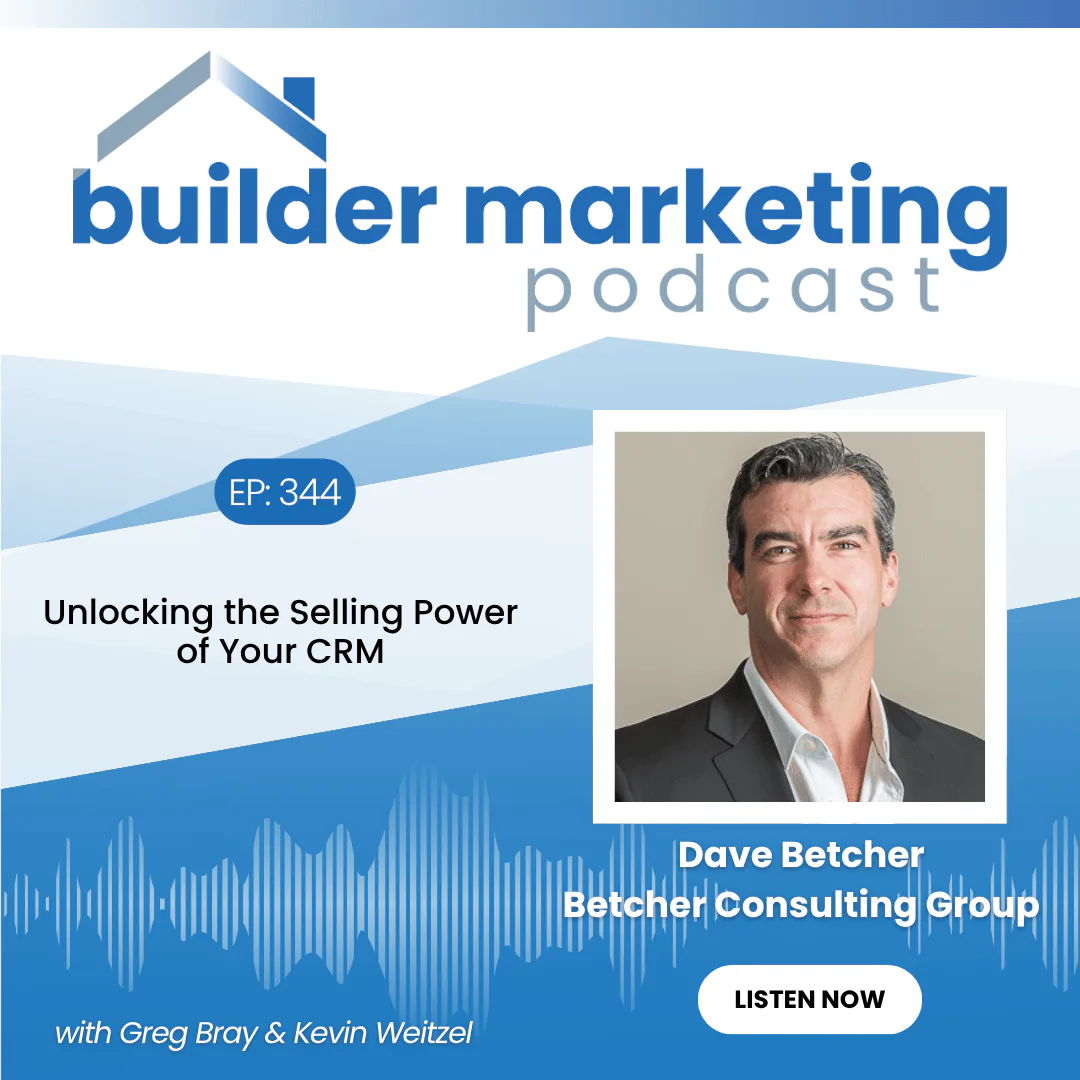
Is your CRM a powerful sales engine, or just an expensive database your team hates using? On this episode of the Builder Marketing Podcast, Dave Betcher of Betcher Consulting Group joins Greg and Kevin to discuss how the strategic use of a CRM can help home builders streamline their operations, drive sales growth, and empower their teams to succeed.
Adopting and implementing new customer relationship management (CRM) software can often leave a home builder team frustrated. Dave says, “For a lot of builders, this is the bane of their existence. They know they need it, but they don't know how to use it. They can't get their sales teams to use it, so they're not getting a heck of a lot of value, so they're paying for something that they're not getting a ton of value from. It just tends to be always a pain in the side of builders.”
The key to unlocking a CRM's full potential lies in shifting the sales team's perspective from a burden to a benefit. Dave explains, “And if we can get salespeople using the CRM, everything magically falls into place. All of our reporting works, all of our coaching is effective. But the challenge has always been: how do we get our salespeople to adopt this as part of their process? I’m not going to say 100%, by the way. However, if we can have salespeople really see this as a value to help them sell and to really provide them with tools which allow them to understand their customers more and really where the opportunities lie, that's where we succeed as a company helping builders with their CRM.”
Ultimately, when a home builder uses CRM as more than a data-tracking tool, they can rise above their competitors. Dave says, “The other thing is don't treat your CRM like a database. Treat it as a selling tool that we can really start to understand our customers, and our salespeople can really capitalize on understanding where their best opportunities lie. And if we can get our salespeople to not to think this is an audit tool or just something that we do at the end of the day, but really start to utilize it, we are going to be in the best shape as an organization because our sales are going to come naturally and we're going to kick our competitors' butts.”
Listen now to learn how to transform your CRM into your team's ultimate selling tool.
About the Guest:
David Betcher is President of Betcher Consulting Group, a HubSpot Diamond Solutions Partner, and a former co-founder of Lasso CRM. With more than 20 years of experience in homebuilding and CRM, he combines deep industry knowledge with hands-on expertise in adapting HubSpot to the needs of homebuilders. His work spans CRM strategy, sales enablement, team training, marketing automation, and reporting, helping builders strengthen follow-up and equip their teams to move buyers forward. David also helps builders turn data into actionable insights and apply AI in practical ways that improve sales effectiveness and the customer experience.
Greg Bray: [00:00:00] Hello everybody, and welcome to today's episode of the Builder Marketing Podcast. I'm Greg Bray with Blue Tangerine.
Dave Betcher: And I'm Kevin Weitzel with OutHouse.
Greg Bray: And we are excited today to have joining us Dave Betcher. Dave is the president at Betcher Consulting Group. Welcome, Dave. Thanks for spending time with us today.
Dave Betcher: I could not be happier to be here, guys. Thanks so much for having me today.
Greg Bray: Dave, I know it's been a little while. So, for those who may not know you, why don't you spend just a second, give us that quick [00:01:00] introduction and tell us about yourself.
Dave Betcher: Well, it has been a little while. I was looking back at my calendar. It's been about four years since we've had this conversation. And, you know, as things progress in our lives, things change, right? So, this is probably a good chance to reintroduce myself. So, I'm the president of Betcher Consulting Group. You may have known me in the past as the co-founder of Lasso CRM.
I have spent about 20-plus years in the home building kind of arena, in all types of home building, whether it's condo sales or it's single family, it's all different types of home building environments. And I work predominantly in the CRM space. If you can imagine working in CRM for 20-plus years, a lot of people would say, "Are you out of your mind?" Well, I absolutely love it. I absolutely love it.
What it gives me the opportunity to do is really just help people in managing their customers, their customers' expectations, managing salespeople, and just really just trying to make this an incredibly efficient system that gives them all the information that [00:02:00] they need, but it also makes for a great customer experience for their customers.
Kevin Weitzel: All right, before we fully geek out into the world of CRM and the world of Dave Betcher, could you give our listeners some interesting factoid about yourself? You can't use the one you used last time, and it can't be about family or home building industry whatsoever.
Dave Betcher: So you know what I've started to do over the last three or four years? I've started to collect vinyl. What a terrible hobby. It just does not stop. We have started, as a family, to collect vinyl, and over the last year, we have over 1,000 pieces of vinyl now, which is very difficult. So, on the weekends, you can find us at thrift shops, you can find us at record collecting events. But you know the coolest thing that I did? And this is where I kind of geek out a little bit.
So, there are so many different versions of The Dark Side of the Moon, right? There's the really expensive version, and there's the really cheap version. But how do you know when you just look at the album cover? So, I created a little app for myself that I can take a [00:03:00] picture of the album cover and the inside label, and I can tell exactly from this little app, it connects to a database, can tell from this app, what's the quality of this. Is it good? Is it bad?
So, I've kind of geeked out along with this, but what it's also done is it's really made how much I spend on records a lot more. Because I won't buy a cheap record anymore, even though it may be Fleetwood Mac Rumors, I need the $100 one and not the $5 one. I'm going, "What are you, out of your mind?" But that's what we've done now. You may ask, how many of those records have you listened to? Maybe 10%. But I've got a great collection on my wall, and I've got this beautiful setup with all these speakers and amps and it's crazy.
Kevin Weitzel: So, I've got 3,000 in my catalog. Behind my head is just a small portion of my records. They're all fully cataloged, so I'm right there with you. Here's my best advice as a vinyl guy my entire life. Once you hit a certain number, and 1,000, honestly, is that number, once you get past that, it gets almost unmanageable and you're not truly going to enjoy [00:04:00] it. You're just basically collecting it to put it on a shelf. My best advice is that you get to a point where you call a number, and I assume you're using, like, a Discogs or something like that
Dave Betcher: Discogs, yep. Yep.
Kevin Weitzel: Perfect platform. My best recommendation is, is that for every record that goes in, one comes out. Start an area where you gift them, and you resell them, you put them up for sale, whatever you do. But that's where I constantly pull one or two records whenever I replace one or two records to trade, giveaway as gifts, et cetera. So, I would recommend that so your collection doesn't get insane like mine.
Dave Betcher: Kevin, can I make that recommendation for my wife's shoes as well?
Kevin Weitzel: Boom.
Dave Betcher: Get a new pair, get an old pair.
Kevin Weitzel: Oh, my goodness. Ladies, ladies, don't be offended by what Dave just said. Don't be offended, because he means it in kindness.
Dave Betcher: Oh, in love. Nothing but love.
Greg Bray: Dave, tell us just a little bit more about the services that Betcher Consulting Group is offering today.
Dave Betcher: Okay. So, I talked a little bit about CRM, customer relationship management, and for a lot of builders, this is the bane of their existence. They know they need it, but they [00:05:00] don't know how to use it. They can't get their sales teams to use it, so they're not getting a heck of a lot of value, so they're paying for something that they're not getting a ton of value from. It just tends to be always a pain in the side of builders.
So, what my company does is we help builders, number one, set up their CRM properly so it works for them. The way that CRMs are designed now, it can really be a personal experience for the individual builder. It's not one size fits all for every builder. You need to have some uniquenesses, and we really need to set it up. So if you're a build-on-your-lot builder, you've gotta set up one way. If you're a condo sales selling 1,000 unit condos, or if you're leasing communities. So, every single setup has to be unique, so not one size fits all. And a lot of CRM platforms are really kinda out of the box now that are very customizable.
However, you really need to know the industry in terms of how we set this up. So, that's what my company does, is we really help builders set up their CRM. So, number one, this is the big one, salespeople actually like to [00:06:00] use it. And if we can get salespeople using the CRM, everything magically falls into place. All of our reporting works, all of our coaching is effective. But the challenge, has always been, how do we get our salespeople to adopt this as part of their process?
I'm not going to say 100%, by the way. However, if we can have salespeople really see this as a value to help them sell and to really provide them with tools which allow them to understand their customers more and really where the opportunities lie, that's where we succeed as a company helping builders with their CRM.
So, you know, I help with integrations, and I help with migrations, but it's really setting systems up so it's the most effective tool that a builder has to help them understand their customers, their best opportunities, and really to help sales agents drive their own business and to differentiate themselves over their competition in any market. That's generically what we do.
Kevin Weitzel: Dave, you know, I come from the automobile industry, motorcycle, power sports industry, and a lot of the CRM there are truly [00:07:00] purpose-built, and they were purpose-built 20, sometimes 30 years ago as a system, and they haven't evolved. And there's some great platforms out there, even if they're some of the old stuff. But do you find that with today's technology, that there are companies that are introducing a CRM platform that is much more malleable versus just being a, "Here's where this goes. Here's where that goes. Here's where this goes"?
Dave Betcher: I really think you need to have that flexibility, Kevin, when you're setting your system up. And I'm going to talk about our websites a lot on this call and just kinda feed that in, and how important it is that we kinda understand website engagement and understanding motivation and intent when somebody's on our website. But in many cases, the conversation that happens after somebody engages with us, let's just say somebody goes to our website and they register, what's always been the case is that the messaging has been very static, and it's not specific or personal to the customer.
So, it doesn't matter how interested I have shown you by what I've done on your website, what my motivation or my lead scoring [00:08:00] has told you, the messaging that you send me is the exact same messaging as somebody who has gone to my Q&A page and has registered. So, it's really important that we can tailor the experience now for the customer who is shopping for a home. And in many cases, that's the messaging that's included within our follow-up emails, for example. So, we can be really tailored to the experience, and it matches our messaging, matches to what somebody has actually shown an interest in.
And I will tell you, the response that we get from people that actually get an email or get an SMS from us that is specific to what they're actually interested in compared to, "Hey, thanks for registering. If there's anything I can help with," you know, the experience is just completely different. So, really tailoring the experience for the customer, but not have it as a burden for the salesperson to have to create a personal message every single time. Let the systems do that. And unfortunately, Kevin, the legacy systems don't have that ability to embed that type of functionality within their platforms now.
Greg Bray: So [00:09:00] Dave, this actually highlights, I think, a real interesting challenge of understanding everything that's possible to do with some of these systems. I think there's probably people listening that have a CRM that say, "Hey, we've got people, they log in and they put in their notes. Check. We've got one. We're using it. Moving on," right?
But yet what you just described is a whole different level of what's possible, where you're getting personalized, you know, messages and follow-ups and things going on. How do you kind of start that conversation with somebody who's still in the, we have salespeople, they put their notes in there, and if I want to go see what they talked about, I can go look up the notes?
Dave Betcher: Yeah. So, when we set up a CRM platform, my first goal is to make this usable for the salespeople and to give them value in utilizing it. I'll set a scenario for us. We get two leads that register today, okay? One [00:10:00] has been on our website 20 times prior to registering. They have clicked on the download a floor plan, page twice. They have looked at, you know, 10 different floor plans, but they really nailed down their search to, you know, these three different models that they have an interest in, okay? That's scenario A. That person has just registered. Now, keep in mind, this person has been evaluating us for 20 days with 20 different website visits, so on the 21st day, they submit their registration form, okay? That's scenario A.
Scenario B, somebody comes to our website, day one, has never been engaged with us before. They come to our website or they register through Zillow or Facebook and haven't even been to our website. Typically, when a lead comes into a CRM, they look very similar, right? We've got our name, email address, phone number, any kind of questions and answers. How'd you hear about us? What do you want to buy? How much do you want to spend, right? That type of information. They all look the same.
However, if we can give the salesperson an overview of what the journey has been [00:11:00] for this prospect up until the point in time where they registered, and give them an action item that says, "Hey, listen, this person is highly motivated today. Do this." And when I say do this, it's even send this email that is personal for that experience.
So, to answer your question, Greg, if the value is for the sales agent and they see it as a differentiator for them or they see it as a way that they can generate more income for them and their families, the likelihood and the impetus for them to use this is much stronger than if it's just a audit tool, it's a reporting tool, or it's a way that people can track what I do on a daily basis. Make the value with the salespeople, you will see magic happen with the rest of the CRM. But it has to be set up purposefully for that reason.
Greg Bray: So, in addition to saying, okay, we need to make it valuable, what are things that maybe the management does that gets in the way, where they're actually making it harder [00:12:00] for the sales team to want to do this? Is it simply about, oh, well, this looks like they're just trying to track and make sure I talk to 10 people or made five phone calls per hour or whatever it is?
Dave Betcher: It's so funny you say that, 'cause I see that all the time, that we set, okay, you need to make 40 phone calls a day. Go. But we have no real methodology in place in terms of why we're making those calls and what do we say, right? I always hear, "Okay, you've gotta create BombBomb videos. You've gotta phone your prospects." But we don't really give them any context in many cases, nor do we tell them what to say.
What do I say when I leave a voicemail? "Hi, it's Dave calling from Project A. Just wanted to follow up on your registration. Give me a call if you have any questions." Zero value in that conversation when I'm leaving a message, right? So, we have to provide the sales people with insight, and then from that insight, we also then, in many cases, have to provide them with a little bit of a script that allows them to be much more personal in their approach.
And I will tell you, Greg, that with the tools that are in the marketplace now, [00:13:00] those scripts can be pre-written so the sales person already has that in front of their face when they pick up the phone and make the call. Same thing with emails, very personal. So, what gets in the way is management, number one, Oh, okay, let me talk about sales managers. Should I? Okay.
Kevin Weitzel: Bring it.
Dave Betcher: Okay. Sales managers have to be experts in the CRM, 'cause if they're not, they can have zero expectation that their salespeople will ever use the tool. Because if you can't define what is important to me as a sales manager, how am I ever going to explain to you how to do that within the CRM? So, the first place that I start is ownership, if it's a small builder, management, and especially regional sales managers. They have to be experts in the CRM, or at least know what their expectations are for their salespeople and how to do it.
If they don't, we can never have the expectation that salespeople will match what our expectations are, because you haven't defined what your [00:14:00] expectations are. And then it becomes an audit tool, right? And if I say to you, "Make 10 phone calls every single day," who am I making them to and what's the purpose? There needs to be value in terms of what the action items are for the salespeople. If they're just doing it to check a box, completely useless. Value, value, value, right? Follow up with the right people at the right time with the right message, but don't make it arduous for the salespeople to do it.
Greg Bray: Now, a lot of times CRM also encompasses what we'll call the nurture process of folks who are not yet ready to talk to a salesperson. They've signed up for the newsletter, for example, or they've just requested some specific piece of information, not like, "Hey, I want to make an appointment and talk to somebody." And that often falls under marketing versus sales as far as what we do with those people, what type of message is going to the newsletter list or whatnot.
Where is that ownership of the CRM? Does everybody get their own little separate piece or is it the sales, you know, the VP of sales and marketing has to cover everything? Or frankly, it's software, so [00:15:00] IT ought to have some say in what's going on here because it's software. What happens within these kind of different needs all within the same tool, if you will?
Dave Betcher: Are you saying that there's gray area in terms of ownership of an initiative, Greg?
Greg Bray: I don't want put words in your mouth, Dave.
Dave Betcher: No, I, hear you. Okay. So, let me give you the best case scenario. We've got one person who is accountable for the CRM in a builder. It isn't one specific area, because a CRM encompasses sales, marketing, warranty, service. We're managing our customers, not just people who are registering on a newsletter registration form, but we're talking about our customers here and understanding our customers and what makes them tick and what surveys are we sending out to people. So, this is really an understanding about our entire customer base. But it incorporates the entire organization.
So, where it should fall, there should be one person who understands every element of the application. But I think the stakeholders, sales, marketing, they need to also be engaged in this entire conversation with regards [00:16:00] to how we're going to set this up. But there needs to be some accountability in the organization that it does fall on one person, and that one person, I don't suggest is IT, by the way. I do suggest it's a little bit more of a customer-facing experience that understands kinda what that customer engagement should be.
You know, to your point, Greg, you just mentioned, what happens when somebody just registers on a page, right? My big push right now is on a website, and I'd really like builders to start thinking about this when they are creating their websites, but not just creating the pages that people are viewing, but labeling them as high, medium, and low intent pages on the site. So, as I'm looking at, you know, a menu on a website, you know, I've got my FAQs, and I've got my warranty page, and I've got my contact us page, do those have the same value if somebody's on that page compared to if somebody's on a specific community within a specific plan?
Greg Bray: What about the blog article about color of the year? That's like a key page.
Dave Betcher: It's so funny you say that because if that doesn't say, "I'm screaming to buy your home," [00:17:00] then nothing does, right? So, on that blog article, I would score that a one, Greg. But if somebody has been to my site 10 times, they've downloaded a bunch of different floor plans and PDFs, and they come back after they've downloaded, that screams high intent to me. So, it's not just about people that are registering, right?
Everybody wants new leads, but within these leads that we are collecting, understanding where people are within their customer journey, and in so many cases, we can track what the level of interest is, not necessarily the quality Interest is different than quality, I will say. I could want a $5 million home, and I've got a $100,000 budget. I could be on your website and registering, however, my budget is not going to match the demand of what you're selling. So, there sometimes can be a little bit of a gray area between the motivation and the actual fit between the two customers.
But as we start to think of when people are on our website, are they visiting our high intent pages or our low [00:18:00] intent pages? And sometimes people will engage with us, and then they'll go away for a year, and then all of a sudden they'll come back, and they'll start to engage again on our really high intent pages on our website. So, making sure that not only are we capturing this information, but we're also notifying the salespeople that this person is hot today.
Having that recognition that this prospect, who may have been a ghost a year ago or maybe registered for a newsletter, all of a sudden they're back shopping for their home. So, really taking that tool of our website and using it not just as a provider of information to our customer, but more importantly, providing it as an information to us as an organization and our salespeople to recognize where this person sits within their customer journey.
Kevin Weitzel: I have, it's a very long-winded question. And I want to paint a picture first before I go into this question, because it's something that has boggled my mind the entire time I've been in the home building industry. We have expectations on OSCs because we recognize that activity does not equal conversion. They're two completely different [00:19:00] KPIs.
Activity is just how many things are you doing in a day, whereas conversion are how many appointments are you setting, how many appointments are kept, how many appointments are converting to a quote, and, you know, sitting down and looking at financing, and then finally closing a deal.
When we hold those kinds of rules and regulations and operating guidelines on OSCs, what do we have to change in our industry to make salespeople follow those same type of mental games that OSCs are held to? How do we get them to not circumvent the CRM and try to do things their old way that they think works and it's awesome? Are there safeguards you can put into your CRM that we can look at not just the activity, but how we see those conversions converting? Did I go too weird on that one, or did you get what I'm asking?
Dave Betcher: Oh, I would expect nothing less than weird from you, Kevin. However, I'm going to answer your question.
Kevin Weitzel: Okay.
Dave Betcher: And I'm going to answer it in two parts, okay? For years, we have been treating every client the exact same. Every person that registers, regardless where they're registering from or what their [00:20:00] intent is, we treat them the exact same. We have these expectations on our salespeople, especially our OSCs, that we are going to follow up in five minutes with every single opportunity, that 30% of those prospects we are going to convert into an appointment. Out of those appointments, 20% are actually going to buy a home, okay? So, we've got these standardized numbers that we have in place.
However, in many cases, three-quarters of the leads that are coming in are coming from a VIP or a coming soon community, right? So, we're looking at this metric, which we've got all these new leads, however, we've also held this standard that we've got to convert 30% of those leads that we're generating into appointments, and then 20% of those people are going to buy a home, and you're going, "How can we possibly do this?"
So, taking out the standardized metrics that we've had in place for years, and that might ruffle a feather here or there. But taking out that 90/30/20/30 rule, and everybody will kind of know what that means in terms of what their conversions are, and really starting to understand that it's not just that we are getting leads coming in from our website, and they're going to an [00:21:00] OSC, and having the expectation that we're going to convert 30% of those leads over to an appointment, but really understanding the quality of those leads and are they looking at the areas where we have the best opportunity to give an appointment to, okay?
So, that's kind of step one with the OSC. Stop treating every lead the same, because they're absolutely not, okay? So, we still have the appointment, and OSCs are typically compensated by the amount of appointments that they're able to set. So, when that appointment is set, there needs to be, number one, a very clear path, process playbook of what happens before the appointment? What's the engagement from the salesperson prior to the appointment to ensure they show up?
I tell you, if a salesperson in new home sales was as good as my dentist in following up with me prior to an appointment, we would have a lot more appointments showing up. So, prior to an appointment, introduce yourself. If it's with a BombBomb video, fantastic. If it's with an email saying, "I'm so looking forward to meeting you. If you have any questions I can answer [00:22:00] prior to coming into meeting you, please let me know. I'll have those prepared for you." Be ready for the appointment. Make it a special experience for the customer. Okay, step one. Before this appointment even shows up, have an introduction in place, okay? Step one.
Step two, the appointment shows up. Great. We've now completed the appointment, okay? That appointment leaves. I've done my presentation. I have to let the CRM know that this person showed up and what the experience was. Okay? Then this is the crazy part. After that person leaves our model home, regardless if they were an awesome opportunity or they were just no one, they're never going to buy a home from me, I have to follow up with that prospect. I have to send them a message, and I need to thank them, number one, for the appointment. I need to summarize what we talked about and what the next steps are.
When I do that, the response that I get as a salesperson allows me to be very, very thorough in my approach. Now, [00:23:00] what we may not know is when I follow up with you as a prospect, I am now tracking what you are doing after you have left my model home. If I send you an email, I can track did you click the email, did you click on a link within the email? I can track did you go back to our website, and now I can start to track you a lot more thorough.
So, the handoff process is the key one. We know the experience is going to be amazing when somebody registers on the website. We just know that because we've trained our OSCs, we've been doing this for years. Stop treating every lead the same on the OSC side, by the way. Okay. However, when we set that appointment, make sure you introduce yourself prior to the appointment. Make sure the experience is awesome during the appointment, but make sure we have continuity in that experience when people leave. Regardless if this is an awesome opportunity or not, the experience needs to remain the same.
I'm Canadian, we don't have Chick-fil-A in Canada. However, when I go down into Bellingham, Washington, and I walk into that Chick-fil-A in Bellingham, it's the exact same experience if I walk into a Chick-fil-A in Phoenix, [00:24:00] in Texas, whatever that experience is. So, we set the standard for ourselves as an organization, and this is what the customer experience is like when they engage with us. There is no gray area. There is no, "Well, I do it this way because I've been in the sales industry for 30 years, and this is how I interact."
We set the standard as an organization of what the experience is going to be, and we have to think about that so much more. And it's not just the experience for the customer, it's the experience for us to now we can start to recognize what does it take to get somebody to buy a home from us? So, that's a little bit. You said you had a long-winded question. How about my long-winded answer?
Kevin Weitzel: I loved it, though. It was good.
Greg Bray: Well, Dave, before we run out of time, we've got to circle back to AI a little bit, just for a minute. You talked about personalized emails and things. Tell us a little bit about this idea of how AI helps decide how to treat each lead. You said don't treat them all the same, [00:25:00] so if they're not all the same, how do I decide what's different or what would I do differently based on what I know about a given lead?
Dave Betcher: Okay. So, I'm a big, and you may have heard this in this conversation already, Greg, but I'm a big believer in showing you intent and using intent to really start to understand, and using the intent, and in many cases we use AI to understand intent, of what they are looking at, not just on our website. If they're an existing client, do they engage with our emails? Do they engage with our social posts? Are they on our LinkedIn page? Do they look at our YouTube videos? We can track all of this now inside of the CRM. So, really kind of starting to understand all of this information.
But the one thing that I love about AI now, and especially in some of these other platforms, the orange platform that I love, is I can summarize every single element of every engagement that we have had, all the notes that I've made about you, all the emails that I've sent you, every response that you have given me. I can tell right within the CRM, and this is out of the box in the [00:26:00] CRM, of is this person an actual opportunity for me? Do they need more nurturing? What are the suggested methodologies for outreach? It provides this all within the CRM now.
The other thing about AI which I love inside of a CRM is I can type up in HubSpot Breeze, for example, which is their AI platform. I can type in, "Give me my top 10 priorities this morning, why I should follow up with them, and what do I say?" And boom, there's my list based on all of these different methodologies that we put into place. But it's that simple. It's all natural language now. All I need to do is just type in like I would to GPT, but it's right inside of the platform. So, if I say, "Give me my top 10 priorities and why I should follow up with them," boom, it's there. So, there's no more guessing. There's no more guessing in terms of what my day looks like. I've got a laid out plan, and it's just using the information that I have inside of my CRM now.
Greg Bray: I got one more technical question for you.
Dave Betcher: Bring it.
Greg Bray: Lead forms, how many questions go on a lead form? [00:27:00]
Dave Betcher: 40 or less.
Greg Bray: 40 or less, okay.
Dave Betcher: No. Yeah, no, I'm kidding. You know, I'm a big believer in just capturing as much information as we need to. The back end of this lead form is going to give us a ton of data, right? It's going to give us all of the marketing data. What's the record source? You know, what engagement, what pages? So, we've got a lot of information, so at the very least, I just want from you name, address. No, I don't even need your address. I want your name, your email address, and maybe your phone number, because I do want to follow up with you on the phone, which is another topic we can get into another day.
I also want a little box there that says, "How can I help you today?" And I want them to be able to have the opportunity to ask a question. Now, when that question gets asked, believe it or not, in the AI tool, I can be responsive to that question based on what you ask. So, I can answer that directly. So, to answer your question, in less than 1,000 words, Greg, I like to have seven or less, five, first name, last name, email, phone, give me a little box.
Maybe, are [00:28:00] you a realtor? I'll be able to define that anyways from the back end whether you're a realtor or not, but if you use a Gmail account, I'd like to know whether you're a realtor or not. Because the experience is different for a realtor than it is for a prospect, and I have to treat a realtor differently in my messaging, in my engagement, in my appointment setting. I have to treat that as a different type of engagement than I would if it was a prospect that was looking for a home that was not a realtor.
So, those five questions, basically, are all that I need, and on the back end of these registration forms, I've got so much information about you in terms of your intent, your motivation, your page views, your sessions. All of this type of information is already getting captured in the CRM, so I don't need you to tell me because I already know from what you've been looking at.
Kevin Weitzel: You know why you don't need their address anymore? I'll tell you why.
Dave Betcher: Bring it.
Kevin Weitzel: If you do your job right, and you put things in the CRM, you're going to know their address because you're going to sell them the flipping house that is going to become their address. Boom. Oh my goodness.
Dave Betcher: So, I was in Boston a couple of weeks ago, and now there's a self-updating [00:29:00] feature inside of HubSpot. So, if I send you an email, and I've got my signature in the email, the CRM will take that signature, name, email address, your company name, it will populate those fields inside the CRM automatically for you. If you and I send some engagement back and forth via email, the AI takes that information. If there's anything that I need to populate into a property value, it does it automatically. So, it's all self-updating now just based on the natural engagement that you and I have. I don't even need my salespeople to fill out that information.
I still need salespeople. This is not saying I don't need salespeople or OSCs. Critical that we have those rules in place. However, I can glean a lot of information inside of the CRM just based on the natural communications that we have, both with phone calls, notes, emails that we're exchanging. If there's anything in there that can update a property inside of the CRM or a question and answer, it will do it. It's crazy.
Greg Bray: Dave, this has been awesome. Before we finish, just any last words of advice for the marketers and salespeople out there today? 1,000 words or less. Go. [00:30:00]
Dave Betcher: Well, number one, follow up with your leads, will ya? We spend a lot of money generating contacts for our salespeople to ignore. We've always said that. I remember Mike Lyon 20 years ago saying that in the marketplace, that we are spending millions of dollars to ignore our leads, and it's imperative that we have, number one, taken the time to understand what the expectation for our customers are and how we are going to match it. So, regardless of what CRM platform you utilize, make sure that it matches the experience that we have demanded for our salespeople.
The other thing is don't treat your CRM like a database. Treat it as a selling tool that we can really start to understand our customers and our salespeople can really capitalize on understanding where their best opportunities lie. And if we can get our salespeople to not to think this is an audit tool or just something that we do at the end of the day, but really start to utilize it, we are going to be in the best shape as an organization because our sales are going to come naturally and we're going to kick our [00:31:00] competitors' butts.
Greg Bray: Awesome. Well, Dave, if somebody wants to connect with you, what's the best way for them to reach out and get in touch?
Dave Betcher: thebetchergroup.com, awesome little reference. Sign up. I love talking to builders, regardless whatever platform they use. Go to my LinkedIn page. Just pop in and just connect with me. I love to connect with builders. I know a lot of people, just like you guys do. We know a lot of people in the industry, but I'm always loving to speak with people who are brand new to the industry, who are looking for ways that they can kind of differentiate themselves or their company.
I love talking to salespeople the best, because I love the salespeople that really want to grasp this and take it to the next level. And I tell you, on your team, if you've got a salesperson who grasps CRM and really takes advantage of it, it's remarkable to see how many people follow, because they feel like they're at a disadvantage if they don't. So, if people want to get ahold of me, just thebetchergroup.com, or go to my LinkedIn page. You can go to my Facebook page if you like. You can see pictures of my dogs. That's always exciting.
Greg Bray: Well, Dave, thanks again for spending time with us [00:32:00] today. It was great. We appreciate you. And thank you everybody for listening to the Builder Marketing Podcast. I'm Greg Bray with Blue Tangerine.
Kevin Weitzel: And I'm Kevin Wenzel with OutHouse. Thank you.