EP: 103
Adapting Sales to the Buyer and the Market
With David Hagan
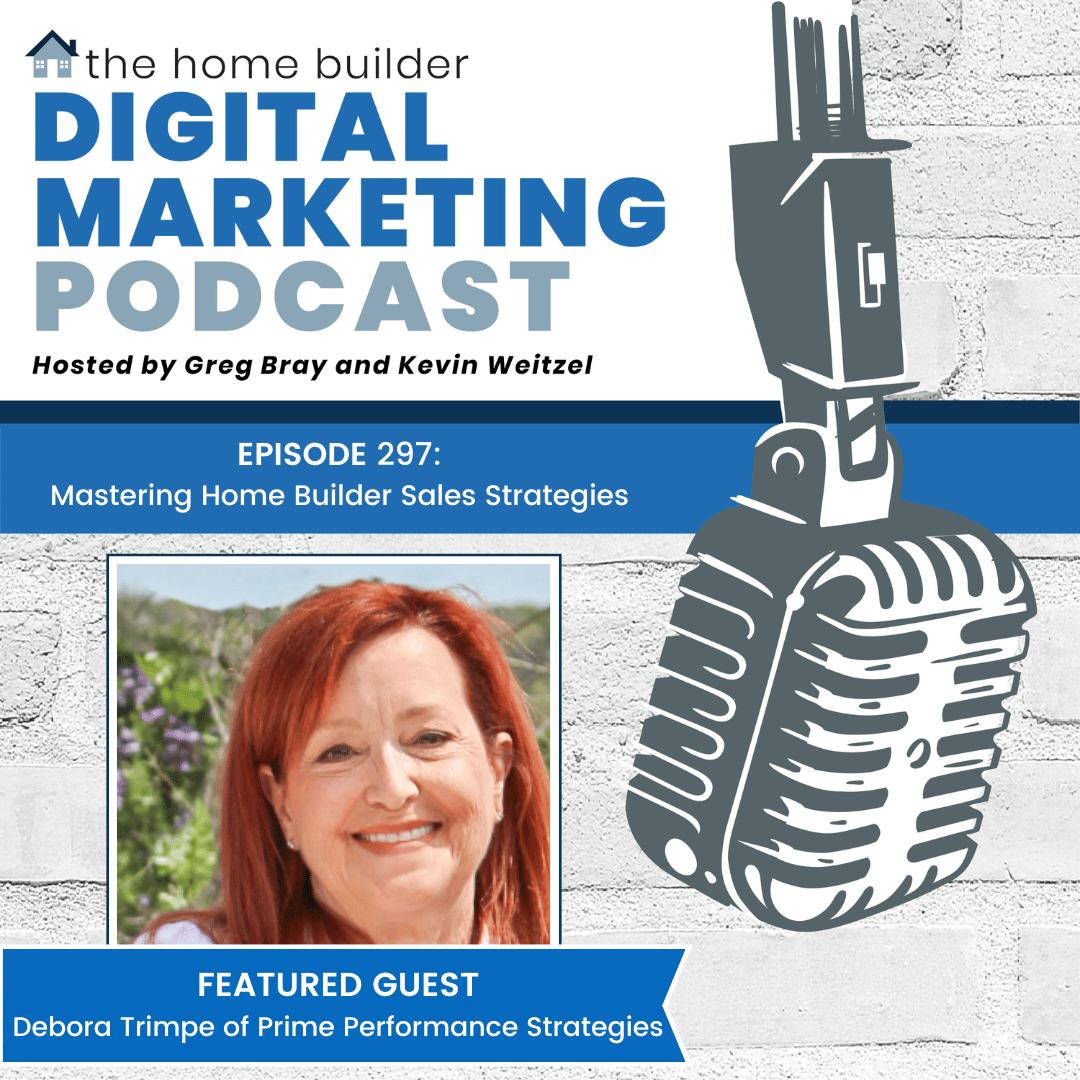
This week on The Home Builder Digital Marketing Podcast, Debora Trimpe of Prime Performance Strategies joins Greg and Kevin to discuss how home builder sales teams can master sales strategies through professional development and effective communication.
A strong sales team is fundamental to a home builder’s success. Debora says, “I really saw that in the home building industry, sales obviously is what produces what we do. Obviously, we can't build a house if we can't sell a house. We can't do great marketing if we don't sell anything.”
In the ever-changing home-building market, sales teams must master open and meaningful communication with home buyers. Debora explains, “I think the other thing that we've learned as the market is in transition, I like to call it. The market is what the market is. It's just in transition. It's always in transition. The more transparent we are and the better questions we ask people, the more likely they will have a conversation with us, and that's what we need in sales.”
Home builder sales teams must be highly knowledgeable across many areas. However, effective selling is about adapting the extensive skills to fit the unique needs of each individual homebuyer. Debora says, “As a salesperson, to be successful in today's environment, I would kind of liken it to, you know, mountain climbing, right? When you go mountain climbing, you have to put a lot of stuff in your pack that you may or may not use. I might need a certain kind of rope, I might need a certain kind of hammer, whatever I need, but I might not use it all. That's what we have to understand as salespeople. We have to know a lot of things, but that doesn't mean we use it all on every person we talk to.”
Listen to this week’s episode to learn more about how home builder sales teams can enhance sales performance through improved skill development and communication.
About the Guest:
Dr. Debora Trimpe is a seasoned executive, award-winning entrepreneur, and nationally recognized expert in leadership development and sales performance, with over 40 years of experience in the business world. She holds a Ph.D. in Psychology with a specialization in Industrial and Organizational Psychology and a subspecialty in Leadership Coaching Psychology. Her work focuses on empowering professionals to improve performance, drive results, and lead with authenticity by applying the psychology of motivation, behavior, and change.
Dr. Trimpe is the founder of Prime Performance Strategies, where she provides coaching and development programs designed to elevate leadership and sales effectiveness for professionals and organizations ready to reach their next level of success.
A dynamic and engaging speaker, Debora has delivered keynote presentations and facilitated breakout sessions at major industry events including the International Builders’ Show, Sunbelt Builders Show, Southeast Builders Conference, and numerous real estate and leadership associations across the country. She is known for translating complex psychological principles into practical strategies that inspire lasting change and measurable growth.
Her professional background spans a wide range of leadership roles — from receptionist to the C-suite — and includes 10 years as the owner of a successful homebuilding company. She also made history as the first woman elected President of the Dallas Home Builders Association, serving from 2000 to 2001.
Before founding her consulting firm, Debora served as Director of Training for a multi-billion-dollar homebuilding company in Texas, where she designed and led statewide sales and leadership development programs.
She is a two-time Amazon best-selling author and has been featured in USA Today, FOX, CBS, Business Insider, and Digital Journal for her thought leadership in performance psychology.
Debora resides in the Texas Hill Country with her husband, Steve, and their three German Shepherds.
Greg Bray: [00:00:00] Hello everybody, and welcome to today's episode of The Home Builder Digital Marketing Podcast. I'm Greg Bray with Blue Tangerine.
Kevin Weitzel: And I'm Kevin Weitzel with OutHouse.
Greg Bray: And we are excited to have joining us today, Dr. Debora Trimpe. Debora is the founder at Prime Performance Strategies. Thanks for being with us today.
Debora Trimpe: Thank you so much for having me, guys.
Greg Bray: Well, let's start off, Debora, help us get to know you a little bit, give us that quick background and overview about some of the things you've been doing.
Debora Trimpe: Okay, so I am a long termer in this business. This is actually my 46th year in the [00:01:00] home building industry. And so, I have been everything from an onsite sales professional to having owned my own home building company for 10 years. So, I have probably a different perspective, I think, on a lot of what home building is because I've served in so many different roles. Right now I have a coaching and consulting company, and most of my customers are larger builders or privately held builders, where we work together to help their sales leadership team and their sales teams to better performance.
Kevin Weitzel: Wow. That's a lot, but before we get started and deeper dive into what we're going to talk with you about, we need to know one interesting factoid about you that has nothing to do with work, family, or the home building industry.
Debora Trimpe: I was in the junior miss competition was first runner up to the Wisconsin State Junior Miss when I went to high school. So, that's probably something nobody knows about me.
Kevin Weitzel: That's super cool.
Greg Bray: Alright. That's awesome. I know enough about that. My sister [00:02:00] did that, and one of my daughters did that too. So, I know a bit about the work that goes into that. Congratulations.
Debora Trimpe: It was a great opportunity to get scholarship money, and that's really what I did.
Greg Bray: So, what did you do for your talent presentation?
Debora Trimpe: I played clarinet.
Greg Bray: I played clarinet.
Debora Trimpe: See, look at that.
Greg Bray: Well, maybe we should get you guys together later for a little duet.
Debora Trimpe: Oh, how about not. I don't play anymore.
Kevin Weitzel: I've forgotten more than I've ever learned. I'm sure.
Debora Trimpe: Well, actually just, and this is another side. I was actually going to be a performance major in clarinet. When I went to college, I was going to go to University of North Texas when it was a music school, and pursue that. And obviously, I did not because I decided that if I had to practice as part of a profession, I probably wouldn't like it.
Greg Bray: That's going to come back to bite you somewhere, I'm sure, but.
Debora Trimpe: I'm sure it's.
Greg Bray: Well, Deborah, before we go any further, just give us a little bit more detail about Prime Performance Strategies, the kind of services and coaching you're offering.
Debora Trimpe: So, [00:03:00] as a coaching group, when I started this, I really saw that in the home building industry, sales obviously is what produces what we do. Obviously, we can't build a house if we can't sell a house, we can't. Do great marketing if we don't sell anything. And so, what I saw is a lot of people struggled in their companies because most of them were using what I would call training. And as part of my PhD program, I had to do a lot in adult education. And what I learned is that adults don't learn the same way as kids do. So, the classroom setting is the least effective and most expensive way to get people to learn anything.
So, I adopted a strategy that I used in my previous life, and that was to really do coaching and mentoring, to actually work with people. Obviously, we do education and growth, but then to follow that up with coaching and mentoring, not just for the sales team itself, [00:04:00] but for the sales leaders. And actually, in some cases, I actually work with the owners of the company as well in an effort to help them better understand their teams and how they can more effectively lead them.
Kevin Weitzel: Let me ask one crazy question, just because you said you work with both owners and with sales staff. Of the two groups, which one come in most open-minded, owners or sales staff?
Debora Trimpe: Owners.
Kevin Weitzel: That's what I thought. Salespeople tend to think they know it all, right?
Debora Trimpe: Salespeople, if they've done this for a long time, they think they have all the answers. I find it really interesting in coaching. I always use the analogy, which I know a lot of other people do. If I'm a football star, and I'm playing quarterback for the Green Bay Packers, not Aaron Rodgers anymore obviously, but I'm playing that role, and let's say I'm getting paid $50 million.
If I look at that quarterback's day, during season, all he does is what? He looks at plays, he strategizes on plays. [00:05:00] Then we spend a ton of time passing the football, throwing the football. Why would he need to do that if he's a $50 million a year player? And we have people in this industry that don't want to rehearse and rehearse and practice and drill on what will make them good, and they don't make $50 million, where's the disconnect?
Greg Bray: So, tell us about that disconnect. Why don't people like to practice? Clarinet or sales strategies, whichever it might be.
Debora Trimpe: This is the psychology piece of it. It's the one word we most fear, and that's called judgment. And so, what I've also learned is that in our business, what we're doing, obviously, a lot of times, is role-playing with people, right? And so, a lot of people go, Oh, this is fake, so I can't do it. It doesn't matter if it's fake or not fake we can do it. The fear is I'm being judged by the person roleplaying with me, or the people that are sitting around watching this. And when people role-play, what they do is they let them go all the way through the process, and then they tell them what they did wrong.
And so, what we do is what we call [00:06:00] real-time coaching. So, if I'm role-playing with you, Greg, you know, we would start going down the road, and then I'd see you get flustered and like, okay, stop. What are we thinking? Why are we getting flustered? Let's talk through that. I can't say what you just said. Well, let's find a better way for you to say that. We connect, and then we go, okay, let's do this again.
Now it frustrates people because we stop a lot. But once they find out that this isn't judgment, but it's actually helping you grow and develop your skillset, then people become way more appreciative of the opportunity. But that's really the word judgment. You're going to tell me I did a bad job, you're going to tell me I'm not good. And that's what I fear.
Kevin Weitzel: So, how often were you stopping somebody? Do you just want to just grab by the shoulders and just shake them, shake the crap out of them? How often does that happen?
Debora Trimpe: A lot. I'm just being totally transparent. I've had to learn. I had a boss who told me one time, I'm sorry, but you're not really a good poker player when you don't like something, you roll your eyes. And so now, actually, I'm a huge [00:07:00] poker player. I love to play poker. And so, I've learned how to control that. Because in my head, I'm thinking, are you joking? And on my face, I'm like, okay, that's great.
Greg Bray: So, when you're sitting here in these role-playing situations, you've got somebody who's finally embraced this idea, okay, I'm going to go all in, I'm going to try this. What are those first steps you take in trying to help somebody improve in that sales conversation?
Debora Trimpe: So, I guess there's a couple things. One of the things that I really spend a lot of time with people on is what we call Socratic questions. Really, it's not a question; it's a declarative statement. So, what we've learned in this business over the years is who, what, when, where, why, how is an open-ended question. It's really not. I'll give you an example.
How long have you been looking for a home? Two months. How big a home do you want? 2300 square feet. How many bedrooms do you want? Three. The questions we ask allow people to say very short answers, and 00:08:00] when people start giving you very short answers, they get frustrated with you, and they start to turn away from you, you start to lose their attention. Right? So, what we might have asked in five or six questions that gets us nothing, we teach a process that says, let's use a Socratic statement or Socratic question.
Like, for example, instead of saying, Do you have kids? Well, that's a closed-ended question. Yes. How many do you have? Open-ended question. Three. What are their ages? Open-ended question. Two, four, and six. What are their names? Notice what I had to ask. What if I said to you, Tell me about your family. Now I get 2, 3, 4, 5 sentences from somebody.
And the other thing psychologically that's interesting about this is that people usually will do what they're told. So, if I say to you, Tell me about your family, you'll take the directive. If I ask you a very closed-ended question or a very small question, you're only going to give me bits and pieces to do that. So, we spend, to answer your question, Greg, we [00:09:00] spend a lot of time helping people learn better questioning techniques. When they learn how to get a better questioning technique, they get more answers from people. The more people give you, the more you have to go with. And when they start learning that, then they start to create better relationships.
I think the other thing that we've learned as the market is in transition, I like to call it. The market is what the market is. It's just in transition. It's always in transition. The more transparent we are and the better questions we ask people, the more likely they will have a conversation with us, and that's what we need in sales.
Kevin Weitzel: And Debora, emotionally, people like talking about their kids. They like talking about their automobile hobby or whatever their issuance is, but they don't want to be quizzed. Right?
Debora Trimpe: Right. Exactly. And so, to your point, Kevin, if I'm asking you how many, what, when, who, I'm a quiz. But when I leave that open and I just say, Tell me about, then the interesting thing, it's like when I [00:10:00] interview people, just to take an aside. When I interview people, I would say like, Tell me the Kevin story, and they'll go, What do you want to know?
I go, tell me whatever you feel like you want to tell me. And it's fascinating to watch the road they take because it tells you a lot about them. It's no different in the sales process. When I say like, Tell me about your family. The things they choose to tell you are very interesting. And I think that's what we also have to do. And this questioning process also slows us down, where we have to listen more to people instead of talk.
Greg Bray: I love that example because I can only imagine the extra insights you gain from that type of a question. While you may still get the same, how many kids and their ages and all of that, the fact that some other thing is going on, like, yeah, well, I'm concerned about my aging parents and whether I'll need to take care of them, you know, in this house at some point in the next five years or whatever. Other things could come up that you might not ever even, and that could be fascinatingly helpful to a salesperson conversation.
Debora Trimpe: Absolutely. And I [00:11:00] think I'm even more sensitive to this issue because I've never had any of my own children. So, if somebody said to you, Do you have kids? I'd say, no. Well, now where do we go? Or in today's world, you know, a lot of people are having more and more trouble having families, so you don't know what wound you may have just touched with somebody. But if I say to you, to your point, Greg, if I say, tell me about your family and I don't have kids, but I would say to you, well, I have a husband who's retired and my kids are grown and gone, but they come back to visit and I have three German shepherds and we need room for them. That's my family.
Kevin Weitzel: So, a dog washing station might be important in your house. If you're an active adult, you might be more interested in the amenities in the community.
Debora Trimpe: Right. If my parents come to stay, then I'm going to be more concerned about where is the hospital located to me, or what other features I might need, to Greg's point, my aging parents might come to stay with me. Or even if they're not going to stay with me, I have a mom who is in assisted living. We had to find a place that was 15 minutes from my [00:12:00] brother's house, because he lives in Austin. So, you make other decisions about what you're going to purchase because of the other implications that are related to family or other things about your job, or whatever it may be.
Greg Bray: Can you give us one more example question, like that one that, you know, just twists a little bit that helps gain more info?
Debora Trimpe: Sure. I would say, you know, for example, I might say, Let's talk about more about the demonstration, the model, right? So, I'm going to take a little different route here. A lot of times, people are just, you know, looking at a model, going, Do you like this? Do you like this? No, I don't. Yes, I do. Whatever. What if I said to you, Compare this kitchen to the one you have now. Think about how much information I might get. I might want to demonstrate, which I see a lot of people do, we demonstrate all the things we want to demonstrate as a builder that are our features. And yet people aren't always buying about features. They're buying about how does this house work for me.
But I do like compare and contrast a lot, or like help me understand some of the things that are going to be [00:13:00] most important to you about the neighborhood you want to live in. See, like, help me understand is something, right? People respond to, Oh, sure, I'll help you understand. But if I said, help me understand some of the things that are most important to you about the neighborhood you want to live in. See, a lot of us sit there and say, and I learned this from my husband. He did a shop with me once.
A lot of people like to say, Oh, we have 50 miles of hiking bike trail. We have this awesome junior Olympic swimming pool, and we have a lazy river for the kids, and we have this and this and this. We shop somebody that said all that. And when we walked out, my husband said I would never buy from that salesperson. And I said, Why? I thought they did a good job of presenting this master plan community. And he said, Deb, I don't put my foot in a pool. I don't care about having a pool. And I said, yeah, but you know, they were talking about our grandkids.
He goes, okay, well, let's just talk about hike and bike trail. Do we hike or bike? I said, No. He said, So now I'm thinking, how much am I paying in HOA dues for stuff I would never use? So, now what did I do is I actually created an [00:14:00] objection potentially for the prospect instead of asking the things that are important to them and then matching what is important to you. Well, let me show you where I had that in my community. Let me show you how you could attain that in my neighborhood. Way different conversation.
Kevin Weitzel: On the sales end of things, especially in the automobile side, they call that loading your artillery. You want to load your artillery with those little factoids and things that are pressure points for them, so you can fire it back when you do have objections. Well, you know, Debora, you said that you don't have any kids. And by the way, this neighborhood's really quiet. We don't have any kids in here. No rotten little brats rolling around, and it's going to upset you and make a bunch of noise you don't want to listen to. Anyway. No, you go a rabbit hole. But yeah, loading your artillery, I totally get it.
Debora Trimpe: As a salesperson, to be successful in today's environment, I would kind of liken it to, you know, mountain climbing, right? When you go mountain climbing, you have to put a lot of stuff in your pack that you may or may not use. I might need a certain kind of rope, I might need a certain kind of hammer, whatever I need, but I might not use it [00:15:00] all. That's what we have to understand as salespeople. We have to know a lot of things, but that doesn't mean we use it all on every person we talk to.
Greg Bray: So, Debora, let's pivot just a little bit towards the buyers themselves and how they've changed over the last few years, especially from a digital education standpoint, and the things that salespeople need to understand about the buyers now compared to five years ago. What are some things you've learned there?
Debora Trimpe: One of the things that our buyers learned during COVID was how to do research. I think we think that they don't do that anymore. I think that is one of the hangovers from COVID is they learned how to research, and now they're researching. It's very fascinating to me because, if people don't have traffic coming in their neighborhood, I always get to hear about. I don't have signage. Well, I don't see a lot of buyers really just driving around trying to decide where I want to drive in. A lot of salespeople don't give people a lot of credit for all that they know before they walk in the door. [00:16:00] I think that's where buyers have changed. They've kept that. They do a lot of research.
I would submit to you that, especially in the markets that I deal with a lot in taxes, for example, is there's a lot of competition in all these markets and there's a lot of choices for people. There's lots of research studies that show the more choices people have, the less likely they are to make a decision. And so, that is part of it, and I don't think we always give a lot of credit to that. I see a lot of times, salespeople aren't finding out who else are they looking at? Why are they looking there? And knowing who we're competing against. Not to negatively sell anybody, but what are they considering? What else are they thinking about, so I have a better, clearer image of them?
Since we're talking about this today, I think every buyer out there, I shouldn't say every, most buyers out there live in fear mode right now. They're afraid to make the wrong decision. A lot of salespeople I talk to think it's an urgency [00:17:00] problem. It's not an urgency problem. It's a fear problem. You know, think about it. You watch the news. What about the news says, you know, now's a really good time to buy a house. You know, all you hear is mortgage rates are too high, right? Even though so many builders have done buy-downs on rates, that's what the buyer hears, right?
And then, of course, you know, we see all these price reductions in the market. Why wouldn't I sit there as a buyer, thinking, well, maybe I should stand by and wait? Maybe they'll come down some more. You know, if I'd have bought two months ago in this neighborhood, now this builder reduced their prices, maybe I would've overpaid. There's just so much fear. And I think when we as salespeople make the mistake of trying to work with urgency, like, oh my gosh, if you don't buy this today, somebody else will. People are laughing at you, going, That's not true.
There's nothing I'm hearing in the marketplace that says that's true, and heaven help you if they drive through your community two weeks later and that house is still available for sale. You look horrible, right? But if you've thought about fear and said to [00:18:00] that buyer, and this is what I coach a lot of people to do, is to say to them, you know, what things would you have to hear, say, or read, that would help alleviate some of the fear for you? Now we know where to go. I know that's a little off the rabbit hole there, Greg, from what are behavior buyers, but I would submit to you those are some of the things that have really changed over the last five years.
Greg Bray: I think that's spot on, especially the fear thing. I was even kind of going there in my head as I listened to you talk, like, I think were always scared to make mistakes, do something, and feel like, oh man, I missed out. I could've got into something better if I just waited. So, there's the salesperson conversation, but let's look at from a marketing standpoint. What are some of the messages that we can put on the website and in our other outreach that can help with some of that fear and maybe mitigate or reduce some of it, even before they show up, so they can feel more confident?
Debora Trimpe: Well, I think that we live in a world where people are very distrustful. I mean, there's some research out there [00:19:00] that says, I know that I'm going say salespeople, but I'll relate it back to marketing. Ninety-seven percent of the people researched said, and this was not about new home sales, but salespeople in general, 97% of the people said they don't trust a salesperson. In this marketplace, even from a marketing perspective, one of the pillars of really building trust is transparency, and I think that's where we miss in the marketing message. Why not say to people, I know it's really overwhelming. I know it's kind of a fearful time to buy. I might do some education on the website. Here's some things that you might want to think about as you buy. Here are some things you might want to look at with builders, as you might want to buy.
I'm going to make some people mad right now, I know it. A lot of builders on their websites lead with their incentives, and I'm sorry, incentives don't sell. You know, if you just break down, what does the word incentive mean? Incentive is something I do to get you to do a behavior that you normally wouldn't. Then what we do is [00:20:00] we create a buyer pool of incentive shoppers. Incentive isn't the best way to buy a home. Features aren't the best way to buy a home. Price discounts aren't the best way to buy a home.
And so, I think, you know, one thing about this industry is that when one builder sees somebody do it one way, then they all replicate. I don't know that that's necessarily the best way to do this. I think you have to think about who is your buyer. All buyer pools are not the same. Who is your buyer? What is that demographic looking for? And then how do I put that message front and center? And I don't think it looks the same for every builder, every price point.
Greg Bray: This is awesome, Debora. I completely agree with you. I see so many websites where the big homepage banner is rate buy down. That's the first thing somebody sees when they come to learn about you. They just did all this searching on Google, or now in ChatGPT, and they're finally coming to your website, and all they see is we have to, you know, give you this special deal [00:21:00] or you wouldn't want this house. It's a total miss. They haven't fallen in love with your home yet. They haven't fallen in love with the neighborhood yet. They don't understand what you offer. And all you're doing is saying, Hey, we can save you x percent on your interest rate.
Kevin Weitzel: It's a weak crutch on the educational side because what you're doing is you're selling an incentive, not selling the home, not selling the community.
Debora Trimpe: Correct. When I work with people too on negotiation, and they come to me and say, The buyer won't buy unless they get this. My first question always is, why do they love this house? Most often it's silence. Until we know why they love this home, we shouldn't be negotiating. That's another issue that we have. That's not about marketing so much, but that's another issue is we negotiate way too early and way too often. And that's the problem, is we kind of have convinced ourselves that all these other messages are what people go for. The more you reduce your price, the more you go with incentive, the more you go with all this other stuff, we're educating people to believe there's money in the pot to [00:22:00] get. Then all my builders get frustrated because the buyer keeps asking for more. Well, why not? You're telling them to.
Kevin Weitzel: So, when I was back in the bicycle industry, we're talking way back in high school days. We had this sales guy come in, and he was a Ziglar type. And he goes, You know, I noticed that this bike over here is for sale. Tell me why it's on sale. And he is trying to educate this young kid, me.
I said, Well, it's a thousand dollars off right now. He goes, Ooh. And he asked me two questions. What's wrong with it? And why does nobody want it? It stuck with me ever since. I'm like, why are you leading with a discount or lowered price? Because if it's a lowered price, nobody else has wanting it. Why else are you lowering your price?
Debora Trimpe: A lot of builders will go to their sales team and ask them, What do you need to make a sale? What is it that's going to help us make the sales today? Most salespeople always go to price or discount. I haven't met a one that says, well, gee, could we have a better photograph of this house, or whatever. It's always price or discount, right? And so, then the builder goes, well, that's what they're looking for. Let's figure out how to get it to them because if we do that, then we'll help them sell more homes. [00:23:00] Then we go do that, and then we don't sell more homes. The problem is, once we say what the discount is or the incentive, then the buyer wants to know, What more can I get? And the biggest challenge in negotiation, if you study negotiation at all, it says, don't let the person negotiate who has the most to lose. And guess what? The person with the most to lose is a salesperson who isn't going to get paid.
Kevin Weitzel: Fact.
Greg Bray: So Debora, as you are working with these sales teams that are in a tough market right now, and maybe they're a little frustrated or struggling or things, what do you tell sales leaders to help motivate them to keep the team marching forward when I'm not going to give you that discount and I'm not going to give you that incentive and you need to sell it anyway.
Debora Trimpe: You said a perfect thing. I'll just say right now, I really do like to think of myself as a disruptor in the space. I don't see this the same way that everybody else does. Maybe because it's my background, and maybe it's because of all my studies and my PhD work in [00:24:00] psychology that allows me to understand more about human behavior. I study a lot of behavioral economics. People should, because behavioral economics is why do people do what they do economically, which makes absolutely no sense.
So, to your point, what do I teach my sales leaders? The very first thing I would say I probably paid Greg a lot of money to say this. I don't ever call it a tough market. I think that's the first place where we make the mistake. The market is just what the market is. Having done this for 46 years, I've seen it in all sorts of different spaces. Maybe that's why it doesn't bother me. When I started selling homes in 1982, interest rates were 18%. So, I'm kind of laughing when somebody's saying 6.25 is a little high.
I had a salesperson tell me this. I worked with him, and he was awesome. And he said to me, he said, Please, Deb, don't call it a tough market. I know you're trying to support me, he said, but the more you say as my coach, tough market, I believe what you're saying, and it just makes me more down. I said, point [00:25:00] taken, we're just going to call it a shifting market. Or I have another builder friend that likes to call it the transitioning market. So, always on its way to somewhere. Right?
The second piece of it that I do, and I learned this in 2008, 2009, when I was sitting with salespeople who had been super successful in the run-up in the market in 2005 and 2006, when they were super successful. Now they're sitting there going, I don't know what to do. I was making four or $500,000 in 2005. I don't even know how I'm going to make 150, and I don't know how to feed my family. I sat down with people and made the mistake; this was pre-PhD work. I made the mistake of going, What can I do to help? And I also met somebody who is really, really direct with me and said, If I knew, I would've already told you.
I think that's a mistake sales leaders make is we go to the field and we say, How can I help? I think most of your team would've told you if they knew how you could help. Your job as a sales leader is to go out there and dig in with [00:26:00] them and help them strategize to get that next sale. You know, when people sell, they don't worry about the market. People like to be on a winning team, you know, and when you get a sale, you're on the win.
The other thing I would say is I think a lot of sales leaders are still living in COVID world of, I'm not leaving the office. If you're not out in the field with your people, you're making a huge mistake. Your people need to see you. You need to be present. You know, I work with one builder right now. I love this. Their whole leadership team, all the way from COO, is walking every aged inventory with their salespeople to say, Let's strategize together to see what we can do to help get this home sold. That's what it takes in this marketplace.
And so, the last piece I want to address is, to your point, Greg is, and this is where I get people upset with me, they go, How do I motivate my team? You can't motivate anyone. Motivation is an intrinsic concept. It's not an extrinsic. Yes, you can short-term motivate somebody with pay or a gift [00:27:00] or a contest, but motivation is an internal construct. So, what I have to do is try to figure out what environment does that salesperson feel motivated in?
And this is where I really work with my sales leaders to become transformational leaders. And what that means is I lead to everyone's need and ability. Need relates to personality. You know, if I ask people that have kids, do you treat your kids the same? They say, No. Why not? They have different personalities. And I say, why as a sales leader, would you try to lead everyone the same? They all need something different from you based on their personality, right? And then, they all have different skill sets. So, why would we want to put things in place that are one size fits all, when really, truly, the more you reach out to people and understand their situation and work with them specifically, the more success you'll probably get.
Kevin Weitzel: So a lot of the tools, a lot of the coaching always [00:28:00] centers around, sell the features, sell the benefits, sell the lifestyle versus, you know, worried about price or incentives, et cetera.
Debora Trimpe: Mm-hmm.
Kevin Weitzel: I think that is true when you're talking about move up home or nicer communities. But what do you say to the salesperson that literally is selling those thousand-square-foot rectangles with no amenities? They're on average dirt because that is what a lot of these builders are being forced into based on attainability and affordability, just because the price of dirt, you know, allowing somebody to have that price point that they can get into. So, is it just the own versus rent mentality that we're going sell? What else can a salesperson do psychologically to aid more in their sales process?
Debora Trimpe: That's a great question. In fact, some of my builder clients are in that very specific price range where it is that first-time buyer situation, right? And so, most first-time buyers are coming out because they're dissatisfied with wherever it is that they live. So, there's a dissatisfaction. So, [00:29:00] how do I create satisfaction in what I have compared to what they have, right?
So, for example, one of the things I hear a lot of, in fact, we just had this conversation yesterday with somebody. They said, you know, people come in and then they want to pay the same amount for a mortgage as they're paying for their apartment. I said, What size is their apartment? They said, 800 square feet. I said, What size home are you showing them? 1400 square feet. And I said, I know you're really smart. This is exactly what I'd say to her. I know you're smart, and I know at some level you knew that for 500 more square feet of living space, you didn't think you were really going to get that at the same rate you pay for your 800 square foot apartment. Right? And they go, well, no. Right.
I ask people a lot about, and this is to your point, Kevin, I ask a lot about what's the backyard space. It may only be a 40-foot-wide lot by 120 feet deep, but you know, some of these footprints are small. The one I worked with yesterday, we figured out they have a thousand square feet of space in the backyard. A [00:30:00] thousand square feet is more than the apartment they currently live in. That's more living space. What does that mean to you? What about garage space? Some of our plans have them, some of them don't.
But then it becomes about the lifestyle that you can have. It still is lifestyle. I may have a smaller home, and I think sometimes, as salespeople, because we've spent a lot of time selling move-up buyers, and we've spent a lot of time with more features, more benefits, all this stuff, I think we forget for some people, this first home is everything. When you compare it to what they live with now, they don't have privacy; they don't have anything. So, it's more than just rent versus own. It's not just about why you keep giving your landlord money. It's how does your life improve with this?
I know the National Association has these statistics. I just read it again, with another group that wrote it. And they were talking about when you rent versus own, let's say you have kids, the kids are more stable, they do better in school. I mean, [00:31:00] so I think sometimes we've lost that because we didn't have to sell that during COVID, is what happens to your family as a unit? How do you become better as a family because you live in a home? It's not just how much, you know, wealth can I create for myself over time, it's what better family life do I have? I don't know. Does that answer the question that you asked?
Kevin Weitzel: I loved it. No, you even went deeper than what I was even probing for, so that was awesome.
Greg Bray: Well, Debora, this whole thing's been great. It's been fantastic to learn from you and your experiences. Do you have any just last thoughts or words of advice that you'd like to share with our audience before we wrap up?
Debora Trimpe: I guess it depends on who's listening, I guess. So, if you're a salesperson that's listening, I would say really, really work on staying curious. The more curious you are about why people say what they say and then follow up with additional questions, I think you'll learn way more about your buyer. The more you know, the easier it is to help them solve their problem.
You know, if you're a sales leader, [00:32:00] it would be what I said before. Get out in the field with your people. Go in and don't ask them how you can help. Dig in and help them find a sale. I'm going to expand on that one more. We didn't talk about this. I've coined a new phrase so everybody can use it now. Marketing is global, traffic is local. I'll give you this analogy. If I have a McDonald's franchise, McDonald's does a lot of advertising on TV, but they're not advertising my franchise.
And that's really what I think all of our salespeople need to do, and our sales leaders need to help our teams with is how do you generate traffic locally? I mean, I'd spent a lot of time working with my clients on it, I have 52 different ways to generate traffic for a neighborhood that actually don't even cost you any money. So, how can you do that with your team? It also gives them activities to do, so when you're not seeing a lot of people, I have sense and purpose every day.
And then last, I would say to those that are listening that own a company, or that are leaders in a [00:33:00] C-suite position, think about what you're giving your people. If you want to expend money on helping them grow, then find a coach. Find coaching along with education. Stop worrying about training. Training is what I do for my German Shepherds. I tell them what to do and they sit and they lay down and they come, maybe, sort of.
I abhor the word training because with adults, it's not about that. It's about learning. It's about problem-solving solving and really, truly, that's how you help adults, and that's who we work with. You help them learn by helping them solve problems, and they're more likely to do that again. And so I guess that would be my messages for the three different groups of people that might be listening to this podcast today, and hope that helps.
Greg Bray: Well, Debora, if somebody wants to connect with you and learn more, what's the best way for them to reach out and get in touch?
Debora Trimpe: The best way to reach out would be, I'll give you two ways. You can certainly call me on my cell. I am welcome to that [00:34:00] 214-909-9939, or reach out to me via email, which is Debora spelled weird, D-E-B-O-R-A@primeperformancestrategies.com. Or you can go to my website, which is primeperformancestrategies.com.
Greg Bray: Well, thank you so much, Debora, for sharing your thoughts and insights with us today. We really appreciate it. And thank you, everybody, for listening to The Home Builder Digital Marketing Podcast. I'm Greg Bray for Blue Tangerine.
Kevin Weitzel: And I'm Kevin Weitzel with OutHouse. Thank you. [00:35:00]