
EP: 58
Engaging Home Buyers with Video Storytelling
With Shane Austin
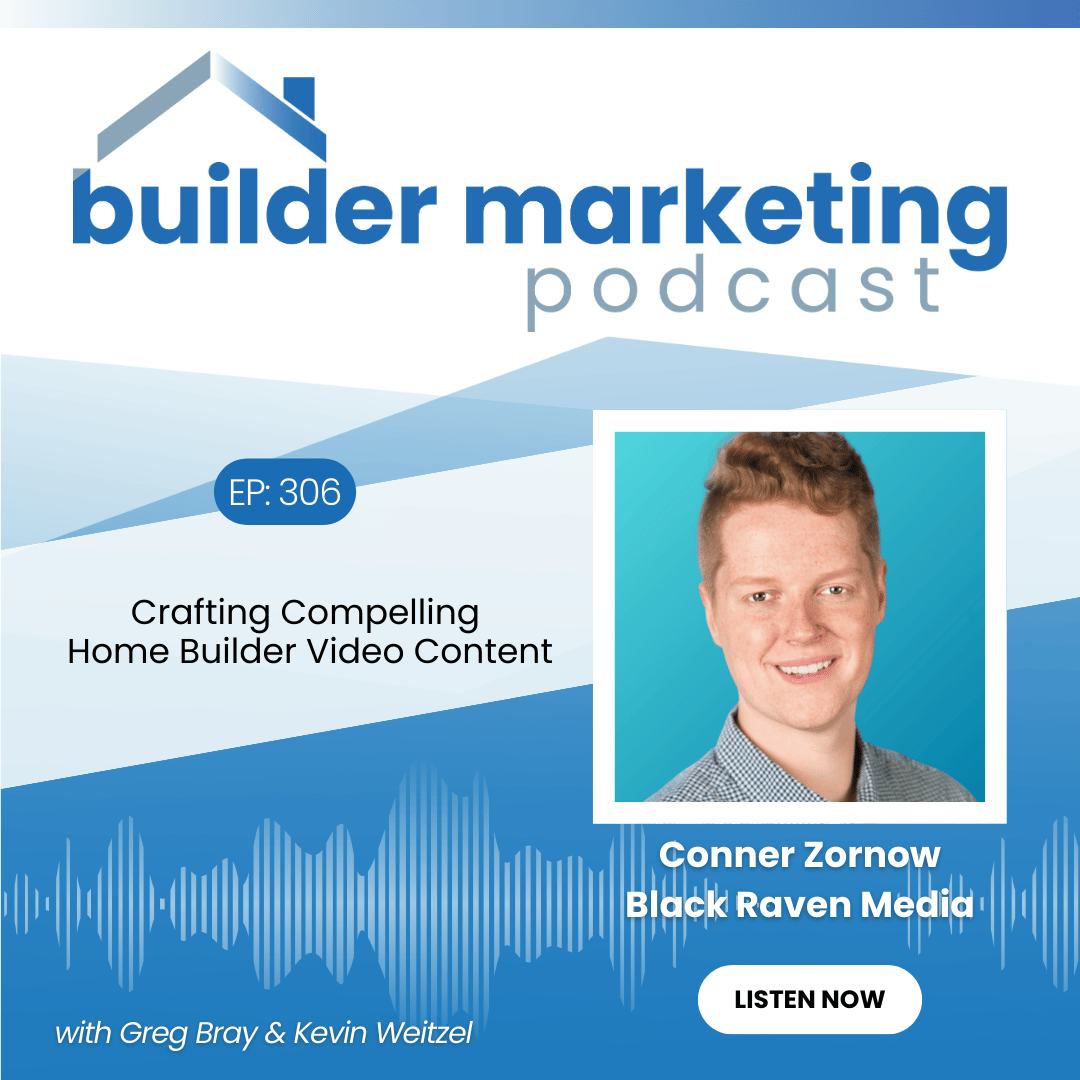
This week on The Home Builder Digital Marketing Podcast, Conner Zornow of Black Raven Media joins Greg and Kevin to discuss how home builders can craft compelling video content that creates lasting connections with home buyers.
Video has become the most effective medium for capturing attention and generates significantly higher visibility and engagement than any other content format. Conner says, “From a technical standpoint, we see video getting 400% more impressions, 400% more engagement than any other kind of format right now.”
Video won’t instantly sell homes, but it is essential in helping to build credibility and rapport that leads to those major purchases. Conner explains, “So, what I'll say is that there is no video on this planet that is going to force someone into a position where they buy a $500,000 home from you. That's not going to happen. But video is a far better vehicle to build trust and confidence in what you're doing over any other person in your market because people get to know you better.”
Video marketing is a long-term investment that fosters genuine brand loyalty by letting your audience truly experience who you are. Conner says, “There's definitely a horizon. There's a length of time you need to have been doing it. This is like any other platform. Video is no different. Immediately, you'll get some results. Yes. But after a year of doing it, you're not just going to have results, you're going to have an audience. You're going to have a community that wants to be a part of what you're doing, and that's loyalty and trust that other platforms have a hard time generating because everyone's posting on social media.”
Listen to this week’s episode to learn more about creating engaging and impactful home builder video content that resonates with home buyers.
About the Guest:
Conner Zornow is the President of Black Raven Media and the executive producer behind Builders Showcase, a long-running TV and digital series that highlights some of the top builders, remodelers, and home-improvement experts across the Midwest. His work centers on helping builders and service-based businesses use strategic video content to modernize their marketing, build trust faster, and stand out in competitive markets.
With years of hands-on experience producing episodic content, working directly with builders, and running a marketing agency that specializes in niche industries, Conner brings a practical and grounded approach to digital strategy. He teaches teams how to turn real projects and real client interactions into meaningful content that drives leads, shortens the sales cycle, and strengthens brand presence across YouTube, social, and broadcast platforms.
Today, Conner leads Black Raven Media’s growing suite of builder-focused marketing programs, helping companies rethink how video fits into the customer journey. His work emphasizes simplicity, repeatable formats, and authentic storytelling — reminding leaders that great content doesn’t start with fancy equipment, it starts with clarity, consistency, and showing who you are.
Greg Bray: [00:00:00] Hello everybody, and welcome to today's episode of the Builder Marketing Podcast. I'm Greg Bray with Blue Tangerine.
Kevin Weitzel: And I'm Kevin Weitzel with OutHouse.
Greg Bray: And we are pleased to have joining us today, Conner Zornow. Conner is the president and CEO at Black Raven Media. Welcome, Conner. Thanks for being with us today.
Conner Zornow: It's a pleasure. Thanks for having me.
Greg Bray: Well, let's start off and just get that quick background and overview. Tell us just a little bit about yourself.
Conner Zornow: Yeah. I've been the president [00:01:00] and CEO at Black Raven for the last two years. Black Raven is a little bit trickier to describe. It's a brand that's spawned out of a TV show that's been running in Milwaukee for the last 27 years, Builder Showcase. Black Raven is the digital marketing side of things, and it spawned out of Builder Showcase in 2013. I bought the company two years ago and have been operating it because we are establishing Builder Showcase as a national brand and are expanding to other cities. So, we have moved from Milwaukee to the Chicago Metro area as well, and we're looking to expand across the Midwest.
Kevin Weitzel: We're going to jump into this, but before we do so, you have to give our listeners one interesting fact about yourself that has nothing to do with work, family, or the home building industry at all.
Conner Zornow: A little known fact about me, at least for my peers the last 10 years or so, is I started my storytelling career in acting. I was in theater [00:02:00] for much of my formative years out of high school and into college. Although this is a little bit about my family, that's where I met my girlfriend in acting class, and we're still together to this day.
Kevin Weitzel: That's cool.
Greg Bray: So, she hasn't seen through the act yet, is that what you're saying?
Conner Zornow: She has not, she has not. I'm very convincing.
Kevin Weitzel: Love it.
Greg Bray: Well, Conner, give us a little more background about Builder Showcase. It's been around in the Milwaukee area, you said, and you're growing, but what exactly is it? How does it work? What kinds of things are you doing there?
Conner Zornow: Yeah. I think the best way to describe Builder Showcase is it's roughly a 30-minute resource guide for consumers in that market to help them find trust and identify the different builders of their area, and basically just provides a step-by-step guide of. Not only what they have available in terms of buildings and homes in their region, but also who the big players are, why they're doing this, what their motives are, if you can trust them, [00:03:00], and it gives little interviews and snippets about their process. It shows off mostly their houses.
So, it airs every week on Fox6, which is the local TV channel there. We've now moved to Fox6 and Fox50, which is the Chicago version. Yeah, the goal is to really just help builders build that community, try to build an audience space for them, and that's why it's been on the show or on TV for so long, because they have a longevity there that's hard to beat. People tell them, Hey, I've seen you on TV. I saw you on the Builder Showcase all the time. That's just a community that's hard to beat, and I want to become a proper steward for that going forward.
Greg Bray: So, Conner, some people feel like digital has taken over marketing, and there's really not a place for like radio and TV and some of the traditional things. We're hearing you say that that may not be the case. How has digital influenced, over the last several years, how the TV show works, or is it also because you're putting it out on YouTube as well? How does all that interrelate together?
Conner Zornow: [00:04:00] Yeah, that's a great question. That's actually exactly what we're doing. And although for the vast majority of traditional advertising, I would agree that TV is really kind of falling behind because people don't want to be served ads to begin with, and now they don't watch traditional television anymore. So, the advertising that randomly pops up throughout the day probably is going to be less effective go forward.
The big difference with Builder Showcase specifically is that the show doesn't feel like advertising. Everything on the show is supposed to be informative or educational. People come to the show because they want to find out that information. So, it's a little different in that regard. But how it plays into the digital marketing landscape is that we not only air the show on Fox, we air it on YouTube as well. We re-air it there. We build a streaming, we call it streaming television channel there, where we tend to build out a fast channel for it in the future, so it's more widely available.
A fast channel is a free ad-supported TV channel. [00:05:00] These are often played on, you know, smart TVs. A lot of smart TVs have their own TV option that's supposed to be the replacement for free local television, antenna-based television. LiVe Avisos, and I know Visio has his own TV property. So, fast channels fill up those properties, so it's more widely available.
As far as the digital marketing part of it, I think that specifically other digital marketing practices like SEO are often well boosted by video and consistent TV uploads because it's essentially another format or a video version of a blog, where you're constantly uploading new information, re-indexing that information into Google so it's easier to find and builds out your authority on another platform. We may get into it later, but AI and other, non-search-based but SEO kind of formatted indexing is also leveraging as transcripts [00:06:00] and description information for these videos on YouTube are also indexed into the Google ecosystem.
Greg Bray: So, you are creating this show. Is it just one builder a week, or is it, you know, a bunch of different builders? How do you kind of segment that so we can understand that structure as we go a little bit deeper into some other areas?
Conner Zornow: So, the show is broken up into 30-second to two minutes. Depends on how much time that the builders want to be involved in, how much content they have to produce on their own side. We produce that content. That's not what I mean, but essentially, you know, someone who's changing out garage doors may not have as much content to show off as someone who's got a whole new house they've just built. Essentially, that breaks up the show into at most two minutes for each builder. There's roughly 10 to 24 builders on the show at any given timeframe.
And then, we also have builders that have partner organizations that are also on. So, they take up more of the show in theory, but are referenced throughout. That's the idea. [00:07:00] So, that keeps it kind of fresh. Each builder gets their own little stake in it. They don't have to worry about trying to fill up 30 minutes of content for their week, and they can still talk about, or we rotate out different spots for them, if they have multiple things they're trying to promote at one time.
Kevin Weitzel: I don't mean to use a bad word, but so is this format very similar to, like, a bunch of micro ads? Should we bleep this, ads? Is it a bunch of like little micro ads, or is it purely informational, more about the process and workmanship, more so than come to Carl's garage door service?
Conner Zornow: Sure. The shorter ones, they do tend to feel more ad-like, and we actually have an ad section in the show that's built out for them. But for the longer pieces, they feel more like home tours. We actually had a company on the show for a very long time; they recently retired, that's the only reason they left. They would actually go on the show and talk about why they were building their houses a certain way.
Let's say they're building their home on a hillside. [00:08:00] They would explain why their deck has a wooden pylon driven into the ground, and then they have a concrete barrier underneath it. But what happens if the concrete barrier's not lined up perfectly? They had a whole two-minute segment explaining what they would do specifically to fix that and why it was a problem. So, it can be anywhere from more ad-type or ad copy-based segments to just a beautiful home tour of a unique home in the region, to this is how we build, and this is our process, and this is what we want to do for you.
Greg Bray: So, Conner, because you've got so much experience putting these segments together for builders as part of your show, let's pivot just a little bit and talk about the builder who just wants to make some good video content and some of the things that you've learned or seen that work well, don't work well. So, if I'm a builder and I want to make my own little two-minute video, what are some of the things that I need to think about as I start that process? What kind of content should I be doing? What does that kind of look like [00:09:00] from your experience?
Conner Zornow: Two of the most important questions, and they are questions that someone in my sphere, like this, is kind of standard for us, but they do slip out of the grasp of a number of people who just aren't used to this is where are you going to put it? It's the most important question because that changes everything about what you're going to do for the video itself. But who do you intend to show it to is the other one.
So, if you're trying to make a video for YouTube, you're probably going to want to make it a little longer than two minutes. Two minutes would be kinda short, actually. YouTube generally wants content between eight and 15 minutes, and they want it to be still the whole time, very informative, useful content. They want people to watch all of it. So, your engagement matters a lot there, and that means that you're editing probably should be fast, but can't be too fast because you can't fatigue them.
The other primary platform that people would do this kind of social production or video production would be Facebook. Or if [00:10:00] people would like, they could go over to the TikToks side of the world. But those are going to require different formats. You're not going to be filming it horizontally anymore. You're likely going to be doing it vertically, which means you have less space to show off what you're trying to talk about. Or you're going to have to have more choreography. So those are really important parts of the tactical side of making this video.
As far as the story or narrative side, the most important thing is just to make sure that you're not trying to present a facade because people don't want that explicitly these days. They do not want super overproduced video. Outside of a website, they're going to want something more conversational. They want something more realistic, talking about your pain points. What's frustrating you this week? Why are you doing this? Because I don't understand those points of conversation.
You can't assume that the consumer is going to know everything about your industry or want to get to know everything about your industry, but you [00:11:00] have to put out content that makes those assumptions because they're trying to have that conversation with you. That's why they're there. Not everyone will want it, but the people who are showing up to your channel are. They're probably going to want that.
Greg Bray: So, when I listen to all that, it sounds hard. Sounds like a lot of work. Is video worth it? Is it really worth the effort and the investment? Does it matter that much, or is it just kind of showy and no big deal?
Conner Zornow: So, what I'll say is that there is no video on this planet that is going to force someone into a position where they buy a $500,000 home from you. That's not going to happen. But video is a far better vehicle to build trust and confidence in what you're doing over any other person in your market because people get to know you better.
Like, if you're going to post something on Facebook and it's an image and people get to see a little bit of your personality, yes, it will [00:12:00] build trust. But if they spend 10 minutes with you talking about something that you actually care about, that's a different story. They're going to get to know you much faster. Specifically, people go on these platforms to watch video nowadays because it's so much more engaging for them. It provides them peeks into different worlds that they're not aware of. And so, as far as the builder, I would say, yeah, it is very important, even if it's difficult.
Because at the end of the day, from a technical standpoint, we see video getting 400% more impressions, 400% more engagement than any other kind of format right now. With AI, it's easy to produce everything, but video is like the last great bastion of authentic content generation. You can make up videos. I'm not saying it's impossible, but it's hard to show off a house that actually exists on video without it being real. I have this house at this [00:13:00] location; it's got to look the same. You can't lie to them; they're going to find out. So, video is the easiest and most effective way of building that trust, even if it's harder to do from a tactical standpoint.
Greg Bray: Now I'm going to take issue, Conner. I bet that if Kevin did a video, he could sell somebody a home. In five minutes.
Kevin Weitzel: Here's the crazy thing. Because as you speak, I think of a couple things. One is from the viewership side because obviously the target is the home buyer, somebody that's willing to pay for, you know, the services of X, Y, or Z vendors. Is the content so real, like I'll give you a good example. I don't know anything about cooking. I'm a horrible cook. I struggle making a peanut butter and jelly sandwich.
However, there's this TikTok video of this gal named Lovina, L-O-V-I-N-A. She is this Amish gal that just makes recipes, and she never takes her eyes off the screen. She just stares at the camera the whole time. She chops up everything in real time right there in front of you without ever even taking her eyes off the camera. Like literally sharp knife chopping into [00:14:00] her hand, but not cutting her hand. I can't stop watching those. Do you get that kind of repeat viewership?
Conner Zornow: Yeah, we do. The builders who have been on our show have been on there for a very long time. They've been on there for 20 plus years. Even if it's not something that's so engaging as Lovina, this is more traditional side, so it is more polished, right? So, it doesn't feel as authentic as what she's doing. Even though that's the case, it's because it's so consistent, which consistency is very important in these platforms and in people as a whole getting to know you.
But because it's so consistent, one of our clients, one of the bigger players in the market, they tell us that like 90% of all of their leads referenced the show somewhere throughout the sales pipeline. Now, do I think that that is the reason they showed up on that given day? Probably not, but they've known them for 20 years. I know you, I've seen you for this long. I'm now ready to do this, and I know who you are because of [00:15:00] the show. That's what video content does.
Kevin Weitzel: What was the response to get from the builders that are on the channel, as far as their ROI for their time spent, whether it's cost them money to be there or not, just their time spent into it. Are they getting people mentioning it when they're coming into the sales office, and apparently, they are.
Conner Zornow: They are. There's definitely a horizon. There's a length of time you need to have been doing it. This is like any other platform. I mean, let's pick on SEO for a second. You can do the world's worth of SEO work in a month. And yes, you will get some results, but we all know that the best results are going to be after six months because there's going to be time. It will have time to reach the market. People will gather that over time.
Video's no different. Immediately, you'll get some results. Yes. But after a year of doing it, you're not just going to have results, you're going to have an audience. You're going to have a community that wants to be a part of what you're doing, and that's loyalty and trust that other platforms have a hard time generating because everyone's posting social media. [00:16:00] It's a pretty picture of a house. There's thousands of other houses. There's no other yous on video talking about how hard it was to build that house. There's no other yous really digging down into the reasons why you're different in how you build those houses. That is harder to generate through imagery. That's harder to generate through SEO and kind of loyalty.
Greg Bray: So, Conner, you mentioned a couple of times about the difference between overly produced and polished versus kind of that authentic. Where is the line, in your opinion, on what is involved in not just looking totally homemade, but also not looking like you've spent a million dollars in Hollywood to put this thing together?
Conner Zornow: Yeah. I think if you are wanting to produce a solid, well-performing piece for Facebook or any other social platform, some tips and tricks, which is what I'm gleaning from the question is to hold your camera steady, make sure that you're in frame. Don't put it too close to [00:17:00] yourself. Talk with your hands. The viewers may not be able to see this, but I've been talking with my hands this whole time because I'm used to being in front of a camera. You got to talk with your hands. You got to show energy.
I don't know if you've heard that adage back in the day, when phone calling used to be far more important for the sales process, they always tell you to get up and walk around on the phone because it brings energy. Just the fact that you're moving. So, energy and proper placement, and then just reasonable lighting. It doesn't have to be great, just reasonable lighting, and you're going to set yourself far above someone who just pulled their phone out in the middle of their car is like, Hey, hey. Like, how's it going? I'm here talking about this thing I'm mad about, and then goodbye.
That will get you some results, but I don't know if that specifically, just pulling your phone out wherever you are and talking to it, is going to get you as good a results as, you know, sitting down, thinking about what you want to talk about, getting an idea together in your head. Doesn't got to be perfect. You don't have to have a script or anything. You know, setting up a good light [00:18:00] and giving yourself, I don't know, 30 minutes of alone time and just talking about something that you actually care about. That is what's going to get you to stand out on social media, and that's what's going to get you a lot of more engagement. Because authenticity, especially in today's market with AI, authenticity is a moat in itself.
Greg Bray: Let's dive into the AI angle, then just for a second. There are tools that will generate videos based on text prompts that are getting better and better. And the good ones you're going to have to pay a little bit more for, as they evolve. But I think one of the opportunities I see with the AI tools is you invest this energy to create this nice video, but then being able to reuse parts and pieces of it. Do you see tools that allow you to kind of take something longer and maybe get some quotes or some snippets or other pieces out of it that are usable in different scenarios? What are your recommendations there?
Conner Zornow: Yeah, I mean, I haven't used it personally. I know [00:19:00] Opus.ai is an online tool that does exactly that. It takes longer-format videos and cuts them down. There's a wide variety of other ones, Descript, which is another AI tool that does the same thing to varying effects. I've used Descript. I have not used Opus.ai in the past. There's also just the manual method, which takes a lot longer.
What I will say, as far as generating longer format videos in AI, that's not only going to be hard, it's going to take a lot more time to review because you have to make sure it's all correct. But, in terms of taking a longer AI-generated video and cutting that up, it might just be better to go in your office for an hour, record 20 videos, than to try and generate, time efficiency-wise, you're probably going to spend more time reviewing all the AI-generated videos you're making. You can see a nice, polished video on AI, but it's going to take you a while to get there, and you certainly have to figure out what makes the AI tick before you're going to get that quality.
Greg Bray: So, as you [00:20:00] think about the builder who's never done any video, and they're listening to this today, and they're going, no, you know what? We should try this. Where do you recommend somebody start? What's kind of a first step? Besides just sitting in your office and talking at your phone, which is actually kind of intimidating. I don't know why, but it's just like you hold the phone up and you freeze. You don't know what to say.
Conner Zornow: Areas to start. One, research is always a great place to start. If you're trying to emulate another builder, or you think another builder, either in your market or not, is doing a really good job on their social media in terms of video, watch their videos, look at what they're doing. If you have questions about a house, you don't know how to make something, you don't want to build something, a specific part of this house, you're going to go try and find that, right? You're going to go see what it looks like. Touch it. Interact with it. It's the same thing with video. You can't touch it necessarily, but you can definitely go and engage with it, see why you like it, analyze it. That's a great place to start if you're trying to get into video yourself.
And then, the other options are, [00:21:00] let's say you're not the one to practice this often, and you want to get into it, but you find it daunting to, you know, sit down and give yourself a 45-minute window to film something, then just do it while you're walking around. I mean, that's not going to get you the most engagement, but it's definitely going to be a good starting place. It's going to be a good practice.
The only way that you're really going to get better at video, I have filmed CEOs of Fortune 500 companies, I have filmed small business owners, I have filmed actors and crew members for various different projects, and I can tell you that no one is good at it the first time. Even if they do it every day, they are not good at it the first time. So, it's going to take you multiple tries to get something right, and that's okay. That's part of the process.
So, I guess I would say the first few steps would be research and then acceptance, you know, accept that you're going to screw it up. That's okay. No one expects you to do perfectly on the [00:22:00] first try. And practice, I guess, the three tips. Practice, practice, practice. You will only get better at it if you practice.
Greg Bray: Kevin, you've done some video stuff. What was your kind of experience getting started?
Kevin Weitzel: Well, mostly just the feedback that I have a face for radio is the biggest feedback that I get. But no, honestly, I have a hard time with my modulation of my voice. I have a hard time not, you know, barking and getting to sound too high and heavy and then getting too quiet trying to overcompensate for it. My criticism for the videos that I do see out there, especially when people are like showing off model homes, is they don't take the time to invest in a simple set of lab mics, something that doesn't make them sound like you're in an echo chamber out in the middle of an empty room where it just echoes all over the place where you have to struggle to hear them, or you hear the wind blowing through.
Those are my little pet peeves that I have. Truth be told, I have a hard time fighting the voice; the volume of the voice is what I have a hard time with. But yeah, as far as getting my beautiful, ridiculously sexy face in the image, that's [00:23:00] natural. The camera loves it. The camera just loves it. What am I going to do? I was born with this.
Conner Zornow: Audio is 50% of video, and yeah, it's important, but there are tools for improving audio that are a lot easier to use than tools like Sora for generating video. So, as far as that, I recommend Adobe Podcast, which is a great, easy-to-use platform. I think you need an Adobe account, but there are other ones that are like it, that can levelize your audio and clean up the background noise and stuff like that, so you don't sound like you're an echo chamber. That's a lot easier to do than the filming part is probably the hardest part.
Kevin Weitzel: Yeah.
Greg Bray: Awesome. Well, Conner, thanks so much for spending some time with us and sharing some of your experiences. Do you have any last thoughts or words of advice you'd like to leave before we wrap up?
Conner Zornow: I would say the wisdom I am operated on in the last 10 years is the best plan is the one you stick to. So, everything you do, you'll get results, you won't get results, you'll figure it out. You'll fail, you'll stop doing it, you'll [00:24:00] try something else. From what I've seen, the best plan is the one that you consistently do over and over and over again. From all other points of success that I've researched in the last how many ever years, that's proven true. You just keep doing it, even if you know it sucks, even if you've recorded a video and it's horrible, just go do it again and keep doing it until it's better, because that's the only way you're ever going to get good at anything.
Greg Bray: Keep at it. Consistency matters. Great advice. Thanks, Connor. Thank you again for being with us. And thank you, everybody, for listening today to the Builder Marketing Podcast. I'm Greg Bray with Blue Tangerine.
Kevin Weitzel: And I'm Kevin Weitzel with OutHouse. Thank you. [00:25:00]