EP: 120
Marketing Doesn't Require Perfection
With Melanie Gowans
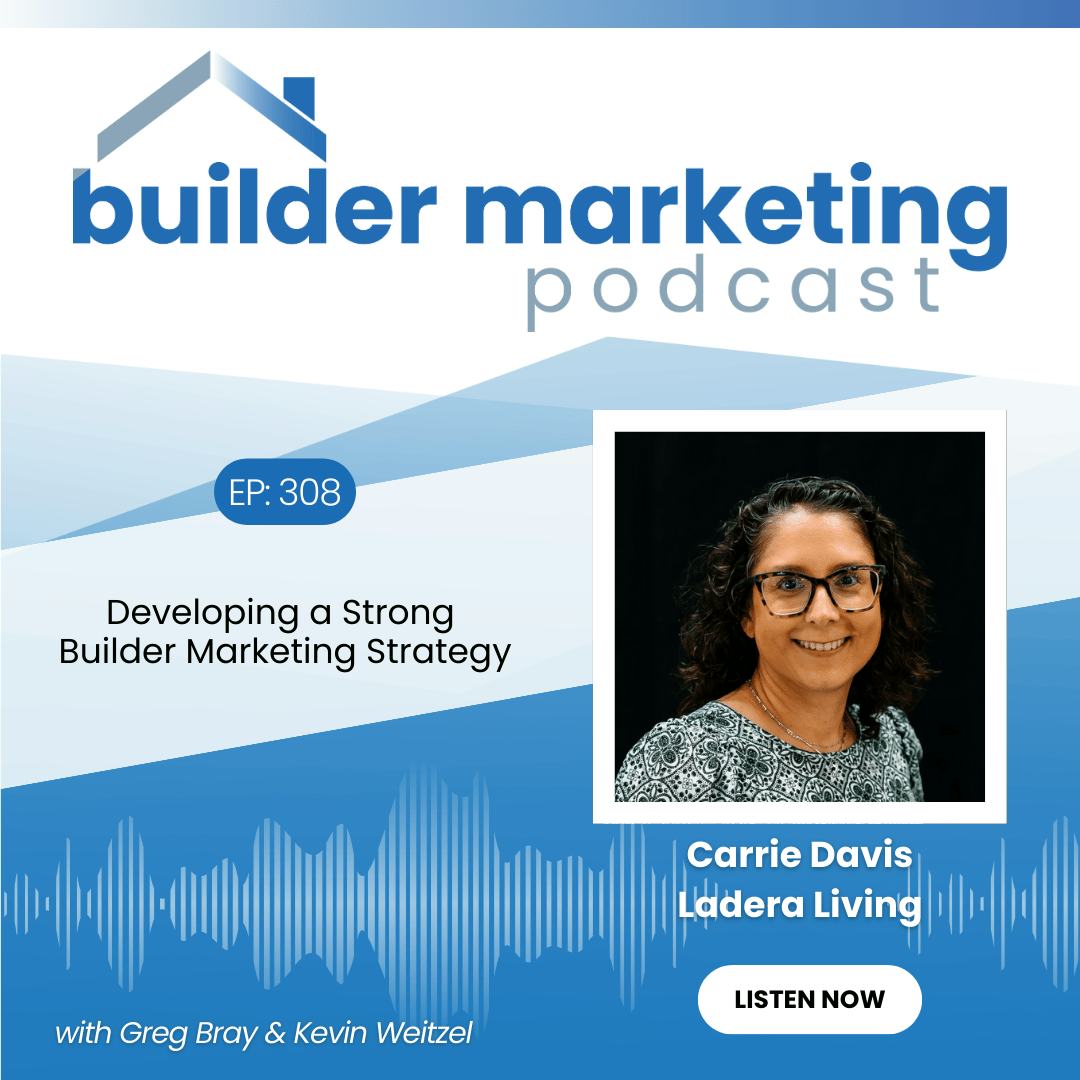
This week on the Builder Marketing Podcast, Carrie Davis of Ladera Living joins Greg and Kevin to discuss how home builders can develop a strong marketing strategy centered on a skilled internal team focused on reaching specific audiences and tracking measurable results.
The foundation of a successful home builder marketing strategy begins with knowing your marketing team. Carrie says, “I think you've got to know your team, first of all. Like, who's on your team and what are their strengths and what are they interested in? I feel like marketers come in three flavors, like Neapolitan ice cream. You want to have all three flavors on your team. You know, you've got your creatives. Those are the chocolate, right? They've got that depth, that warmth. You've got your party people, the events that bring all the excitement, and those are the strawberry. And then, you've got people like me, the vanilla, the data, the analytical types. You've got to have all three types on your team.”
Another key component of an effective marketing strategy is understanding your home buyers. Carrie explains, “But with a home, you know that's your everyday life. That is where your dreams happen. That's where your best days happen and your worst days happen. So, it's about the heart, it's about grabbing the heart. You've got to touch people, touch their emotions. Sometimes it's not about product. It's about can you afford this? Is this the absolute most beautiful home you can afford? Absolutely. Then let's do it. What's stopping you?”
A robust marketing strategy is also data-driven. Carrie says, “You've got to double-check your analytics to make sure you understand where your traffic is coming from. You can't look at first click or last click either. I mean, you've just got to rewire your brain that you're not going to know. Bottom line is you're not going to know where did that person first hear about you, and what was the thing that made the decision for them to actually come in? You've just got to be everywhere. You've got to be in Meta, you've got to be on TikTok, you got to be in Twitter, you got to be all the places you don't think are important because people are there and people have their favorites.”
Listen to this week’s episode to learn how to establish a powerful home builder marketing strategy.
About the Guest:
Carrie has truly enjoyed working in the Homebuilding industry for 20 years. Her degree is not in anything related, so everything she knows has been on-the-job training. She has a passion for Marketing Analytics and getting back to basics in 2026. Carrie is a firm believer in experiential education, servant leadership, and collaboration.
Carrie lives in Colleyville with her husband and 12-year-old son, Henry. They also have a 28-year-old daughter, Briley, who will be getting married next year. They share our home with their three rescue pups, two fish tanks, and more house plants than her husband wants! Carrie enjoys reading, gardening, and time outdoors.
Greg Bray: [00:00:00] Hello everybody, and welcome to today's episode of the Builder Marketing Podcast. I'm Greg Bray with Blue Tangerine.
Kevin Weitzel: I'm Kevin Weitzel with OutHouse.
Greg Bray: And we are excited to have joining us today Carrie Davis. Carrie is the marketing manager with Ladera Living. Welcome, Carrie. Thanks for being with us today.
Carrie Davis: Hi, glad to be here.
Greg Bray: Well, Carrie, give us a little bit of that quick background and introduction. Help us get to know you a little bit.
Carrie Davis: Okay. I have been in home [00:01:00] building for about 20 years in multiple roles. Started off as a salesperson and then just went around, did lots of different things from sales to selection studio, and then got into marketing, and that's my niche. I love it so much.
Kevin Weitzel: All right. Well, let's tackle that, but before we do so, give our listeners an interesting factoid about you that has nothing to do with the home building industry, work, or family.
Carrie Davis: Ooh. Well, I was going to say that my first job out of college was at a therapeutic wilderness camp, so that's kind of a work thing. Let's see what else. I love fish tanks. I have two fish tanks, and I've got lots of different fish, and I keep betas with community fish, which a lot of people don't like to do, but I do.
Kevin Weitzel: I've got four fish tanks, and I've got those little tiny baby shrimp. I don't know what they're actually called. They're just little baby shrimp. Most of mine are all red. I had some blue ones and some orange ones, but now they're all just red. I put some in with my beta, thinking, oh, my beta will just have a snack. Well, it immediately tried to attack the fish, and my girlfriend went absolutely berserk, arms spinning around, and she [00:02:00] went in a panic. But then, after that, the beta just ignores them and just watches them swim around. So, there you go.
Carrie Davis: Yeah, I've got little tiny shrimp with my betas too, and they are sometimes snacks, but also they just cohabitate. They're good.
Kevin Weitzel: Nice.
Greg Bray: So, how did you go from therapeutic camping to getting into marketing?
Carrie Davis: I think at that time in my life, there was no way I was going to go work in an office. The camp was closing down. You know, at that time it was, let's see, early two thousands. As we've seen, there's been lots of documentaries about those types of places. This one wasn't like that. It was much better run. But they just decided it was time to close it down. That wasn't feasible. It wasn't something that was going to survive very long. So, we all had to find jobs. I was like, I can't work inside. And I had a friend who had left, who was now a realtor. So, she was like, come be a realtor. So, I started to be a realtor, and then she was like, I'm going to work for a builder, come work for a builder. So, I went and worked with her. I kind of fell into it by accident, but then I just loved it.
Greg Bray: So, Carrie, as you look at the experience you've had with growing [00:03:00] builders and builders of different shapes and sizes, what has been kind of your journey in the types of homes you've worked with over these various years and the types of buyers that you've been trying to get in front of?
Carrie Davis: I've worked with tons of different ones. The builder I was working with in 2007, when everything crashed down, they had about 30 homes on the ground that were over a million dollars. That was their inventory. Each one was over a million. I was selling at the time the townhome product, which was in the 350's. That was a very high-end builder. I went from them to what was selling at the time was 99,000, little small homes.
That one I was very excited about because at the time, they were doing some stuff that was amazing. They did guaranteed energy efficiency, and they had vinyl windows, and they had blown cellulose installation. That saved a lot of money for those people back then. So, yeah, I've had experience all over the board. And then, you know, as we were growing, we became a move-up builder, and then we did some acre product. So, and now I'm with the 55-plus. So, I feel like I've been all over the [00:04:00] board.
Greg Bray: So, can you tell us a little bit more about Ladera Living and kind of the background of the company there?
Carrie Davis: Yes, it's a 55-plus in the DFW area. It is really a lock-and-leave type situation. They're all gated communities, and it's perfect for Gen X. I know that it's something that, like everyone thinks, retirement village, or they think it's kind of like a nursing home, but this is actually a place where you can have that freedom. You know, it's smaller, it's got great finishes. But if you want to go, follow Fish. Are they still touring? You could do that now that you've got your empty nest.
Greg Bray: Kevin, did she just say that 55 plus is ready for the nursing home?
Carrie Davis: We're not. It's the anti-nursing home. It's the freedom home.
Kevin Weitzel: I turned 55 this next year, Greg, and I'm telling you right now, I eyeball those places all the time, and I'm thoroughly jealous because, honestly, they don't have to take care of the lawns. They don't have to paint the exterior. You basically just go live in the house, and when you want to, just go visit your [00:05:00] grandkids, because a lot of us are having grandkids now, you just jump on a plane and go and leave your whole house. You don't have to worry about anything. I love it.
Carrie Davis: Right? Yes.
Greg Bray: Carrie, with the experiences that you've had, if you're talking to a builder today, what are some of the things that you would ask to learn more about their strategy and where you would want to start in kind of understanding what they were working on?
Carrie Davis: I think it depends on are they a builder with a lot of inventory or not. If they are, and I think that's probably the place a lot of builders are going to be right now, is things that didn't move or, the market shifted. What does the website look like? Do you have a write-up for every single home? Do you have photos for every single home? How are you differentiating that from the others that you have that are available? So, definitely taking a look at the blog, the CTAs. Is that user experience smooth? Is it smooth and easy for people to get in touch with you? So, that's a good place to start.
Kevin Weitzel: Let me ask you this, though, because you're messaging typically doesn't vary. I mean, [00:06:00] we're all still selling, you know, no matter whether they're a billion dollars or you know, 99,000, and you say your second product you were selling was 99 grand. It's still human beings that need to put a roof over their heads, one of the key things we need as humans to stay alive. But does your messaging change? Like, when you went from a million-dollar home, did you just wash, rinse, repeat that stuff? Or did you have to come up with a whole new creative?
Carrie Davis: Absolutely. I guess I'm kind of just going with the assumption that you know your demographic, but yeah, you've got to know who your buyer is. That's why I'm saying the 55-plus is now Gen X, so you want to focus on what speaks to Gen X. You don't do the same thing with them as you would just your regular move up, because you've got to give them those reasons to understand why it's important for them to find this 55-plus community versus just any other community. Because you have your choice at 55, 56, wherever you want to be.
Kevin Weitzel: When you're shopping a luxury car and they talk about how it has massage seats and it has, you know, dual climate zones and cruise control and turn signal assist and all the other snazzy things you [00:07:00] can get on a fancy car, a self-driving mode, and then you go to sell that, you know, $14,000 starter car. I mean, what do you do? You say, Hey, it's got a steering wheel. You know, how do you make the marketing messaging behind selling that basic home something more interesting than it has a front door? Woo-hoo. You know?
Carrie Davis: Absolutely. I mean, you don't want a product dump. Selling a car and selling a home, those are two different things. You're driving your car around, people are appealing to, oh, the status and the clout and all that stuff that comes with cars. But with a home, you know that's your everyday life. That is where your dreams happen. That's where your best days happen and your worst days happen. So, it's about the heart, it's about grabbing the heart. You've got to touch people, touch their emotions. Sometimes it's not about product. It's about can you afford this? Is this the absolute most beautiful home you can afford? Absolutely. Then let's do it. What's stopping you?
Kevin Weitzel: So, you're saying that the memories can still be made around a Formica countertop versus Corian marble?
Carrie Davis: No, [00:08:00] absolutely. Yeah. I mean, the memories are going to happen whether or not you can afford a home. So, that's the thing. It's just like helping people to dream about what is that like for your holidays? How does your family experience that first day of school, the spring breaks? The time that you have off, are you in your garden planting flowers or not? You know, you can do that anywhere. But yes, I think that's still important to mention because people have their hobbies and their fish tanks or whatever that they're going to set up in their house, whether it's a really expensive one or not. So, I think the messaging is, your home, your heart. Draw people in for their heart.
Greg Bray: As you've tried different messages over the years, have you found certain ways to make that more emotional connection as opposed to what you call the product dump? I think we see a lot of product dump out there. What have you seen that has worked more effectively?
Carrie Davis: I think imagery. I mean, it just depends. Like, if you've got a lot of product, you've got to sell homes, you're going to do your socials and all of that stuff, it's just going to be product, right? But if you are trying to do build jobs, you [00:09:00] want to appeal to a different story, and that is creating that space that you want, even if it is a lower-end product. I mean, that takes time as well, and people get to plan and dream about that. So, the messaging is about hope. It's about expectations. It's about creating what you want in your life, manifesting those things.
Greg Bray: There's a lot of work that goes into all that, of course. Most builders don't have thousands of folks in their marketing department. How do you recommend deciding what you want to kind of have on the team in-house versus who do you partner with and maybe potentially outsource to various agencies and other partners?
Carrie Davis: Right. I think you've got to know your team, first of all. Like, who's on your team and what are their strengths and what are they interested in? I feel like marketers come in three flavors, like Neapolitan ice cream. You want to have all three flavors on your team. You know, you've got your creatives. Those are the chocolate, right? They've got that depth, that warmth. You've got your party people, the events that bring all the [00:10:00] excitement, and those are the strawberry. And then, you've got people like me, the vanilla, the data, the analytical types. You've got to have all three types on your team.
If you don't, I think of the three, for me, being the analytical person, I would say the events and the creatives are the easiest to find for outsourcing. Like you've got to have someone strategically minded on your team to drive the strategy, and outsource the creative part, outsource the events part. But if you are not able, if you're relying on your third-party vendors to give you a report on your analytics and how your keywords are doing and all that stuff, without being able to verify it yourself, you're driving in the dark with no headlights.
I think it's very important to be able to trust your partners, but also to verify, to be able to look under the hood, get in the back end, get in your analytics, and make sure are these numbers do they jive? As agencies get big, too, everyone they also have a lot going on, and you can get lost in the shuffle if you don't pay [00:11:00] attention and double-check things. So, I would say if you can only have one marketing person, make that a strategic marketing person.
Greg Bray: Kevin, I'm sitting here thinking what kind of flavor you are. I think I'm going to have to go with a swirl.
Kevin Weitzel: You know, personally, I'm a texture person. I don't like the crunchy things in my ice cream. I want smooth all the way around. So, I think I'm like a caramel or hot fudge and a strawberry swirl in the ice cream, regardless of flavor. I mix with all ice creams. I'm those creamy toppings. Boom.
Carrie Davis: Little marshmallow cream in there.
Kevin Weitzel: Yes.
Carrie Davis: I love ice cream. Andy's is my favorite. I don't know if you guys have that where you're at.
Kevin Weitzel: We do.
Carrie Davis: Oh yeah.
Greg Bray: So, Carrie, when you see people that maybe get their ice cream flavors all mixed up, what are some mistakes that you've seen some builders make with their marketing and made you cringe out there?
Carrie Davis: Just the lack of follow-up. You know, and every time I'm looking, I'm working with a builder [00:12:00] or talking to other people, I just go on and fill out a form. The follow-up is terrible. You've paid for the web traffic; follow up with your leads. The other thing is like TV ads, the Roku ads. Why are builders even considering spending money on television ads? People don't want ads on TV. Everybody has been paying for years for streaming services to have no ads, now the streaming services have ads, I don't know. I don't like the ads at all.
Kevin Weitzel: I think there's one exception, Carrie.
Carrie Davis: What?
Kevin Weitzel: The Super Bowl. I do not follow professional sports whatsoever. And I know I'm a weird dude because I don't fall in that demographic of, yo, my favorite team. It just doesn't work for me. However, I will watch the Super Bowl and fast forward the football for the commercials.
Carrie Davis: So, the ads. And that's an ad event. Like everybody expects that, right? That's a thing that it's become, not sure that it's necessarily having an impact as far as people actually doing something they hadn't done before. If I've never drank Dr. Pepper in my life and I see a Dr. Pepper ad at the Super Bowl, am I gonna go try it? [00:13:00] Probably not. I don't know. That's my take on that.
Kevin Weitzel: Even if Taylor Swift herself is sipping a Dr. Pepper with cherry additive, you're not gonna think about that?
Carrie Davis: No.
Kevin Weitzel: Oh, okay.
Carrie Davis: I'm not a Swifty.
Greg Bray: I just want to go on record and say we are not recommending that builders should be running Super Bowl ads.
Kevin Weitzel: No. You know how much those things cost? It's crazy.
Greg Bray: Yes. More than a house.
Carrie Davis: But it's funny, like when I talk to people, and they're like, really proud, oh yeah, and we're doing a TV ad. I'm like, what?
Kevin Weitzel: Carrie, we have a disease in our home building industry, and that disease is that we are seeing a large portion of homes built by a very small conglomeration of huge companies.
Carrie Davis: Yes.
Kevin Weitzel: And I've never understood this concept. Why is it that when Pepsi and Coke own 99.9% of the soft drink market, why is it that they have to spend hundreds of millions of dollars a year advertising against each other? So, is it that they need to advertise against each other, or do all the small maws and paws need to advertise to be visible in a world of all these Goliaths that they're having to compete against?
Carrie Davis: [00:14:00] When I start thinking about that as it relates back to home building, again, I think it's the decision making of, is this a $5 decision or is this a $250,000 decision? It's a different dynamic. It's a different mindset completely. So, and the equivalent to that would be, what are you doing to create your organic search results? Because that's the visibility that you need when someone's going to go search for 55-plus near whatever neighborhood my daughter lives in.
You've got to come up on those searches, whether it's paid or it's not. Or my mom's talking into her phone and asking about where's the nearest, whatever. You know, that's the visibility that we want to have right now. So, I don't know that big TV commercials for smaller brands are going to do the same as they do for a big brand. I mean, you just kind of expect it from these big brands, but it's not a lever that's pushing people one way or the other, I don't think.
Kevin Weitzel: In full clarity, I wasn't necessarily saying that builders need to be looking at TV. I'll just say in general, how do small builders compete? What are they going to do to compete against these large behemoths that literally can [00:15:00] go in and buy them out of land? You know, they can buy up all the prime dirt. They can buy the prime areas. You know, how does that smaller builder compete in the world of big behemoths?
Carrie Davis: You've got to shift your focus away from where those big behemoths are and down to the bottom of the funnel. You know, thinking of things like, I know this is going to be controversial, Zillow and realtor.com. For us, the last time I had a chance to make a big impact, when it was with the builder I was with, we went with the Zillow Select PC, Select Budgeting, whatever it was, where you basically, they're not sending you any leads at all unless you pay for them.
And so, I would leave those communities as levers to pull later if I needed to get more traffic. But I could see in my Google Analytics that we were getting a lot of traffic through Zillow. It was coming from Zillow. Now, in my area, we have mostly realtors bringing the clients in. But that's not because the realtors found us, it's because the clients found us in Zillow, realtor.com, Trulia, or whatever, and they would [00:16:00] send it to their realtor. I want to go see this, and the realtor would call us and make the appointment.
So, that's the way to stand out with these behemoths, yeah, they're going to have that recognition. People know who they are, they're going to have these big realtor followings because they'll pay those realtors extra money and whatever, but you've got to be where the customers are when they're looking. They're on their phones, and they're getting those notifications from Zillow and realtor.com. I mean, they get set up, and they just get a little ding, oh, here's a new listing in your neighborhood. So, you've got to keep that bottom of the funnel stuff fresh.
Greg Bray: So, you mentioned there, Carrie, the idea that you were using your analytics to actually understand this relationship and this connection. And so, when your boss comes to you and say, we don't need to do marketing because realtors bring us all our leads, you've got some data that says, well, wait a minute. There might be a little bit more to it than that. What are some of the things that you look at on a regular basis in your reporting, and some of those, you know, metrics that you're tracking?
Carrie Davis: Right. So, I would say I haven't always done it. I'd say I started doing it in the last maybe six [00:17:00] years. Every single community, every single month, I would look at traffic to lead, the lead to appointment, appointment to sale. And that's not just the OSC leads, but also the walk-ins. Tracking all of that and using your website as the benchmark. So, you don't need the outside industry information; you just need your own benchmarks. What's my benchmark? So, this is the whole website, average of what we're doing, and then by community, is this community specifically above or below the benchmark?
And you find that some communities you're going to have to spend more money to get more awareness to get people there than others. Others are just naturally going to draw more. That goes back to the, was it the four Ps. The price, product, location, all that stuff. So, you have to try a little bit harder sometimes with different ones. Then you have these levers that you can pull. Oh, I'm going to pay for the leads here for this community this month, because they're not getting as much traffic. And then those Zillow leads that come in, you might pay for 10 leads, and it might be a thousand dollars, but those are good leads when they do come in.
You've got to double-check your [00:18:00] analytics to make sure you understand where your traffic is coming from. You can't look at first click or last click either. I mean, you've just got to rewire your brain that you're not going to know. Bottom line is you're not going to know where did that person first hear about you, and what was the thing that made the decision for them to actually come in? You've just got to be everywhere. You've got to be in Meta, you've got t be on TikTok, you got to be in Twitter, you gotta be all the places you don't think are important because people are there and people have their favorites. Like some people are only Meta, some people are only Twitter, some people are only TikTok, and some people are only realtor.com, and some are only Zillow.
Greg Bray: So, for that smaller builder who's maybe overwhelmed trying to deal with all of that, is there one place you would recommend starting? What type of tip would you give there?
Carrie Davis: I would say Zillow. Well, MLS. If you don't have your houses on MLS, start there for sure. But if they are, then I would start with syndicating your communities through Zillow, and they have a pretty low entrance point for the PPC select. You [00:19:00] don't get all the leads coming straight to you, but that's okay because the traffic will come to you from Zillow's page.
Greg Bray: So, in today's world of shrinking budgets and small staffs and everything else, we're always looking for efficiencies. What are some ways that you've found some of these new AI tools to help you better improve what you're able to produce and deliver for the marketing team?
Carrie Davis: I think it's great. I love ChatGPT. I love Jasper. Sometimes I'm at a place where I get to pay for those things, and sometimes I just do the free. You know, I think there's a lot of negative or nagging on real on marketers who use it. But who cares? Like is it effective? Yeah, I think so. Because how many times when you have a lot of inventory that you're trying to do social posts, how many different ways can you say three bedrooms, a kitchen that's gorgeous? Type it in a ChatGPT, say, you know, optimize this for meta, optimize this for Twitter, optimize this for Instagram, and it'll spit it back out to you, and you can copy, paste. It saves [00:20:00] time.
When these tasks are repetitive, your creativity just slowly dwindles. It just gets harder and harder over time, like if you've got to get this done, you know, in a short amount of time. If your builder tends to build the same floor plan over and over, well, how many different ways can you think of to describe that floor plan? If you're doing a lot of it, you've got floor plan A in every community, and you've got more than one in every community. You've got to have something to draw people in. They don't want to keep reading the same descriptions over and over.
If you're doing it right and you've got buyers on your website for more than a minute, they're going to read more than one description. So, they catch onto that pretty quick if you're just phoning it in and copy pasting everything over and over. So, yeah, it helps to keep that copy fresh. You can use it for your Meta ads, especially if you're using the dynamic creative, you've gotta have five different copy, five different headlines, five different descriptions. Type one version in, and then have ChatGPT give you three more, four more.
Kevin Weitzel: Is there gonna be a home that's gonna do something outta left field like that realtor out of Florida that [00:21:00] Breanna Banaciski that does those sarcastic videos where she talks about, look at this home, looks like a murder scene. You know, and then she walks you through, and she uses some expletives in there, of course, as well, but she's getting like crazy, crazy visibility. Do you think that she just was magical at hitting that creative at the right place, right time? Or do you think there could be a builder that could emulate that without being cheesy and possibly without offending?
Carrie Davis: I feel like realtors have a better chance at that than builders do. Yeah. I think it's easier. A builder, it's difficult because you spend all this time with your brand, building your brand and having it be one way and, you know, a couple weird videos can make people go, what? What does that mean? I think we've seen a few of those where brands get canceled because of one video that went awry. Yeah. So, yeah, I think you got to be careful with that for sure. But can you do something fun? Absolutely. Something different. I've seen salespeople wear a Grinch costume and tiptoe around their little house during Christmas, and with their Christmas decorations up, and that's fun. That gets lots of views [00:22:00] too.
Greg Bray: Well, Carrie, we appreciate the time you spent with us today and the thoughts you've shared. Do you have any last thoughts or words of advice you'd want to leave with our audience before we wrap up?
Carrie Davis: Yeah. I'd say, if you've got a marketing team and you want to get things more up to your expectations, then revise your expectations. Marketing is omnichannel. You can't make decisions based on first click and last click, and really understand your team, like the people that you have working for you have strengths and weaknesses. They have interests and want to grow in different ways. Where can you support them growing that's going to benefit the company. So, find out what is it they really want to do and help them to do it, and you can have a much stronger team.
Greg Bray: Well, thank you again, Carrie, for being with us. If anybody wants to connect with you, what's the best way for them to reach out and get in touch?
Carrie Davis: I've got all my information on LinkedIn, so they can be friends with me on LinkedIn.
Greg Bray: Awesome. Well, thank you, everybody, for listening today to the Builder Marketing Podcast. I'm Greg Bray with Blue Tangerine.
Kevin Weitzel: And I'm Kevin Weitzel with OutHouse. Thank you. [00:23:00]