
EP: 19
Marketing Psychology & Influences on Consumer Decision-Making
With Tim Curtis
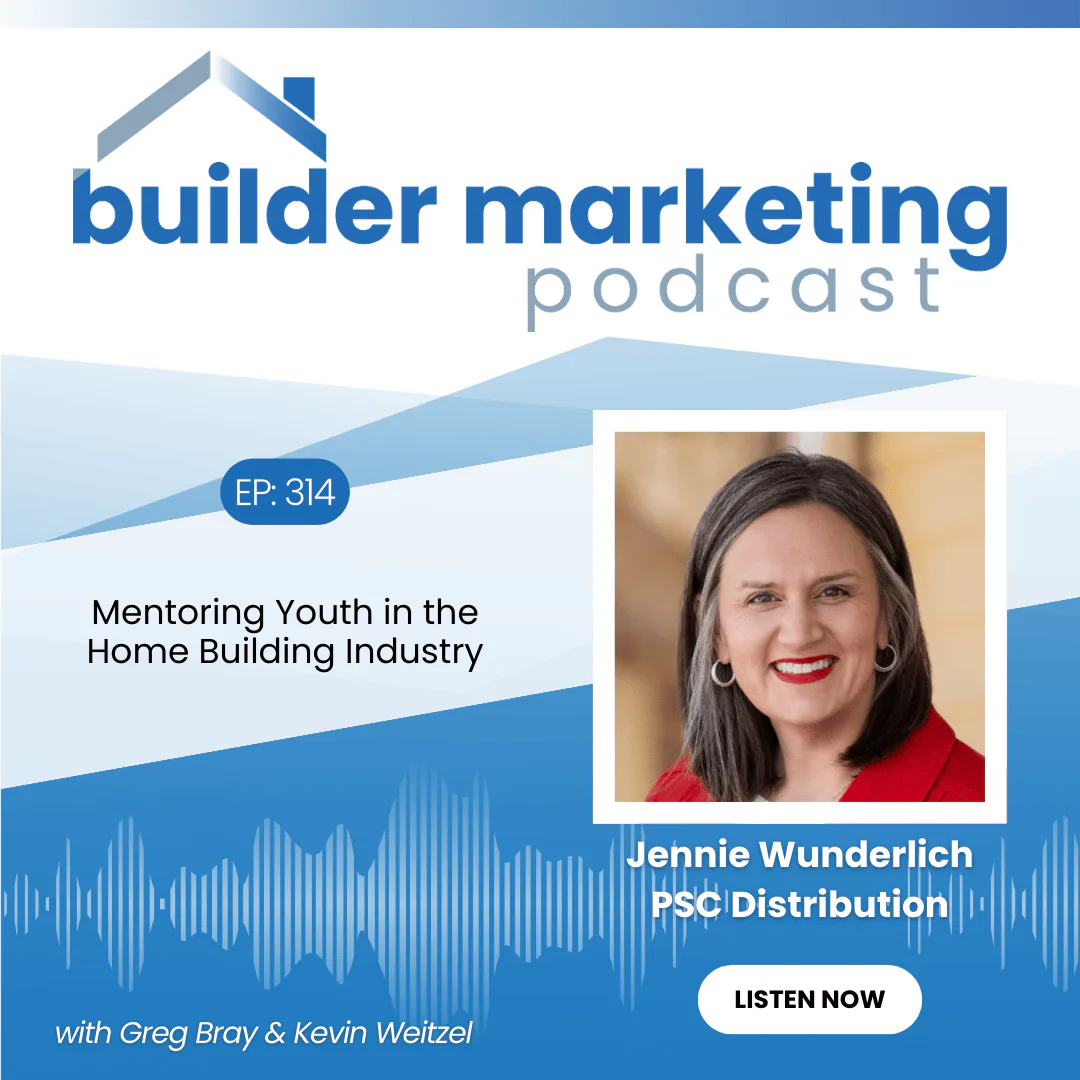
This week on the Builder Marketing Podcast, Jennie Wunderlich of PSC Distribution joins Greg and Kevin to discuss how home builders and those in the trades can help shape the future of the industry by mentoring young adults through workplace shadowing and professional training.
Youth graduating from high school are often missing basic competencies needed to transition to the workforce, and Jennie wanted to help make a difference. Jennie says, “We are really hurting for workforce. They also said the problem is a lot of the kids that we're getting, especially if they're young, are really struggling with basic soft skills. And so, I said, well, what can I do? I kind of noodled on it a little bit of like, what if I created a program where youth could go job shadow with home builders' association members, with builders, plumbers, electricians, all of them. So, I said, what if I created a day of professionalism training, if you will, and they had to go through all of this. Each year, we've tweaked it a little bit, but that was the impetus behind the program. And I called it Grow and Connect because I wanted these youth to grow, but then I needed to connect them with opportunities here. So, that's how the program was born, if you will.”
Those interested in participating in this type of mentoring need to have a big heart and understand that it isn’t always easy. Jennie explains, “But kids are tough, and meeting with them all day and overcoming those obstacles, not getting visibly frustrated with them when you're like, what is going on here? And then realizing though, you'll come to care about them. So, make sure you have a high helps sort of gene and that you enjoy that, but also have somebody really organized on your team that helps coordinate…you really need all the pieces to not overwhelm yourself or feel really frustrated, because then you won't continue. So, you kind of really want those things in place.”
Jennie says, “Even if it's not this program, our youth very, very much need mentors, and you can find a way to connect. Because you have something to give, if it's just to care, to ask those questions, have them share with you. They really do want to grow and provide. Well, they don't want to grow. No, they do. They're afraid to do it. They don't know how to do it. They want to.”
Listen to this week’s episode to learn more about how to guide the next generation of home building professionals.
About the Guest:
Jennie Wunderlich is the president and fourth-generation co-owner of PSC Distribution and Studio H2O Kitchen, Bath & Lighting Showroom in Iowa City. An Army veteran and West Point graduate, she returned home after her military service, humbled and grateful for the opportunity to learn, grow, and help lead her family’s business alongside her cousin and her husband, Ben.
As a community small-business leader, Jennie is passionate about strong, values-based leadership and about supporting the people who keep local communities thriving. She is actively involved in her local and state home builders associations, where she serves in leadership roles and works to strengthen the building industry and advocate for its future.
Jennie also has a heart for youth development. She leads her children’s 4-H club and regularly shares with young people about opportunities in the skilled trades, business, and military service, encouraging them to overcome challenges and pursue their full potential.
Jennie and Ben are raising their three children—two teenage daughters and an elementary-aged son—on a small farm in the Iowa City area, where life includes two fun dogs and a flock of 4-H chickens.
Greg Bray: [00:00:00] Hello everybody, and welcome to today's episode of the Builder Marketing Podcast. I'm Greg Bray with Blue Tangerine.
Kevin Weitzel: And I'm Kevin Weitzel with OutHouse.
Greg Bray: And we are excited to have joining us today, Jennie Wunderlich. Jennie is the president and co-owner of PSC Distribution. Welcome, Jennie. Thanks for being with us.
Jennie Wunderlich: Thanks for having me. I'm excited to be here.
Greg Bray: Well, Jennie, let's start off and just get to know you a little bit, give us that quick background and overview about yourself.
Jennie Wunderlich: Sure. So, [00:01:00] I was born and raised in Iowa City and after graduating from high school, headed out east to West Point and spent some time as an army officer, a lot of leadership training, some time overseas. And then I was pregnant with our first kiddo and my dad said, you can come back and learn the family business in Iowa, and if it's not for you, that is just fine. But I was married at that time and still married to my incredible husband, Ben. I met him at West Point and so we both came back to learn the business. Now we're still here. So, I co-own the business with my cousin. We're the fourth generation, and my husband works here as well.
And so, part of our business has a kitchen and bath showroom. So I spent a lot of time interviewing people. There was also hiring and firing involved and then getting involved with the Home Builders' Association was a primary part with this role. Then talking with a lot of fellow distributors as well as just other people in the building industry getting involved that way, and just passionate about youth, leadership, service. So, I'm a [00:02:00] 4-H leader and our kids do 4-H now. So, a lot of things trying to just help people connect with opportunities.
Kevin Weitzel: Well, this is the part of the show where we go into, it's a show now, Greg. It's not just a podcast, it's a show. This is the part of the show where we actually go into an interesting factoid about yourself. However, I have to make a slight change because you already said a whopper. You said that you went to West Point and you were an army, so we're going to eliminate that too. So, here's what we're going to do. We need an interesting factoid for our listeners about you that has nothing to do with work, family, the home building industry or army life. Break out with it. What do we got there, Jennie?
Jennie Wunderlich: Goodness, I am all about musicals. I can definitely break into some random musical songs. I might do that in all sorts of different cases, especially like the Music Man, which is from Iowa. So, I would say I love musicals, love singing along and always wanted to be, you know, on Broadway back in the day. So, there's your random factoid.
Kevin Weitzel: So, it sounds like you have skills and they're multiplying.
Jennie Wunderlich: Nice. Grease. Well [00:03:00] done.
Kevin Weitzel: We had a gal Veira Builders out in Florida that also was into the musicals. I think I gave what, eight musical references, Greg.
Jennie Wunderlich: Impressive. Well, my son also plays trombone like I did. Not 76 of them, but, you know, we just kept going.
Greg Bray: That's awesome.
Jennie Wunderlich: This is going to be my new challenge. Okay.
Greg Bray: Well, Jennie the quick background about your company. You mentioned a little bit, but tell us a little bit more about who you guys are working with and the types of services you offer.
Jennie Wunderlich: Absolutely. So, started as purely plumbing wholesale distribution back in 1951, and then it has branched from there into HVAC distribution as well. And then my dad was also the dreamer around the kitchen and bath showroom space. So, we've been a Kohler distributor for a long time and now have almost 7,000 square feet of showroom with cabinets, countertops, a lighting showroom, accessories, saunas now, so that has been fantastic. When I took ownership, I actually headed down to the warehouse to work, because that's what I did on one of my deployments in the Army and I love that [00:04:00] as well. So, we just distribute all over pretty much the eastern half of Iowa out of a single location. We have about 50 employees. We're doing well. We're pretty thankful, but that's kind of a day-to-day for what we're doing.
Greg Bray: Awesome. And I'm sure some of our folks are listening going, this is a little different because we typically are talking to builders. Right. But one of the things that got us really interested in kind of having you on the show is you've been involved in some workforce development and employee development efforts that are really inspiring and intriguing. So, we wanted to dive a little bit deeper into that. So, what got you interested in that and kind of there's an opportunity to make a difference here?
Jennie Wunderlich: Absolutely. So, I was part of the Home Builders' Association and I was part of different subcommittees and I knew I was coming up on the leadership ladder. I was going to be the president at some point, and I really don't like to be part of groups just to be part of groups. Like, and we all can do that, right. But I'm like, I want to make an impact, trying to ask people in the organization what would bring value. What could I do to bring value? And they're like, honestly, you could help us with [00:05:00] workforce. We are really hurting for workforce.
Well, that's also a big ask in some ways too. I'm going, how on earth can I use either my gifts, experience, things like that to help with workforce? They also said the problem is a lot of the kids that we're getting, especially if they're young, are really struggling with basic soft skills. That is something that I have worked hard to train with my team and my own kids. You know, the military impacted that a little bit, as well as just my mom to be honest. And so I said, well, what can I do?
I kind of noodled on it a little bit of like, what if I created a program where youth could go job shadow with home builders' association members, with builders, plumbers, electricians, all of them. And so, I talked to some of those friends of mine that have those businesses. I said, Hey, would you take a kid for a shadow? And they're like, well, the problem is the kids that come, either they don't show up, you know, even things like they don't take their shoes off when they go in someone's home. They don't know how to talk to people by looking them in the eye. I'm like, okay, okay.
So I said, what if I created a day of [00:06:00] professionalism training, if you will, and they had to go through all of this. Is this a guarantee that they will do it with you? Absolutely not. But it will be top of mind for them and give them tools, very specific tools on hand. Maybe. In all honesty, they're friends, right? So, they're like, okay, Jennie, we'll try this for you to see what happens. Thankfully, they were wonderful. Are we learning? Each year we've tweaked it a little bit, but that was the impetus behind the program. And I called it Grow and Connect because I wanted these youth to grow, but then I needed to connect them with opportunities here. So, that's how the program was born, if you will.
Greg Bray: So, is this aimed at like high school age students? Who's kind of your target?
Jennie Wunderlich: The first year I did it, I started it with, I was like, Nope, they need to be 18 because I don't want to worry about, honestly like, approval from parents. So, I started with that, and then the builders were like, uh, can you get them younger? This is a little late. I'm like, okay, I can try. Well, then we figured out how we had to get waivers for parents, and so then we went down to 16. There's [00:07:00] some that we have that have graduated and some that are still in high school.
To me, it's whatever works with the group you have that year. Whoever happens to come, you know, we had some homeschool kids. I don't care if they've already graduated and they've, you know, kind of been floundering around for a year or two. As long as they will show up, do what we ask them to do, and work, you know, for them to get to have these job shadows without any sort of commitment, it's not going to hurt their resume. Great. I don't care if they're 23. I mean, they could probably be older, but that'd be a little strange.
Greg Bray: So, why is there this need? Why are we struggling to even have kids interested in this industry? What have you learned as you've kind of been going through this and talking and kind of recruiting for this and things like that? Where's the disconnect that you've found?
Jennie Wunderlich: Oh, goodness. Quite a few different spots, I would say, parents, a lot of times if they are not in the trades or a builder, they just don't think about it. It is not top of mind. You don't see it on billboards necessarily. I'm in a university town, so University of Iowa Hospitals and [00:08:00] Clinics is here, University of Iowa, that's a major four-year university. So locally, that's what's pushed. I understand, but at the same time, there are a lot of students that might not be the kicker, but their parents don't know about it. They haven't heard about it. That's not in their wheelhouse.
And honestly, in the schools, like in high school, they don't really talk about it. Until, in the past two years, we've restarted locally a student built home project, which has really, really helped at least get it top of mind for students. But trying to get in with counselors because sometimes they're like, well, the only thing I know of is the unions. There's so much more. There's so much more. And there are a lot of local businesses that aren't affiliated with the union that would love to hire and will train and mentor. So, I think a lot of, just a lack of information. Maybe a stigma too, right? Oh, blue collar or probably can't make anything doing that.
Or now, unfortunately, I want to be an influencer. People have come through and that's what they're going to be. I'm like, well, and maybe. See, you two are influencers here with your podcast. But, [00:09:00] like what? You know, I want to be on YouTube and TikTok and make a million dollars like everybody does on here. And trying to be like, that's so rare. So, so, so, so rare. And having a job you could do with your hands. In Iowa, we unfortunately got rid of shop class a while ago, and we're trying to get that back in schools because the kids that really like to work with their hands, maybe don't have that opportunity.
Kevin Weitzel: So, number one, Greg, where are you keeping these millions of dollars of people make for these podcasts because I haven't made a penny on this thing yet? We've been doing this almost six years, brother.
Greg Bray: Kevin, you're co-host.
Kevin Weitzel: Much smaller percentage of the zero. Zero times zero. Yeah, I get that.
Greg Bray: Actually, I give you 90%. Don't you know that?
Kevin Weitzel: Oh, is that what it is? 90% of zero is still zero, man. Alright, so Jennie, let me ask you this. So, what you're going to tell me is that in Iowa, you guys don't have a program that puts billboards next to the be all you can be and the few and the proud billboards that, you know, the government spends millions and millions of dollars on? You don't have billboards that are grabbing people and giving them a [00:10:00] pathway to the blue collar jobs?
Jennie Wunderlich: Unfortunately, no.
Kevin Weitzel: And with that, shame on the public school system for getting rid of shop because music and shop and the humanities are literally what make us human beings that we are. You know, you can teach the basics all day long, but until you expand the horizons, I think you're truly limiting the potential of the humans that we're raising.
Jennie Wunderlich: Yeah.
Greg Bray: So Jennie, as you've been building this program, learning and things there, what have been the reactions from participants, both the students and the builders and other trades that have been mentoring and inviting them in?
Jennie Wunderlich: Yes. Can I give a couple examples? Otherwise, it might be hard to explain because it kind of depends on the activity. So, we do a few different things during the day and having them go over and practice everything from eye contact. Like, well, how long do I look in someone's eyes? Like, just long enough to say what their eye color is. And we practice web to [00:11:00] web handshake, and they have to do it here in this room that I'm in actually is where we've been hosting it and practice, and then they are awkwardly trying to shake hands. I'm like, Nope, you're grasping too quick. You got to go deep. Go all the way in.
Posture, all these things that unfortunately a lot of them were like, this is uncomfortable. I've never done this before. I'm like, that's okay. We own the fact that we're uncomfortable. We own the fact that you're going to feel awkward, so is everybody else in this room. I make them move with a purpose. I do a lot of role play. So Greg, I've now hired you. I'm paying you $25 an hour to go move, let's say this carpet into this home to install for this lady. And then I show like, oh, pretend you're on your phone. Right?
Because they can't have phones in here, and that throws them off. Why can't I have my phone with me? Like, well, because I tell you what, I don't want to pay you to be on your phone. And then I pretend like, well, do you want to pay this person over here? Do you want to pay Emily to be on her phone when she's supposed to be moving this or the other?Well, no, like, but you're just glancing down. Well, how many times do you glance down? You know, a lot of those things, and it's so [00:12:00] fun to watch it click. Talk about facial expressions. I used to get in trouble during basic training in the Army because I like show a lot on my face. Well, I was in show choir for goodness sake,
Kevin Weitzel: Sister, you preached the choir on that one. I got in a lot of trouble in basic training for that.
Jennie Wunderlich: Right? Yes. So, showing them people are going to make that really fast if you're like, whatever. I don't want to do this. My face is just showing this negative attitude when these employers are asking you to do something or customers are asking. Goodness, it makes a big difference. So, watching them embrace that. I don't know if you've seen those giant Post-it notes, they're like three feet high maybe. And they each get a giant Post-it on the wall behind here, and it's for them all day.
We end up doing a personal SWOT analysis. They've probably never done a SWOT analysis before. Hey, what are your strengths, weaknesses, opportunities, threats. After doing a personality assessment. Sometimes they did them in school but didn't necessarily think about them too much. And so, no, let's dive into this. Really, what are you great at? What makes you tick? What fires you up? Okay, let's put it on here. Now, [00:13:00] how can we connect that with different opportunities that we have if you're an attention to detail person.
We do talk about appearance. What do you wear when you walk into this interview or this job? Is your shirt wrinkled? Is it clean? Did you just roll out of bed? Have you taken a shower? These very, you'd think simple things, but I share it from a perspective of a boss and people that I've hired and those I haven't and why and how they showed up and all of those different situations that may happen. We talk about characteristics of a great employee. They're not clock watchers. They're growth minded. They're a team player, trustworthy, humble, respectful, positive, all of those things. They have to give examples.
One kid, he's like, well, I work at McDonald's. It's super frustrating when the guy before my shift, like leaves all the stuff out, doesn't clean up, you know, before me. I'm like, okay, so let's talk through this. Right? So, you want to be the one hopefully that doesn't do that for someone else. Not just complains about the other guy, we can tell the sort of mentality of [00:14:00] victim. I've seen quite a bit and trying to help them get out of that. Okay, let's focus on what you can change, which is you. Who can change you? You can change your attitude. So, that has been fun.
I know the people on the podcast won't be able to see it, but this is one of the best activities we do. So, I brought these nice like technic car Lego sets. So, they've done all this stuff in the morning, we have lunch and then I pair them off. And I said, okay, you two, you are going to start putting together this Lego car as fast as you can. You both have to work on it. and you need to do it completely as the instructions show. Go. Right? So, they're all competing in this.
Well, then as I got tougher each year with it, then some of them are at different stages. I would swap them in the middle, so then they'd have to switch people and switch cars. Oh my goodness they're frustrated. Like, this is ridiculous. This isn't the one I've worked on. I said, okay, here we go. Nope. Switch it. The first year, Ephraim, [00:15:00] he got about 85% done, he and Emily, and Emily really didn't say much. He did it all. He was starting to take it over.
Nope. He said it's fine. it's close enough. I said, Ephraim, it's not done. He said, it's close enough and he's getting super agitated. I said, Hey, you have all the instructions here. Work with Emily. Figure it out. Sure enough, it took him about another 20 minutes and he got it done and he's feeling so good. I said, okay. So, this is just like when you're gonna go to your job shadows or a new job. You have to work with someone you don't know, they didn't know each other before today, on a task you haven't done before, but you're going to be given instructions and you need to do it completely all the way to the end as asked. Okay, this is what you were talking about. Got it. And just helping them in a new fun way, doing a Lego car. Think about this because you're going to have those things. So, that has been great.
We had a panel, so let's say you two gentlemen and two more or whatever from local businesses and the HBA builders and things would come in and they got to share. And then they got to go to these giant post-it notes with each kid, and talk to them about their strengths, weaknesses, opportunities. That's how [00:16:00] these business owners are like, I am all in on this. Watch what these kids are doing and learning. Yep. I want them to come shadow with me. This is awesome. Let's do it.
And then I also have two forms they have to fill out when they go to the job shadow, because we talk a lot about feedback. Youth today really have a hard time taking feedback. Don't we all though? Like, how many of us would be like, okay, the end of this podcast, Greg, Kevin, tell me everything I could have done better. Well, one of them, I know I'm talking too fast, but, okay. So, how do we say, what could I do better? Or if you give me negative feedback, how do I take it?
Typically we get defensive. I'll give feedback and they, well, it's fine. Let me give you like da, da, da. No, let me think. Stop for a moment. So, they have to meet with a supervisor. And one of the things they have to fill out, they have four questions in order for them to get paid, they have to do both of these is what could I have done differently? What could I have done better? And I said, I'm looking for four sentences here. I'm not looking for nothing. Right? I said, they said I did fine. Like [00:17:00] no, ask them really? And you have to write what professionalism skills did I witness at this job where I shadowed. So just helping them process this.
Then they have to meet with a principal in the business. So Mr. Bray, how did you get into this business? What professionalism skills did you need to have? So, then there's some buy-in from the owner as well, because they're getting to share how they got to this process. So, at the end of the week, they have to submit those for us to the HBA for them to get paid. The businesses pay the HBA $150 and if they show up every day they're required and they work and they do this, then they get paid $150. Now that could be different wherever. Some people won't pay, it's fine. This is just what we've decided to do.
Kevin Weitzel: So, I have a solid question for you because you brought up something that's interesting to me because I see this, and not to lump everybody into one group, but there's a lot of apathy. There's a lot of just this, I don't care about anything. I mean, we get these kids coming to school that literally have zero skills, zero aptitude to want to learn anything new, no interest in anything [00:18:00] other than, oh, who's this influencer, which you mentioned. How are you attracting those kids that have zero aspiration or goals or anything? Like, they don't know how to read a tape measure. They just barely eeked through school. They don't know the basic math that's involved in reading the dimensions of a floor plan. How are you tackling that aspect of it? I'd be interested to know that.
Jennie Wunderlich: Yes. So for me, it's been a couple really good contacts at the high school who they know those kids. So, Mr. Johnson is like, I know kids just like you're describing, and those are the ones that I want to introduce you to Jennie. I want you to come and try this program. So, it has to be people that know them in the space. Because you're right, otherwise we wouldn't get them. I would say of anything that's probably the biggest weakness in the program right now is trying to figure out how to get more students or even students that just don't know what they want to do but have never really worked with their hands and it might be for them.
I feel like, there's these almost kids floating out there. There's the apathetic ones. Yes, but there's ones that might not be [00:19:00] apathetic, but they know they don't really want to do more school, four year university, study math. But I guess I'll just find a local job. I don't know. Like they're just kind of unfortunately on their own and their parents or one parent might just be working their tail off and not have time to say, well, what else is there out there? And you might not know. I mean, that's the biggest thing I think is trying to get more connected. I wish I had a better answer on that, Kevin.
Greg Bray: Well, Jennie, let's look at this a little more from the builder or trade owner's perspective. Do they come at this from a, this is going to make a difference, or is this like, oh, it's like a service project for the day kind of? Or are they actually saying, Hey, you know what, there's real opportunity here for me to help my own company be better in the future?
Jennie Wunderlich: I'm incredibly blessed that I have wonderful businesses in our HBA that genuinely are like, this can make a difference. So, maybe if I cast a little wider net, I would have more of the, well, okay, this is where I can check the block and say I'm doing something, you know, [00:20:00] that's good for the community. That isn't who I've been able to connect with. Our best story is probably an electrician in the HBA reached out to that first year and the gal that we connected with him, so she comes through and in all honesty, and she'd tell you this now, like she, couldn't look up. Her shoulders were hunched. She had a trouble in school, a lot of other things.
And she came on senior skip day to meet with me, like, as a senior, which said something to me and she is like, well, I think I wanna be an electrician. I'm like, okay, Emily. That's cool. Well, we have some different opportunities. She came to the day of professionalism training, and it was very, very unique and she learned to kind of come out of her shell a little bit. She first job shadowed with a plumber. She's like, oh, I want to be a plumber. I'm like, what? And I think she hadn't maybe had that many positive experiences in a work environment or something.
And I said, okay, Emily, that's great. How about we still try the electrical just because I have that job shadow lined up and you said you wanted to do [00:21:00] that when I first talked to you? She said, okay. So, Grout Electric and Kyle, the owner, he and I went to high school together. We were actually in show choir together. He wouldn't like people to know that, but he is actually a phenomenal singer. Anyway, so he's like, sure, she can job shadow here.
She didn't really know what a two by four was, but she showed up every single day, did everything we had talked about in the program. She was professional, responsible, trustworthy, all the things, and Kyle told her at the end, she says, no, I want to be an electrician. He said, okay, well you need to work for me for a year. You do that and then I will put you through school for this. And she is, and now she's in her second year of training. She's an electrician installing lights in our showroom. Sorry, Kevin.
Kevin Weitzel: No, no, no. So, that's actually a great example, and that segues into my next question, which is this. Do you have builders and/or trades that have found so much success in your program that they actually push it forward in part of their identity of who they are as a builder or a contractor or whatever? Do any of them say, over here at x, y, z homes, we took Timmy. Timmy was a dumbass and Timmy had no [00:22:00] pathway forward in life. He was just born to be a loser and look what we transitioned him to. He's our best framer we've ever had, blah, blah, blah. Do you have any of that?
Jennie Wunderlich: No. If I'm honest, we don't. Kyle is just such a good, humble guy. Like he doesn't share it all. He doesn't say, this is what I'm doing. And it good and bad. The program, we're not great at marketing. I'm so excited because I would love for people across the country to reach out. Like I'll just give you all the curriculum, tweak it how you want it. This is about getting as many programs to help if it will in your space. But it's funny. No, they do it all on the down low. And we're young, right? We're four years in maybe. I'm still learning. This is definitely a trial and error each year.
Kevin Weitzel: So, builders, trades, the HBA, you're not getting the buy from them to where they're promoting these programs as part of who they are as an identity as a company?
Jennie Wunderlich: Yeah. So the HBA has. Again, it's new and new is scary. So, the people that are in it with me that have done it are so great, and every volunteer is like, this is great. We are trying to [00:23:00] figure out, thankfully we haven't happened, what if something would happen to a kid on the job? So, then there is a little bit of, we're trying to figure out maybe even with NAHB's help, how do we have protection for businesses if, you know, Bobby's not being smart and does something that he shouldn't do.
Unfortunately, people just sue people left and right. Where for the first few years I didn't think about things like that because that's not top of mind. So, now those questions that we're getting bigger are arising. So, we're still trying to navigate that going, okay, how do we protect the builders that want to do this when there are rules and you know, I get it, labor laws? But that's definitely something, you know, maybe someone listening to this is like, Hey, I'm all over that and I did something and it worked. Great. Wonderful. Maybe they'll reach out to me and give me some tools.
Kevin Weitzel: Well, Greg is just about to release a commercial on the socials. It's going to be something along the lines of, I haven't seen the final cut yet, but it's, you know, over here at the Builder Marketing Podcast, we took this hairy schlep, this monster of a man that was literally on his pathway to living [00:24:00] in a gutter, and he became the co-host of this wonderful podcast. And look at the success we've had with Kevin. Boom. Greg, when is that commercial coming out?
Greg Bray: As soon as we get the budget approved. Yeah. Well, Jennie, I know HBA here in Atlanta, where I'm at, they do an annual career day kind of thing where they do the little booths and the students can come and, and kind of ask some questions and things like that. How would you compare this, from a pros and cons and things, you know, this type of a program compared to more that exposure career day kind of concept?
Jennie Wunderlich: Absolutely. And we have that here, Build My Future, which is outstanding. And I would consider that like the shotgun blast. Where I am trying to be a sniper, like I am going after very targeted, these six to 12 students per year. Okay, like dial in deeper. I mean, there's some hard things when they're putting up on the wall and they have to go all about themselves first and the number of kids coming through.
Like one of the first [00:25:00] things is kids listen, no dad. Right? And that just hurts. Like that just hurts like crazy. But they're diving deep into like what do they view as their identity. That's different than, hey, we're doing a nailing competition, which those are fun. Gets kids with hammers and all that stuff. I feel like this is a deeper dive into kind of helping them unpack, and the tools I'm talking about aren't just for the building industry, right. It could go anywhere for them. I just hope that they would connect with these opportunities.
I love Build My Future and those big events because my daughter even was like, mom, this is kind of cool. I didn't realize I could do this, that, or the other. And it hits a lot of kids on a variety of topics much, much bigger than what I can do in this small space. This is can go along with, but definitely does not come close to, maybe even different missions. I would say.
Greg Bray: Now, I know Kevin's a big fan of The House That She Built and trying to get more women in the trades. Have you found a difference in which gender is interested in this, or do you feel like it's kind of across the board?
Jennie Wunderlich: No, [00:26:00] absolutely. There's more guys or at least are interested from when I speak with them. And I think trying to help people realize that, like, I consider I'm in the building industry, but I'm on the distribution side of the house, right. And then I'm in the showroom. There are so many opportunities in the building industry that don't necessarily involve swinging a hammer for whatever gender. But helping, girls especially say like, oh, you're in the building industry. Like you have this flag pin with this hammer on it. What is that about? Like, okay, let me tell you. And if you want to swing a hammer, awesome. Do it. I love building a birdhouse with my grandfather. Like there I have so many wonderful memories of building that I'm thankful for. But yeah, definitely there's just more guys interested as of right now.
Kevin Weitzel: I assume that you attract some rural youth to the program, you know, people might live out in the sticks or in the boonies. You know, there's not a lot of pay opportunity, to go work at a restaurant, and not nothing against work in a restaurant, but there is so much more financial potential going to the home building industry for those rural communities and still being able to serve those rural [00:27:00] communities. Is that part of the structure that you can talk about the pay with these kids that are in the program?
Jennie Wunderlich: Absolutely. Especially because we make them do goals. You know, one girl is like, I want a crash rocket. Alright, well how are you going to pay for said crash rocket? What is going to happen and not get yourself in crazy debt? Right? You don't pay for it with a credit card. Saying this is how much you can earn. Do you have to work first? I think that's what's hard too with some of these students. Well, I want to make it now. Listen this is life. This is where you work private up, right? Like you start here, but you can actually progress fairly quickly in this industry if you are doing all those things. You show up, you work hard, you're honest, you're a team player, really, they will progress you, and if you can learn whatever the task is.
That's why I love what you're saying, rural. So, I live in rural Johnson County, like on a gravel road and our kids are at a rural school. And those are great kids for this because they could even stay if they're like, well I love my small town. You can be a plumber or a builder in a small town and then, you know, do work all around it, or [00:28:00] even up here in the city. It's a fantastic opportunity. So, we definitely talk about pay because they care about it. I'm just trying to help them associate how do you get there with it?
Kevin Weitzel: Now, do the same rules apply to those rural kids that still have rotary phones, that they can't bring that rotary phone to their sessions with their tag along?
Jennie Wunderlich: Yep. No rotary phones either? No pagers? No. No. None of it.
Greg Bray: But they still allow telegraph, right?
Kevin Weitzel: Bring your morris code switch.
Jennie Wunderlich: Yes. They're emergency flags they can raise up. Yes.
Greg Bray: Jennie, have you met Kevin? I just didn't know if you met Kevin.
Jennie Wunderlich: Yes, I have. Yes.
Kevin Weitzel: So, I do have another one for you because it's perplexing to me. Think about military rank. So, if they all go in as a private. Can they earn that strike to get like a journeyman, and is that something they could promote that almost like a rank system, you know, level one, level two, level three. once you've graduated through that system. It's blowing my mind that the builders aren't getting more behind this and making it part of their culture of a company. We've had success with seven [00:29:00] kids out of this program and they're all successfully working for X, Y, Z builders. It blows mind that you don't have that.
Jennie Wunderlich: We're still very small, so I'm pushing through a handful of kids each time. But my hope is the more they gain ground, and it's tricky because some of the kids that you talked about, the apathetic ones, I did have ones come through that didn't show up every day. So, that hurts the program. So, you're going, okay, how do I tell the truth about the really good ones, the Emilys and the Austins, but don't sugarcoat the fact that you know what? You're still going to have those kids that I only have them for a day. Right? What's happening at home?
And they need usually a mentor. There's a piece that I almost feel like I'm missing a little bit too at these locations. That's why they have to meet with that supervisor, but depending on how great the supervisor is, if they aren't kind of nudging them or asking them those tough questions, or maybe even peeling back, it's hard to earn trust. Trust with these kids is so important. They're so anxious. They really need to just get off their phone because they're watching things that [00:30:00] make them feel bad about themselves.
They don't have any confidence and saying like, Hey, just stop looking at everybody else. Stop looking at all these people that you're never going to meet. These people are probably not even like anything that you see on their social media anyway. So trying to help them, that scares them almost like, but this is my safeguard, even though it's making me like mentally unwell.
It's so fun, the beginning of the day when they have to put that phone outside this room, they are so uncomfortable for probably two hours. By the end, they are talking with each other, they are interacting with each other. So yeah, I think we definitely need some more success stories. I think for these builders, the ones that are doing it with me right now still believe in the program, and so they're willing, but it's trying to just gain some more traction. We're young. That's okay.
Greg Bray: Yeah. Well, Jennie, this has been fabulous, and thank you for being completely upfront and honest about the good, the bad, and the ugly of what's happening. But kudos for all the good. Just making a difference in one kid's life is worth all the effort. It sounds like there's a lot of opportunity here as well. If there's [00:31:00] somebody out there who is interested in trying to get something like this started, what would be your quick where to start kind of advice?
Jennie Wunderlich: Absolutely. I would also check if they're doing it with their HBA, make sure they've got a buy-in of like team help. You can't do it alone. You've got to have builders, electricians, plumbers, whoever that want to help be the partner. So, making sure you have a team. I can sometimes get it over my skis because I'm like, oh, I want to do this, that, or the other. And so being like, Ooh, who's your team, Jennie? Who's going to help you do this?
So, I love sharing, like at IBS when people ask me for my card. I'm happy to send them all of our curriculum. They don't have to recreate anything or they can tweak it all to themselves. But I have it all built, so they're welcome to email me at jennie@pscia.com. Really, I'm happy to share that. You got to have the heart for it, and we all have hearts for different things. This is not a critique. There are certain things the HBA does that are awesome, I'm just not as passionate about. Right. And that's okay.
But kids are tough, and meeting with them all day and overcoming those obstacles, not getting visibly frustrated [00:32:00] with them when you're like, what is going on here? And then realizing though, you'll come to care about them. So, make sure you have a high helps sort of gene and that you enjoy that, but also have somebody really organized on your team that helps coordinate.
Okay, if Kevin's going to take this kid this day and Greg's going to take this kid this day, you really need all the pieces to not overwhelm yourself or feel really frustrated, because then you won't continue. So, you kind of really want those things in place. I'd say learn from my mistakes that when I first did it, and I'm like, okay, I'm goning to do it all. Well, I'm not good at everything. So, it's better to have people that are good at other things on your team.
Greg Bray: Well, that's awesome. Jennie, we'll put that email in our show notes as well so people can reach out to you. And thank you for the offer to share so freely what you've worked on so long. Again, little bit of a different topic for us than a lot of our other episodes, but there's a real need in this industry to have the next generation prepared to move us forward, or we're going to be hurting. There's already builders that struggle to find enough folks to get the work done. We need more homes built and this is a great little piece of all that. So, thank you for sharing.
Kevin Weitzel: And besides the Marine [00:33:00] Corps being the greatest military branch of all times, could you give any other final advice for our listeners today that could apply to what we've talked about today?
Jennie Wunderlich: Even if it's not this program our youth very, very much need mentors and you can find a way to connect. Because you have something to give, if it's just to care, to ask those questions, have them share with you They really do want to grow and provide. Well, they don't want to grow. No, they do. They're afraid to do it. They don't know how to do it. They want to.
I heard this, all of us want to be loved and respected for who we are right now. We all want to be loved and respected for who we are right now, but we all want to grow and be better. We don't want to be the same, and where those two meet is at feedback. Because your feedback is on where you are right now to help you grow and be better. And so helping them and yourself, how can I be better? What could I have done better in this so that I can grow and then help my kids and everybody I come in contact to do the same will really kind of blow the top off this [00:34:00] thing.
Greg Bray: Well, Jennie, that's some great last words. Thank you, snd thank you so much again for sharing. Thank you everybody for listening today to the Builder Marketing Podcast. I'm Greg Bray with Blue Tangerine.
Kevin Weitzel: And I'm Kevin Weitzel with OutHouse. Thank you.