EP: 284
Home Builder Marketing That Stands Out
With Kelly Primeau
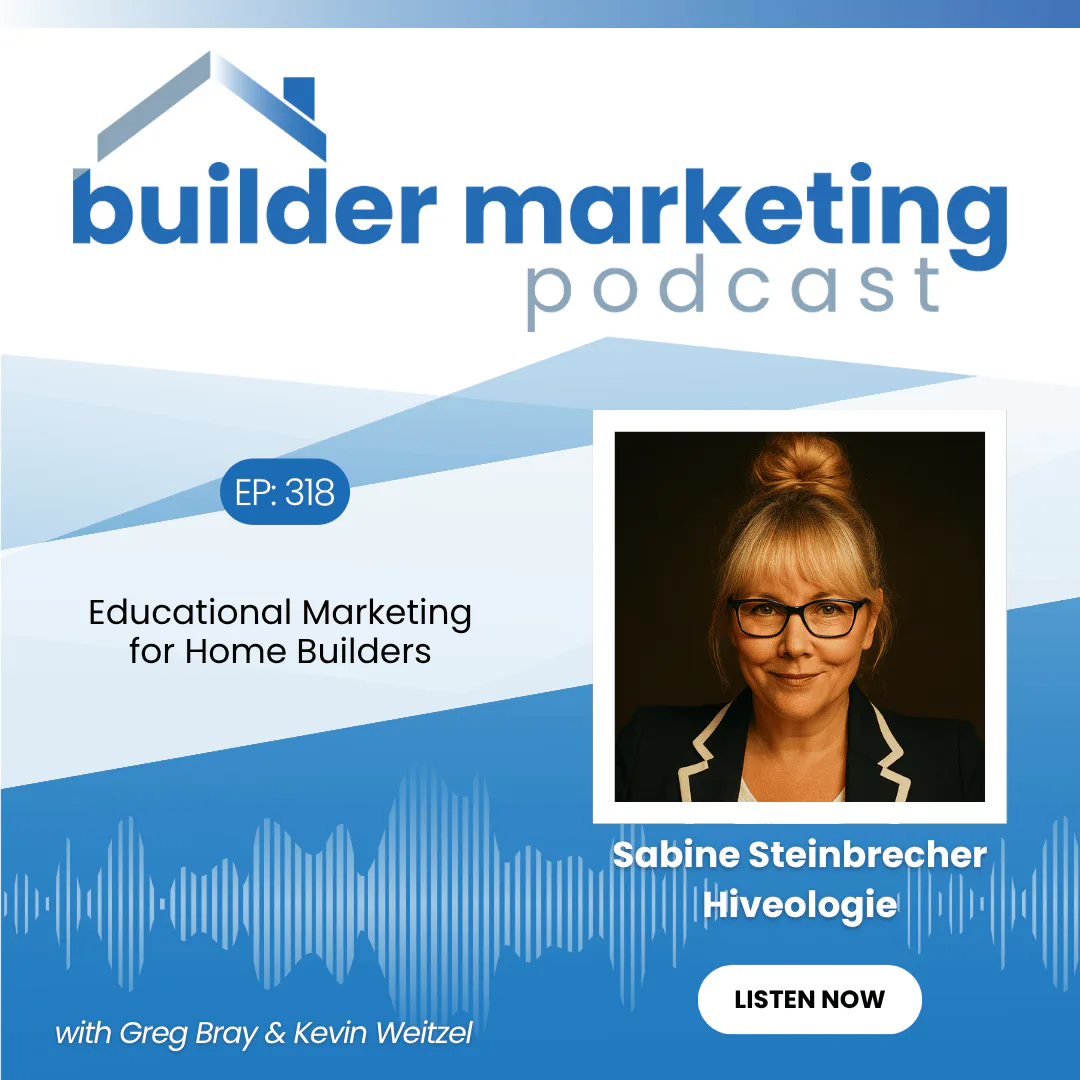
This week on the Builder Marketing Podcast, Sabine Steinbrecher of Hiveologie joins Greg and Kevin to discuss how educational marketing helps home builders create an unbeatable competitive advantage, build instant credibility, and shorten the sales cycle.
Education marketing is a strategy that prioritizes teaching potential customers over directly selling to them. Sabine says, “I think the easiest way to think of it is like a strategic authority system built through education, so using education to either drive your thought leadership, help people through one phase or two of the sales funnel. It could be front-end, middle, back-end. There's all sorts of things that it can do, which is actually kind of the cool thing. So, it's definitely not just a content plan. This is a very strategic authority system about the right type of education, delivered the right way to one of your audience segments.”
With AI now answering buyers' questions directly, educational marketing is no longer optional. Sabine explains, “So, one of the things to think about when we talk about this issue of why it's sort of relevant for home builders right now is this whole issue of AI, how builders and builder product and listings are found in the first place. So, we know now that more and more consumers are getting their information through an AI source of some kind. The way that AI positions their responses is usually through more of a synthesis of answers from trusted sources.”
To get recommended by AI, you have to provide it with high-quality, expert content. Sabine says, “So, instead of the old school way of just ranking on Google, which you could purchase basically, this is different. You can't buy ranking in the AI. You have to feed the AI properly. So, a way to do that is by publishing consistently very clear, structured, expertise-driven educational content. That's probably the best way to think of it. So, the more you teach, the more you get cited, recommended, et cetera, as opposed to being ranked. So, that's one reason. So, this is a way now for everybody to be found in a future where, let's face it, almost everybody is going to be using the AI part of Google or just using one of the GPTs to find things.”
Listen to this week’s episode to learn more about how providing high-value information can help a home builder become the go-to industry expert.
About the Guest:
Sabine is an award-winning writer, producer and the Founder/CEO of Hiveologie, Accelerated Learning. A four-time RISMedia Newsmaker, she is one of the original edtech entrepreneurs and architects of real estate e-learning. With over 25 years in education design, marketing, analytics, and strategy, Sabine has delivered more than one million courses and helped hundreds of thousands of agents accelerate their success alongside her prestigious clients and partners.
Widely regarded as one of the most sought-after experts in real estate education, Sabine has built a learning ecosystem that fuses cutting-edge instructional design with actionable training and technology. Her programs have transformed how professionals learn, implement, and generate results, giving them the tools, systems, and accountability to build sustainable income and thrive in any market.
Very few in the industry have her track record of innovation and proven execution. From live coaching and training programs to groundbreaking learning platforms, Sabine continues to redefine what’s possible for organizations and professionals who want to grow faster and smarter.
Personally, Sabine lives in the Finger Lakes, NY, is an avid beekeeper, and is one of the few women ever to have won the Baja 1000 off-road desert race.
Greg Bray: [00:00:00] Hello everybody, and welcome to today's episode of the Builder Marketing Podcast. I'm Greg Bray with Blue Tangerine.
Kevin Weitzel: And I'm Kevin Weitzel OutHouse.
Greg Bray: And we are pleased today to have joining us Sabine Steinbrecher. Sabine is the CEO and founder at Hiveologie. Welcome. Thanks for joining us today.
Sabine Steinbrecher: Thank you for having me. My pleasure.
Greg Bray: Well, Sabine, let's start off by just helping people get to know a little bit of your background. Give us that quick introduction and overview about [00:01:00] yourself.
Sabine Steinbrecher: Yes, I would love to. So, I started one of the very, very, very, very, very first EdTech companies in North America back in 1998. So, I have been doing education, technology, and education delivery forever. That is everything I'm all about. Over a million courses delivered hundreds of thousands of agents and learners trained, and since then have been lucky enough to be an award-winning educator, producer, writer, and all that good stuff.
Kevin Weitzel: Alright. Before we jump into any bit of that, we need to know an interesting factoid about you that has nothing to do with work, family, or the home building industry whatsoever.
Sabine Steinbrecher: I have two really good ones, so I'm going to give you them quick. One is, I am a three-time Baja 1000 off-road race champion, so I'll let that just like the little mic in my hands there for that one. That is a good one.
Kevin Weitzel: That is a good one.
Sabine Steinbrecher: Isn't that a good one? I know. And then the other one is, which is one of my personal, current favorites, is I keep bees and I have built my whole social mission around my [00:02:00] business, around bee conservation efforts.
Kevin Weitzel: Are you like an angel? How much more perfect could you be? Good night.
Sabine Steinbrecher: Thank you.
Kevin Weitzel: Bee conservation provides life for everybody, literally everybody. We talking Baja? Are we talking like, open frame, or are we talking trophy trucks? What are we talking?
Sabine Steinbrecher: We're talking amateur class, but truck class. First two years was a Hummer, and then created our own little team and another team and built our own, started its life as a Jeep scrambler, and then now it's just a Baja. You know what they're like. But we did not have the budget for a big, big trophy truck, unfortunately. That would've been fun.
Kevin Weitzel: Greg, have you ever seen these trophy trucks that she's talking about?
Greg Bray: I have seen some pictures, but I have never been close to one.
Kevin Weitzel: Pictures can't describe it. Imagine traveling across the desert, all undulated terrain, just hauling butt like you're in a hovercraft, but your wheels are moving feet at a time underneath you while the motor is just putting out like NASCAR horsepower. [00:03:00] It's amazing.
Sabine Steinbrecher: That's another chat. We'll talk about that. I'll tell you all kinds of crazy stories. You'll love it.
Greg Bray: So, Sabine, you mentioned education and education technology. How did you go from that kind of generally into more of the real estate home building kind of specific sector?
Sabine Steinbrecher: When I started my business way back when we had decided to go after associations first and foremost. It was funny because I had a team of about 20 sales guys, all of them paid very well and I was going through a little database and I realized that nobody had called the National Association of Realtors, the largest trade association in the world, 1.2 million members back then already. So, I literally was so annoyed.
I picked up the phone that moment called their mainline and just fluked into an opportunity that they had happened to have an RFP that was open. They put me right through thinking I was calling for that, and that started a relationship with them for over 20 years now, doing education [00:04:00] on the real estate side. And of course, that led me into peripheral markets, including things like mortgage and builders and things. But the builder space is more recent. That's only been in the last two years.
Greg Bray: Well then give us that quick background about hiveologie, the kinds of things you guys do and offer, so we can understand that.
Sabine Steinbrecher: I think in its most simplest form, what I'm trying to really do now is help organizations turn education into their most powerful marketing asset or training asset. That's sort of the core vision, but that's done through three different things. It's the ed tech if they need it. A lot of people these days have ed tech, so we don't have to be doing that. But we do have some new AI stuff that's very cool and unique to us.
There's the whole area of education production and distribution. So, let's say if you wanted to build a marketing course, people would come to us and we would help turn it into an online product of some kind, and then do distribution. So, that could be the storyboarding, the writing, the editing, the building, whatever it is. And then if it falls into one of the markets in which we have some sort of community or some sort of audience, we also [00:05:00] help in many cases with driving adoption or driving revenue as well, putting it into, it could be builder or real estate space or whatever it is.
And then the last part, which is primarily what I think we're talking about today is the education marketing piece of my business, which is really understanding how to use education to provide and to build out a authority for a bunch of different reasons, and I'll get into that in a minute. But we provide the strategy and the execution, if desired, behind what we're talking about today.
Greg Bray: So, education as a marketing tool, what does that mean to you in a little more detail? Because I don't think that everybody puts those together immediately when they think about, oh, what can we do this week to do better marketing, is not necessarily what comes up.
Sabine Steinbrecher: I agree, and that's why I'm so very excited about this. It feels like after all these years of doing it, just doing training, I'm finally put it all together to understand how to use education to really build. I think the easiest way to think of it is like a strategic authority system built through [00:06:00] education, so using education to either drive your thought leadership, help people through one phase or two of the sales funnel. It could be front end, middle, back, end. There's all sorts of things that it can do, which is actually kind of the cool thing. So, it's definitely not just a content plan. This is a very strategic authority system about the right type of education, delivered the right way to one of your audience segments.
Greg Bray: So, I just want to make sure that we're on the same page here. We're not talking about, necessarily, that like Blue Tangerine wants to create a course. That's something you guys do, but that's not the heart of what we're talking about today. We're talking about more about how do we go to our prospects, the people we want to talk to, and instead of saying, Buy our stuff, buy our stuff. Instead, we are giving a different kind of message, to help them educate themselves, so to speak. Am I understanding correctly, or am I confusing that a little bit?
Sabine Steinbrecher: A course could be part of the asset set for sure. It just [00:07:00] needs to be about your area of expertise. So, if it's a marketing course and it's designed specifically for builders, that would absolutely be part of a strategic authority asset, no question.
Greg Bray: So, what are, from a home builder's perspective, the kinds of topics that make this relevant for them, and why they should be considering using education in their marketing plan?
Sabine Steinbrecher: I think there's a bunch of things and there's some newer things that have been more recent. So, one of the things to think about when we talk about this issue of why it's sort of relevant for home builders right now is this whole issue of AI, how builders and builder product and listings are found in the first place. So, we know now that more and more consumers are getting their information through an AI source of some kind. The way that AI positions their responses is usually through more of a synthesis of answers from trusted sources.
So, instead of the old school way of just ranking on Google, which you could [00:08:00] purchase basically, this is different. You can't buy ranking in the AI. You have to feed the AI properly. So, a way to do that is by publishing consistently very clear, structured, expertise-driven educational content. That's probably the best way to think of it. So, the more you teach, the more you get cited, recommended, et cetera, as opposed to being ranked. So, that's one reason. So, this is a way now for everybody to be found in a future where, let's face it, almost everybody is going to be using the AI part of Google or just using one of the GPTs to find things.
The other part of it is because there's a perception out there that AI is making information free and available to anyone. So, I often get asked, how is it still relevant to just create more content? And the answer is, AI makes this information available, it doesn't make it trustworthy or consistent or credible. That's where we come in. We are the experts in what we do. There's an enormous [00:09:00] amount of contradiction out there. There's a lot of noise. There's far too much information these days for most people, myself included, to make a decision about pretty much anything. It's very hard. If you research deeply, you'll eventually get massively contradicting or hallucinating, if not wrong information. So, it's one thing for us to create content and put it out in the world and become the experts that people can begin to trust. It's the other for them to simply look it up and find whatever it is they happen to find. So, I think that's another big distinction about why this is extraordinarily relevant.
It's also, I would say, a land grab moment. We have a period right now where the people who are doing this well will be the ones that a year from now, two years from now, will be positioned inside of these tools the right way. I honestly think it's difficult for any of us to forecast much out of, say, two years from now because of what's happening with AI. But given what we know today, those are all really good, relevant reasons, and there's a bunch of other ones. Things like people decide who they trust [00:10:00] before they ever reach out these days. So, if you're out in the world with trusted content, the right content, especially that's educational, people will find you and follow you and hopefully fall in love with you long before you've ever even talked to them. So, there's tons of other reasons too.
Greg Bray: I think it's great about the AI angle there. Because you're right, we can't fake it anymore with like just keyword stuffing and then all the other things that kind of came into play. Not that SEO was a fake it game, but there was an element to that, for sure.
Kevin Weitzel: So, I have a question for you. This is partially one of my complaints about so much dependency on AI. What you alluded to is that, yes, there's a lot more information, but it's just information. It doesn't necessarily mean that it's correct information. So, is it the job of what you do to rewire a salesperson, a marketer, if you will, to be able to read the underlying messages that the person in front of you is giving you?
Because if you've moved them past that informational side and then into a door swing, you [00:11:00] don't want to start the whole process over again. You want take whatever information you have in your CRM and use it to your advantage. We call it loading the artillery, so you can fire back against their reasons to not buy. But, do you think it's more about becoming more of an educator to your potential home buyer than it is about trying to work them through to the next steps of the sale?
Sabine Steinbrecher: It will probably do both, but the place to start for most would be answering all of the core questions that you get every day. So, things that, for instance, are objections that they hear every day, or maybe it's what the salespeople are dealing with every day, or whatever it is to get them to both trust you and know you know your stuff, and that is generally where most people start. It's like figure out who your core first audience is, like which segment you're going after.
So, let's say it's a, you know, senior that's downsizing or whatever it is that happens to be your gig and work out what I call sort of like an educational topic ladder that helps them [00:12:00] from the most basic all the way through to later you can go much deeper, of course. Because this is an evolving strategy and it's not about just more, it's about just answering the right questions and going deeper into what their pain points are, how it is you conserve them, how you can answer objections, tell them about who you are, all that good stuff.
Kevin Weitzel: So, how are builders making a misstep in this scenario?
Sabine Steinbrecher: From what I've seen so far, and you guys know better than I because you've done this much longer. But from what I've seen is a lot of them don't do it at all. So, there's a gap, I'd say period. And that's true, by the way, for most industries. The truth is, this strategy works anywhere. I don't care if you're an organization, or a builder, or an individual that's trying to be the expert in something. But most of them don't do anything.
And then, the other side of it, I think, is it's not done consistently, is probably the most important thing. There isn't this strategy that's being executed consistently if they do anything at all. It's like random throw at the wall strategies that I think, unfortunately, if they aren't working with a good [00:13:00] marketing group or have an internal team, that is still a lot of what I see out there.
Greg Bray: Hey everybody. This is Greg Bray from Blue Tangerine, and I am so excited to let you know that the registration is now open for the 2026 Builder Marketing Summit. We're gonna be in Dallas, Texas this year on September 23rd and 24th, and we are working on an amazing lineup of marketing OSC and leadership content for you. Please check it out@buildermarketingsummit.com and get your registration in today. Remember, there's limited seats available, so don't miss out. Again, builder marketing summit.com. Can't wait to see you there.
So, when you think about the builder that hasn't ever done this before and they're sitting here going, oh, this sounds interesting. What is it that they're doing differently? Because they've always been talking about, oh, these are our beautiful homes, so I'm just going to educate people on why these homes are beautiful and why they should live there. Is there something more that needs to go into it to really become education versus just product pitching?
Sabine Steinbrecher: Yeah, product pitching is basically what I would consider more of a push strategy. You're just telling them stuff, and you're out there pushing your information out in the world. If you're doing an education marketing strategy, you're attracting, you're pulling, you're magnetizing your content so that people are going to see you as that trusted leader. And the only way that works is to go through what I consider to be sort of like a series of steps to get to the right content.
I'll give you an example of a [00:14:00] builder that I worked with. This was a small home builder. They make these tiny homes, nice ones, but they consider themselves luxury tiny homes. The steps we went through are to start with the audience segments that they want to attract, and then hopefully pick one of those and what the desired outcome is. So, for instance, we wanted to go with the who buys and why. We found a whole bunch of them. I think we had eight different segments in the end. Some of them consumers, some of them B2B. We wanted to make sure that we really spoke directly to their needs, to their fears, their aspirations, their dreams, all that good stuff.
So, we started with their end consumers and their top three. So, mostly downsizing was their biggest, but they had a couple of others. They also wanted to focus on small developers, people who wanted to build those awesome little tiny home communities. That was another avatar, and then real estate agents and orgs to get them to help sell their stuff too. That was step one.
And then step two was what's the outcome? Are we looking at just thought leadership? Are we looking at attention, recruitment, lead gen, adoption, onboarding, you know, retention? Which step of the [00:15:00] process are we talking about? And for them it was all front-end because they're brand new. They were absolutely not concerned about the rest. So, this was front-end thought leadership, attention, recruitment, mostly lead gen, frankly. So, we just wanted to establish them as sort of the leader in the small footprint living area, and then make them a category leader from the get go. So, that was the goal.
And the way that we did that is through a tailored educational tracks for those specific avatars. For them, because they wanted to be very visual and it was a good model for them, we ended up going with a whole bunch of video, a lot of YouTube, but also much smaller nano assets too, that we were dripping out. And all of that to say, the topics fall out once you know who you're talking to and you know why you're talking to them. It's very easy to come up with the assets, and then it's just a question of the asset types.
So, you know, are you doing a combination of things, like small stuff that's fast, lightweight, single idea assets? Are you moving into deeper, multi-point stuff like a workshop or whatever? Are you going really deep into things like whole [00:16:00] platform development, like a YouTube channel, or are you go doing a big course? Or maybe you just want to write a book. Depends on who your audience is and who you are. So, all of that together is kind of the way we work through it. Did that help you at all?
Greg Bray: Yeah. Well, and I think, you started to get into this idea of sometimes we get stuck on, well, what do we say? What do we talk about? What's the topic? But what I'm hearing you say is the topics are not hard if you've done these other steps first of understanding who it is you're trying to talk to, and then understanding what they want to know.
Sabine Steinbrecher: Exactly. And I always say the easiest thing to start with are the questions you get asked every single day, FAQs that you're always dealing with, hows and whens. How you do something differently, how it matters to them, all that good stuff. That's easily the easiest place to start here.
Greg Bray: Is there one format that is better than another, like writing versus, you mentioned video versus courses? Is there one that's like easier to start or [00:17:00] is it just depends?
Sabine Steinbrecher: It's very much a, it depends answer. It depends on the audience. I always say, think about where they live and then deliver it to them the way that they like to get their content. So, if your audience lives on Facebook and their Facebook group people and you should just do that, do that. If they're, you know, people that you know live in YouTube, then you know you need to do video. It really just depends. You have to figure out where they live, most of them.
Greg Bray: So, how much content is too much? How deep do we go? We always hear people have short attention spans. It needs to be bite-size. Where's kind of that balance? Because there's also this argument that like AI and some of these things, they want depth, they want longer and more sometimes to kind of put it all together. What are your thoughts?
Sabine Steinbrecher: So, the good news is this strategy is a self-selection strategy. You put up your expertise in formats that make you happy to start. I would suggest building out a strong strategy over time but at least [00:18:00] start with micro. So, these are little 30-second videos or little downloadables or whatever it is that you feel comfortable doing. At least get rolling. That will build over time, and over time, as you create more and more of those assets, that will start to rank inside of AI too. So, you don't have to start with a full course. But I will say, because it is a self-selecting exercise, because this is pull marketing, not push marketing, you're not burying anybody. You simply lead them. They will find you as they start looking for information, and they will go through it as deeply as they're ready to go.
A good example is, I'm looking to buy a new vehicle. So, I've been buried in YouTube videos and I am utterly perplexed at this point because I haven't found any one good source that really makes me feel confident that I can listen to their advice. Because one says this company's crap, another one says, this one's crappy. It's just painful. So, that's the sort of thing that as a buyer, I'm ready to make a purchase. But a year ago, I was just sort of thinking about it, so [00:19:00] I'm not going to go as deep. That's typical. So, that helps. So, I don't think you have to worry about too much content. It's more important to get one channel right, and to be consistent, truthfully.
Greg Bray: So, I'm trying to put this program together. I'm getting the team all fired up. We're ready to do it. What's the big roadblock that stops the process? You know, we get the one thing done and then we never do another one. What is it that gets us into the consistency over time?
Sabine Steinbrecher: I think you just said it, it's A, having explained why and how it matters, for sure. Number one. So, everybody's on board. Developing a proper strategy and sticking with a strategy, so you're just executing. And then committing to either the team hours to execute it, or outsourcing it, one or the other. You have to have all three of those or these are just going to be inconsistent, random stuff that some of us are doing now. Won't change.
Greg Bray: Sometimes when people think of outsourcing, I think they struggle with, well, how will they know our stuff, how will they get the voice right, and things like that. Are [00:20:00] there ways to help a partner better produce on your behalf than others? Any experiences in that area?
Sabine Steinbrecher: Yeah, I mean, we, because we've started doing this in the last couple of years, so I've had to learn that process internally as well, like how to do it for others. I've found that it helps if you're working with somebody that already understands to a degree this industry they're in, at least to start. For instance, I'd rather work with you guys in the builder space than an agency that doesn't know builders. It just helps. So, start with that.
But the second part is you need to be able to communicate what your brand is about, and go through the steps that I mentioned. When I do this in a workshop format, there's six different steps that we walk people through to show them how to do this. It's things like we talked about already, like starting with an avatar, figuring out who your audience segment is, then moving onto your key messaging. You need to do that with an organization. It isn't just go figure it out. There's steps to this for sure. Either way.
Kevin Weitzel: [00:21:00] I 100% agree with what you just said. I'm a firm believer of steal conceptually. Find your concepts no matter where they fall. If it's at the zoo, if it's at an ice cream parlor, whatever concept you can glean from, and implement into your thought process on how you want to improve. But then go to experts for implementation because you're experts, you can drive them with that concept, but you don't necessarily want some ice cream shop telling you how to build homes,
Sabine Steinbrecher: Right. Exactly. We were joking about this before we started the session today, but I think it's actually fairly simple. The core of this is easy to sort of get to once you know who you're talking to. Because everybody that we'll be working with, so let's say it's one of your clients or one of mine, they already have expertise. They're doing something special already. They know what they're doing. Frankly, the more niche they are, the easier it is. Like these guys with a like tiny home, that's a little niche. It's easy to come up with all the ways in which they're different. You know, how you can compare what they do to [00:22:00] somebody else, what it's like living like that. You know?
Kevin Weitzel: It is easy. But is it? Here's where my question's coming from.
Sabine Steinbrecher: Yeah.
Kevin Weitzel: If you look at something like Porters, you know people that just put a whole bunch of garbage and collectibles and stuff in their house and next thing you know, they can't walk down the hallway. Easy answer is they know they need to clean their home. It's disgusting. However, they're so inundated with just all the different things that have to take place they don't even know where to start. And I think that's where most builders get into. They know they want to improve something, but there's so many different avenues, so many different channels coming at them, they don't know where to go to begin said process of improving A, B, or C.
Sabine Steinbrecher: You're right. I think you're right. For me, it always feels like it's such a simple strategy, but execution of anything is always tricky for sure. But you're right. There are five or six steps you have to go through, and if you're not willing to go through those to help all of the execution fall out from there, because there's still the execution step. You need the strategy first. So, if you're not willing to do that, then none of this is [00:23:00] go
Greg Bray: So, you already mentioned a little bit about the AI side from a consuming the content standpoint. Let's flip it. What AI tools are you seeing that can be helpful in the creation and managing the process and maybe making it a little easier to get some of this done?
Sabine Steinbrecher: Yeah, I flip back and forth between a whole bunch of them and depending on which day, I'm not yelling at one of them. So, and I know I've been told someday they're going to be sentient and I'm not supposed to do that because they're going to come after me first. But I do it anyway. I can't help it. I'm still in between Claude, ChatGPT, Gemini for a combination of things. And it's really funny because I would've said to you a little while ago, like, creating a graphic or doing this or whatever works better over here. Honestly, it feels like whatever day it is that one of them gives it to me the way I actually wanted it. It's so crazy.
And I've been using it since they started, like from the moment. So, I'm decent at prompt engineering, you know, and I still find they're a bit frustrating. But for all of this stuff, for getting clarity on strategy, [00:24:00] awesome tool for that. Any of those three, I would say go for it. And the rest of it is all, depends how deep you want to go. Like video editing or creating graphics and that kind of stuff. You know, that's a different story. But definitely for this step of working through the strategy and figuring out your questions and who your audience segments are, you can absolutely start asking questions to get good feedback from any of those three.
Greg Bray: So, if there was one piece of content, if you're looking at like a builder's website or their marketing program, and there's one thing that they must have, what is it that you look for first to see, have they checked this box, whatever that box is?
Sabine Steinbrecher: I don't, because it depends. I can't say they need to have a blog or they need to have a YouTube channel, or they need to have whatever. It's the channel is the channel. It's more important that they're covering off the topics.
Greg Bray: And is there a topic that comes to mind regardless of the channel that they should have no matter what?
Sabine Steinbrecher: The who and the how. Absolutely. Who they are, who they speak to, who's pain they're solving, that has to be up there, and how they do it needs to be part of it too. That's the [00:25:00] two most important things, and almost no one has all of that. Not just builders. I mean, that's unusual to come across that in a really thorough, decently done way, for sure. I really don't care what channel it is. Whatever works for their buyers is what matters.
Greg Bray: So, you're talking about kind of fill in the blank of we help blank do blank in that straightforward of a type of a statement somewhere in their material?
Sabine Steinbrecher: I think that's a start, but you want to go deeper into true education. That's just a statement. So, education would be actually educating them on how they do things differently, why they do things, who they do it for, what aspirations that they're solving for, or problems or objections. That's done in a more educational matter.
If you're doing a little educational nugget talking about let's say what kind of roofing you use or whatever that's different than somebody else's or whatever. You know, if you're having that conversation, it's just educational. You're just telling people what you do, so you don't have to worry about being too slick. You don't have to worry about it being [00:26:00] boring. It's just education, and education almost never goes wrong. Let's face it, it's very apple pie. Even if it is the nuts and bolts that some people might think are boring, those are the questions people have. They wan
Greg Bray: Do you run into the fact, because I think this does happen, where to us as the company, like say, the builder, we're so familiar with it. we think everybody understands it already, and we forget that the buyers don't do this every day. They buy a home how many times in a lifetime? Not very many, and certainly not a new home compared to the way a builder knows it. I think we get too close to it. How do we step back and not just think, oh, well that's not important. They already know that.
Sabine Steinbrecher: I think the best place to start would be what are the questions people are already asking you? If they're asking you what's different between buying a new home versus the residential resale, you're probably starting there. Like how are they different? What's, you know, the situation with financing, what's the situation with upgrades or you know, how do I [00:27:00] get the kitchen I want or whatever. Like all of those things.
I know there's that information out there, but it's not all in one place, under one expert for their audience and for their type of property, whatever home builder type they are. That's missing for everybody, and there's in a moment in time now where people will be able to sort of grab that positioning where that didn't exist before. There's more to this strategy later that can go much deeper, don't get me wrong. But this is a great place to start, for sure.
Greg Bray: Well, Sabine, this has been great information and we appreciate you being so open and sharing so much with us today. Do you have any kind of last thoughts or advice you'd like to leave with our audience before we wrap up?
Sabine Steinbrecher: I would say make sure that there's some level of measurement so they know if they're hitting some of their goals over time is going to be a really big one. Because all of these assets can be used in multiple ways, but if they aren't leading to something that's helping you and you should know what you want, then that's [00:28:00] something to keep tweaking and moving towards. And then honestly, the basics we already talked about is just be consistent. No marketing works once.
Greg Bray: Awesome. Well, again, thank you for your time. If somebody wants to connect with you, what's the best way for them to reach out and get in touch?
Sabine Steinbrecher: I'd be happy for anybody to just either connect with me through LinkedIn. My name is unusual enough that I'm easy to find. Same with Hiveologie. But they can also find me through my personal email, which is my S-A-B-I-N-E@hiveologie.com, and I'd be more than welcome to send everybody a summary or guide on this if they'd like it. I have, surprisingly, some educational assets on this stuff I'd be happy to share. Just drop me a note or put it in LinkedIn and I'll get it to them.
Greg Bray: That's awesome. Well, thank you again, and thank you everybody for listening today to the Builder Marketing Podcast. I'm Greg Bray with Blue Tangerine.
Kevin Weitzel: And I'm Kevin Weitzel OutHouse. Thank you.
[00:29:00]


