EP: 340
2026 Builder Marketing Summit Recap
With Greg Bray and Kevin Weitzel
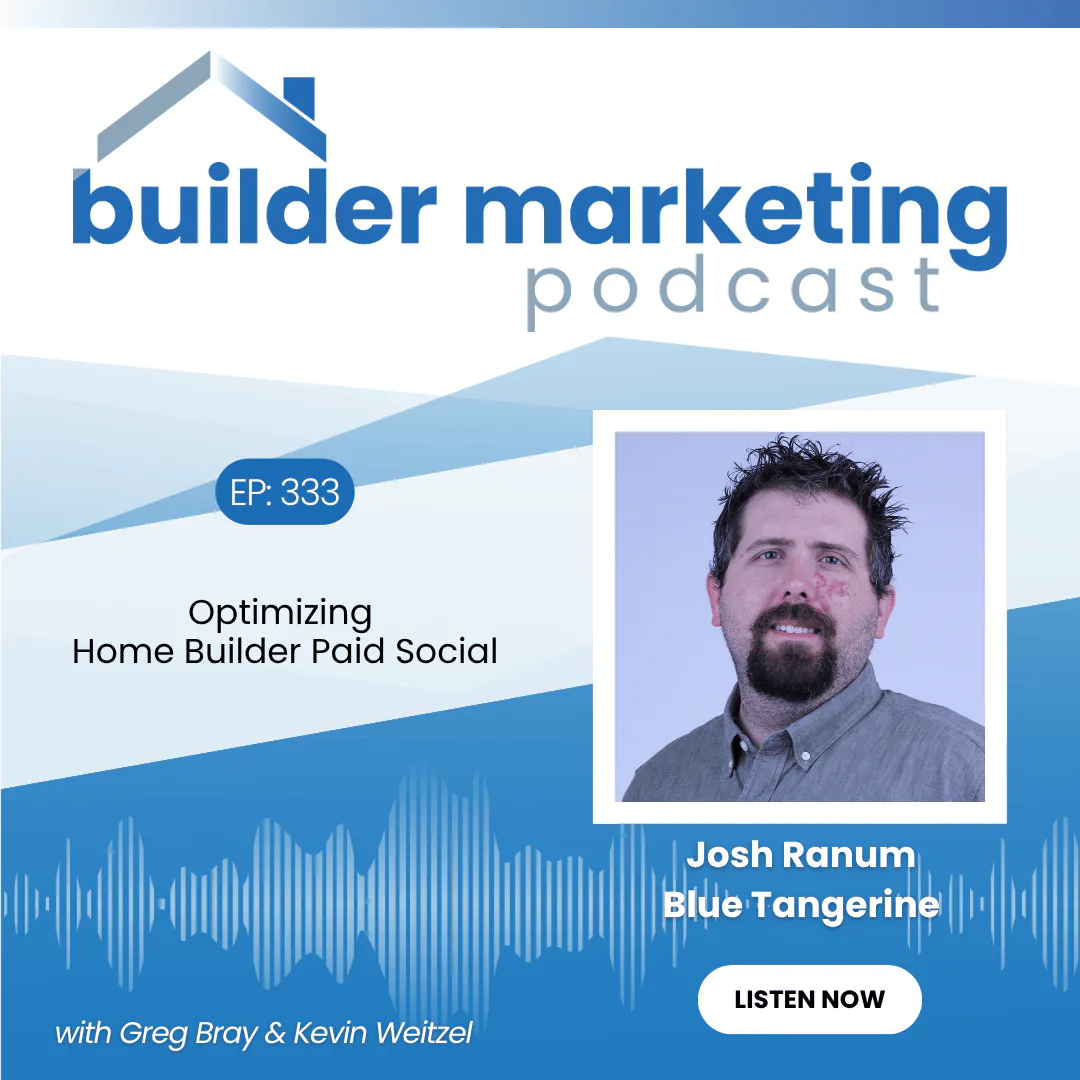
Are your paid social campaigns performing at their absolute peak? In this episode of the Builder Marketing Podcast, Josh Ranum of Blue Tangerine joins Greg and Kevin to discuss how home builders can optimize their paid social strategy and get higher returns on ad spend.
Home builder marketers can easily get lost in ad settings and completely miss the bigger picture. Josh says, “You can really build a full marketing strategy on paid social, especially in the last three to four years on Meta, the complexity in which you can set up objectives and creatives and testing and get in the weeds on the tactical side. But I do think that actually developing a framework or a strategy is definitely something that has been missed and misunderstood.”
While many home builders rely on stagnant, repetitive imagery, diversifying ad formats is what actually drives paid social success. Josh explains, “I think the other thing that's misunderstood, and that's really missed is what I would call a lack of creative diversity. That really comes down to a lot of companies and home builders will templatize their inventory ads or their brand ad, and it will be a repetitive approach to the same topic from a creative or image stance, even to the point where the ad formats don't change month to month, every six months, you know, every year. It just becomes kind of really stagnant from a creative side. So, I think one thing that I've noticed with home builders that get more out of their budgets from a lead generation stance or a traffic stance is that the people that really lean into having that creative diversification are the ones getting the results that they're seeking, on that front.”
Determining the right budget is a vital first step for home builders before launching any paid social campaign. Josh says, “I think what drives it for most home builders in my conversations is just knowing, like I need to send X amount of people to the website and I need to generate X amount of leads for these homes that I need to sell. And so, then we work with them to back into what those budget initial kind of recommendations look like. They often are much higher than what they actually have, but we can work with them to kind of balance that out.”
Listen now to learn how to get the most out of your paid social campaigns.
About the Guest:
Joshua Ranum is the founder of Ranum Media and the Fractional Paid Media Director at Blue Tangerine, where he helps production home builders develop paid media strategies that drive measurable business growth. With more than 12 years of agency experience, Joshua has led paid media strategy across Google Ads, Meta Ads, and other digital advertising platforms, including serving as Director of Paid Media at multiple agencies. He specializes in aligning paid media with the home-buying journey, helping builders move beyond lead generation to create campaigns that build awareness, earn consideration, and drive qualified tours and sales.
Greg Bray: [00:00:00] Hello everybody, and welcome to today's episode of the Builder Marketing Podcast. I'm Greg Bray with Blue Tangerine.
Kevin Weitzel: And I'm Kevin Weitzel with OutHouse.
Greg Bray: And we are excited today to have joining us Josh Ranum. Josh is currently serving as the paid media director of Blue Tangerine. Welcome, Josh. Thanks for joining us today.
Josh Ranum: Appreciate it. Thanks for having me and excited to dive in.
Greg Bray: Well, before we dive into anything, let's just find out a little bit more about you. Give us that [00:01:00] quick background and overview about yourself.
Josh Ranum: Yeah, I'll give you my elevator pitch. Started about 2013, getting into the paid media field. Really started off as an assistant traditional media planner, booking newspaper and print insertions. And so, I quickly realized at that time that that was going to go nowhere. So, I decided to swap to the digital side. So. I've been building my career ever since, working at different agencies, working in different industries.
Hands-on-keyboard strategy, leadership teams, you name it, I've likely done it in my career. I would say the last, about four years I've started to specialize more in the home builder side as far as the industry goes, working with a lot of clients from paid search and paid social side. Could go longer, but keeping it short for now.
Kevin Weitzel: So, from what you just said there, you're telling me that obituary writing isn't big money? Because that's still pretty active, right? No?
Josh Ranum: Still active, you know, but newspaper insertions for Medicare, Medicaid insurance [00:02:00] companies wasn't really my bag. So, I wanted to do something, you know, quote, "hip and fun," so.
Kevin Weitzel: Hip and fun. Well, speaking of hip and fun, let's find out a fun factoid about you that has nothing to do with work, family, or the home building industry whatsoever.
Josh Ranum: Yes. It's not my first podcast. My first podcast I started back when I was in my early 20s with my best friend that ran for four years, where we focused on talking about pop culture, video games, movies, insert anything, you know, bachelor related there, that you do in your early 20s.
We got up to, like, 1,000 listeners per week. But I quickly realized that having a handle of Peaches didn't really translate into, like, an official career. So, made that full transition into the quote, "corporate or advertising agency world." So, if you see me out and about, please don't call me Peaches, and you cannot find those recordings anywhere because I have painstakingly gone through and removed them, after being embarrassed multiple times.
Kevin Weitzel: I will forewarn you, there is a correct answer to this follow-up question. What is, in your opinion, [00:03:00] the superior platform, PC or console games?
Josh Ranum: Oh, well, to me, it depends on what age I am. I think as a teenager, I went pro playing on Xbox playing video games, and then as a mid-30s, late-30s individual, I am PC. So, I think it just depends on your age is my best answer.
Kevin Weitzel: Wow. Do you see how he skirted that answer there, Greg?
Greg Bray: Yeah, he did. He did.
Kevin Weitzel: Depends if you're in this category, and if you're not, come on.
Josh Ranum: If you're young, you're like this. If you're old, you prefer the PC.
Kevin Weitzel: You answered it correctly. PC is the superior gaming platform.
Greg Bray: Well, speaking of things that can be in different categories, let's talk about social media, Josh. I think that's our topic for today, and one of the things we wanted to tap into some of your experiences about. For people who are listening, I think social media can mean a couple different things. So, we're going to split out what I call organic social, which is where you're creating content and posts and articles and all of that.
And then we've got the, what we call paid social, which [00:04:00] is the advertising side, right? We want to tap into the paid social conversation today, because that's an area that you've spent a lot of time with. So, let's just start off just from a home building perspective, because you've been working with builders now for a bit and gotten to see some of the ins and outs of builder campaigns. Where is paid social fit for most builders in their strategy? What do they think about it or maybe misunderstand about it in that big strategy placement conversation?
Josh Ranum: Yeah, I think that with the home builders that I've worked with over the years, it kind of spans the different areas. I think the most common one to me is that they use it as a way to drive QMI inventory, you know, quick move-ins, more product focused type creative to the market, really expecting people just to see the home and schedule a tour. I've seen it where they focus more on what we'll call community events, so just promoting like your classic Facebook event. [00:05:00] I've seen it where they've really focused on just boosting their organic social side of things.
And I think paid social does all of those things, but I think one area, and I think maybe it's misunderstood or sometimes I think it's a lack of resources is, it is more than just a tactical approach. You can really build a full marketing strategy on paid social, especially in the last three to four years on Meta, the complexity in which you can set up objectives and creatives and testing and get in the weeds on the tactical side.
But I do think that actually developing a framework or a strategy is definitely something that has been missed and misunderstood. I would say even five of the last seven accounts that I've audited from a new business perspective, social does one thing. The main takeaway, for me, from paid social over the years is that it does one thing, but it also does a lot of things and it does a lot of things well, from that side of it.
I [00:06:00] think the other thing that's misunderstood, and that's really missed is what I would call a lack of creative diversity. That really comes down to a lot of companies and home builders will templatize their inventory ads or their brand ad, and it will be a repetitive approach to the same topic from a creative or image stance, even to the point where the ad formats don't change month to month, every six months, you know, every year. It just becomes kind of really stagnant from a creative side.
So, I think one thing that I've noticed with home builders that get more out of their budgets from a lead generation stance or a traffic stance is that the people that really lean into having that creative diversification are the ones getting the results that they're seeking, on that front.
Kevin Weitzel: So, to put this in layman's terms, you're saying that Baskin-Robbins shouldn't have [00:07:00] 33 vanillas? They should have their multiple flavors and depending on what that buyer's needs would be, if they want crunchy or fruity or whatever?
Josh Ranum: Mm-hmm. Yeah, I think, you definitely always want to focus on the product, but I think if we use the Baskin-Robbins piece of it, it's what else are they putting out there from an advertising perspective outside of just hitting home on the 33 vanilla flavors that they have or the different crunch options. Or you know, I'm a sprinkles guy, so sprinkles on there.
It's more about, you know, maybe their little storytelling, little branded ad talking about someone and their daughter going after a soccer game, picking up ice cream. Or maybe it's a testimonial where somebody sits down and talks about how impactful Baskin-Robbins has been. It's not the same, because I think home building and purchasing a home is more impactful life stage and journey than going to Baskin-Robbins, but.
Kevin Weitzel: But they still have stages. They still have stages. So, when I go in order ice cream, I have to look at my 33 flavors, then I have to look at my toppings. And because there are different stages, there are different ways that home builders have to roll out these.
Josh Ranum: True. I like it. I will begin to think of the [00:08:00] home buying journey as going into an ice cream parlor. I like that.
Greg Bray: I'm waiting for Kevin to surprise me and say that he sold a sponsorship to Baskin-Robbins.
Kevin Weitzel: I'm goi reach out to their corporate office tomorrow.
Josh Ranum: The sentiment for sure is there, because it is very much like that journey of going from that initial, "Hey, maybe we need to buy a new home," that dreaming stage into kind of that consideration or comparing down to finally picking out your product, right? Do you want a two story single family home or a three story town home? I could see the journey there.
Greg Bray: So, to that point, Josh, when you're talking with builders about their social advertising strategies and process, do you find that builders are very much like, "I just need leads, so just do whatever it is that gets me a lead tomorrow." And they want the lead tomorrow, and forget about this whole longer nurturing process that could also be supported by the social platforms. Where's kind of the starting point? Do we just focus on the move-in-ready stuff and that's the leads we're going for? Do we [00:09:00] worry about the person that's 12 months away from buying a home and we're trying to get in front of them? What are your experiences there?
Josh Ranum: This is the classic paid media answer, which is depends on your budget. But also if we want to go deeper than that, I think covering off on that kind of bottom funnel schedule tour inventory product ads is critical, because at the end of the day, if you're not moving those homes, you know, someone's talking to you about it as the marketing person, the marketing contact. So, that is kind of what I would call the foundation is more at the bottom funnel.
I always tell people try to save twenty to thirty percent of their budget and allocate that towards more of that demand building, kind of what you referenced, Greg, kind of that top funnel, getting those impressions, those clicks to the website, engaging the users, whether it's on Meta or TikTok a little bit further, you know, ahead of schedule, if you will, as opposed to just really focusing on that more bottom funnel focus. So, I always try and do both if I can, using a framework. But I know that sometimes budgets are tight and you [00:10:00] just have to move that inventory.
I think when it comes to that piece of it, my advice is always, yes, you need to focus on schedule tour, or whatever that main sales CTA or CTA is on your site you're trying to drive. But that doesn't mean that you have to always run the same exterior shot on your ad. And so, that's where that diversification comes in, you know, new templates, new formats, running carousel ads, highlighting all the interior features you want to highlight, your ad copy supports it. And then maybe there's an incentive push, you know, from the bottom funnel perspective. There are still different ways to create that diversity instead of always just having that main product, here's your exterior with the price attached to it.
Greg Bray: So, before we get too much farther into the conversation, let's clarify platforms that we're talking about. Is Facebook still king of the hill? Is that the only place, Instagram falling under that, you know, with Meta, or are there other social platforms that are really worth a test and a [00:11:00] conversation?
Josh Ranum: In my experience with what home builders are willing to spend money on, I think Meta, AKA Facebook, and Instagram are still kind of kings of the hill, if you will. I've gone down the path of testing out on TikTok, on that social platform. The other one that's really out there that a lot of people don't really consider a social platform, but really is, kind of spans both social and online video is YouTube. I would say that from a Meta perspective, Facebook and Instagram are still number one most used. And then I would say most home builders are utilizing YouTube in some way, where TikTok is kind of that distant third, if you will.
Depending on your buyer demographic, you may see better success on Facebook versus Instagram, but from a setup perspective and ad perspective, you definitely can reach both of them pretty easily. You're go a higher scale or more available inventory on the actual Facebook platform versus the Instagram platform, simply just because of the user counts.
Greg Bray: Some of [00:12:00] these things depend on budget and there's some folks that have experiments that, okay, hey, Facebook's easy, I can boost a post for $10, you know, or whatever. You can get something out of that at a relatively low budget. What are some of the drivers of budget and how do people kind of decide what they should be budgeting? I know dollars probably vary dramatically on number of markets and things like that that we're dealing with, but what are some of the other kind of dials that influence budget?
Josh Ranum: I think the number of homes that need to be pushed is what I always try to get back to. You know, if you have 12 communities and we have a $500 budget, we need to figure out, what we're doing. But if you have three or four homes that need to be pushed at the end of the day, we can back in and kind of waterfall a formula to come out with expected leads, expected traffic from a 5 or $1,000 budget.
I think what drives it for most home builders in my conversations is just knowing, like I need to send X amount of people to the website and I need to generate X amount of leads for these [00:13:00] homes that I need to sell. And so, then we work with them to back into what those budget initial kind of recommendations look like. They often are much higher than what they actually have, but we can work with them to kind of balance that out.
If you were a home builder today trying to figure out how much I should allocate to, you know, a Meta campaign, a good reference point is the benchmark for a click on Meta is a dollar. So, for every dollar you spent, you're likely going to send a user to your website. And so, if your higher ups are saying you need to send 500 users to the website incrementally a month, you know you can spend 500 bucks on Meta to do that.
That's a very crude way to do it. You know, but if it was, "Hey, that's the only information or goals that I have is I need to send traffic to the website," that's how I would go about it. From a leads perspective, it's between, you know, 100 bucks to $150 from a cost per lead stance is what we typically see for something that's like schedule a tour, contact form, things of that [00:14:00] nature.
Greg Bray: You made a reference to one of the mistakes being kind of getting stuck in a rut with the creative and the ad design, and maybe kind of just following a template, just swapping out, you know, the different home picture on the same ad and things like that. What are some of the reasons that you don't recommend that, that you think the variety makes a difference?
Josh Ranum: I think it's two things. You want to do that and have that in place. The issue becomes when that's your only solution. So, if you do that for 12 months, that's great, but you're not really getting additional creative concepts tested in the platform. You're not seeing what else potentially could work. So, It's not that that's a bad thing. Like, a lot of times from a production stance, if you're the only person there that works on marketing, you gotta turn them out, right?
But I think if you look at different templates and try to collage them together or add different banners for incentives and kind of test out different creative formats, I think you'll find that online there's a lot of resources out there [00:15:00] that will give you, quote, "competitor examples" that you can draw inspiration from that are likely just templates in Canva, that you can just drag and drop your images into to develop that. So, I think it's not that it's a bad thing, it's just that how can you plus that up, you know, moving forward month to month to test out different formats? Because it could be your classic carousel, you know, switching from interior shot of the bathroom to the kitchen to your exterior back patio. Like, that's always worked for you. That's great. What else can you put into the system to learn and test out?
One of the major things definitely wanted to get across here is that it's a podcast in 2026, I'm sure we'll talk about AI at some point. But from a Meta perspective, they are very much building their algorithm and back end, Andromeda is the name, to focus on using these different creative elements to find out who and what works best. And so, if you're only having, like, one signal or one [00:16:00] input, you're really limiting the potential of that algorithm to learn, adapt, and actually find out what's working for you.
So, it's kind of a mindset shift of instead of it being, like, fully just creative, images and things of that nature, the creative diversity kind of turns into adding in more signals for the algorithm to learn from and to test out and to find what works best with your audience instead of you telling it what works best with your audience. That's that kind of building piece of it that I think, I work with other industries, it's not just home builders. A lot of industries are still grasping on how that works and how they can have that level of creative production to continue to build and test and iterate and move down that pathway, so.
Kevin Weitzel: And I have a question, and this is kind of a weird sideways question, but since you mentioned AI, I realize, you know, I'm not ignorant to the fact that we have to make things searchable by AI. We have to make it function well with the new tricks of the trade, if you will, [00:17:00] that AI is forcing upon everybody. However, I'm hearing grumblings of more and more and more people that are sick and tired of the obvious AI-generated content.
Josh Ranum: Mm-hmm. Yep.
Kevin Weitzel: What is your opinion on that, number one? And number two, with all these AI automation processes that are out there, where does human strategy still come into play?
Josh Ranum: Great question. I could take 90 minutes to answer this one, but I will try and keep it within four to five minutes. I will say talking about, like, the creative imagery and things of that nature, I think that we as an industry from a creative side lean so heavily into these AI generation creative platforms so fast and so quickly that somebody like me who doesn't have an extensive design background can go in and say, "Well, home builder, I can create 15 ads for you in 30 seconds, and here they are." Right? That doesn't mean that the prompts I've used or the design principles I've put in [00:18:00] are quality.
A lot of the backlash coming from, buzzword, AI slop or AI images, is warranted, in my opinion because I do think that there is still an expectation of these need to be quality and these do need to come through as polished. That's something that some creative AI platforms do well and others don't. But I think it's more about who's using it and inputting those prompts and using that platform to generate those images, and I think there's going to be a course correction there as these become more ingrained in even these larger platforms like Google Ads and Meta.
Like, you can start to build these AI images in those platforms yourself now. As that becomes more prevalent, they're going to push more money in there, and so it's going to become more of some of the work stream. I am not the doom and gloom guy to say, "Well, we'll never need creative production again," and the days of designing 1080 by 1080, you know, images for paid [00:19:00] social are over. I'm not that guy. I think there's always going to be a need for the human design element, on that front.
I always joke about it as like when I think about AI taking over and, like, how that impacts my job, I always think more about how I evolve in the same way when I deal with paid search or paid social, the things I did five years ago I don't do anymore because it's all automated. So, five years from now, the things that I'm doing for paid social now, just going to transition.
I think there will always be a need for somebody to steward these platforms because if you're spending $50,000 a month in Meta, a lot of people just aren't comfortable saying, "Okay, here's $50,000, platform. I don't know what I'm doing and I have maybe 10 minutes of learning. Go spend my money." I still think there's going to be a need for, you know, a subject matter expert to steward that much of capital around.
At the same time, I do think that it opens up the pathway for somebody that may [00:20:00] not be able to pay for a service like a partner or an agency where they can kind of do it themselves well enough through learnings from online media and YouTube videos and webinars. But, I don't think my job is going away, it's just going to evolve, and it's evolved in the last year and it will evolve in the next five years without question. Hope that helps.
Greg Bray: So Kevin, here's something that everybody might not know. Josh is coming to the Builder Marketing Summit and he's going to be talking about paid social and how to dive in deep and really make these campaigns work. I'm pretty excited that Josh is going to be there. So Josh, give us that little taste of where you're headed with that presentation so that people know that they can't miss it.
Josh Ranum: My time is going to be spent more on the talking about strategy and developing a framework for home builders to work within. I'm really going to focus on identifying kind of three different stages for the home buyer journey and how paid social plays into that. We [00:21:00] all know that it takes a lot of time for somebody to go from the dreaming stage to actually scheduling a tour and getting into a home to see what it looks like. My talk will speak to how to use Meta and potentially TikTok and other social platforms, and how to build a framework that allows you to message to this user, your potential prospect, along that journey.
There will be some notes about creative, and so if you're interested in this idea of creative diversification or how do I create more ad formats or what kind of content do I need to develop, a lot of that will be in that presentation as well. I'm going to walk through kind of a framework for you guys to potentially use moving forward, one that I use for my clients, and then some content ideas that can help strike up some conversations internally with your teams to develop some new content ideas to run as ads.
Greg Bray: Kevin, that sounds like a can't-miss presentation to me. What do you think?
Kevin Weitzel: It is. It's not only a can't-miss presentation, it's a can't-miss summit. Boom.
Greg Bray: So if you haven't signed up [00:22:00] yet, make sure you get your tickets at buildermarketingsummit.com because the remaining seats are very limited. So, if you've been putting it off, it's time to get on with it and grab that seat before it's gone. We're excited that you'll be there with us, Josh, and we appreciate the time you spent with us today. Any kind of last thoughts or words of advice before we finish up?
Josh Ranum: One of the common questions that I get is how do I learn about all these things? And so, one thing I always try to give at ends of presentations or podcasts or meetings is places to look. From a paid social side, I think one, this is an unprompted plug for a platform called Motion, and their webinars are very well run. They're once a month. They talk a lot about how to make your paid social creative more engaging, talk about hooks, talk about iterations and testing and how to use the algorithm, and they do it from a more of a creative lens than, like, a really hard technical background lens. So, if you find yourself as a [00:23:00] marketer more in that creative role, responsible for developing campaigns and ideas and concepts, Motion is the name of the company that I really have found to be really helpful.
Greg Bray: Terrific resource. Well, Josh, if somebody does want to connect with you, what's the best way for them to reach out and get in touch?
Josh Ranum: Look me up on LinkedIn. Look me up on the Blue Tangerine website. Reach out there for sure. But you can always message me on my LinkedIn profile.
Greg Bray: Well, thank you, Josh, for sharing with us today, and thank you everybody for listening to the Builder Marketing Podcast. I'm Greg Bray with Blue Tangerine.
Kevin Weitzel: And I'm Kevin Weitzel with OutHouse. Thank you. [00:24:00]