EP: 308
Developing a Strong Builder Marketing Strategy
With Carrie Davis
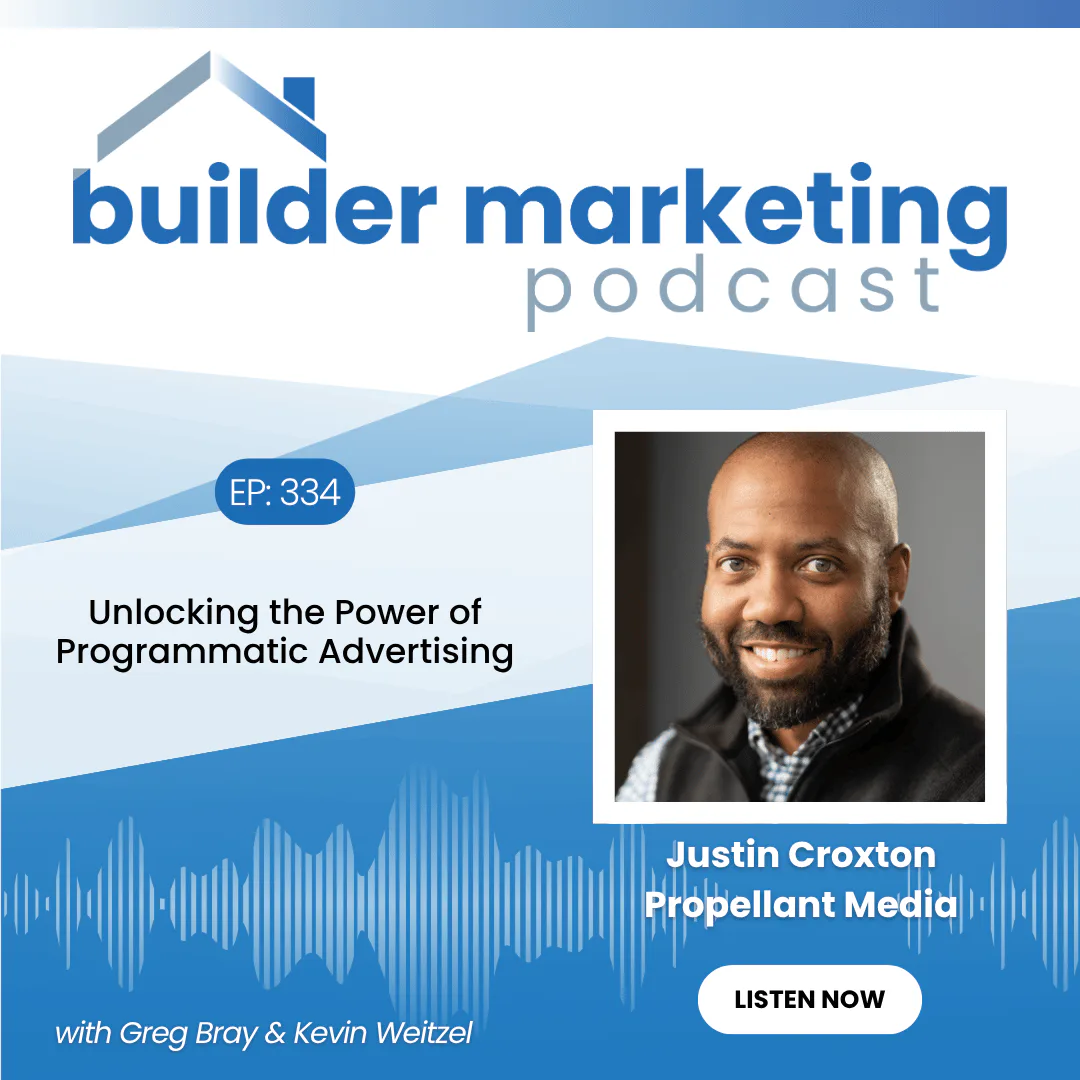
Ready to go beyond basic digital advertising? On this episode of the Builder Marketing Podcast, Justin Croxton of Propellant Media joins Greg and Kevin to break down how home builders can unlock the power of programmatic advertising to reach home buyers at the right moment, in the right location, with the right message.
Programmatic advertising differs from traditional digital advertising. Justin says, “It's essentially the buying and selling of ads in real time. You're not taking an insertion order or giving it to an advertiser and asking them to place a bid on this website. It's doing that across millions of apps and websites in real time. That's how a lot of advertisers have been able to scale via particular audiences that they want to reach and just overarching inventory that's out there. That's what programmatic essentially means, is the buying and selling of ads in real time.”
Reaching your ideal customer requires moving beyond basic search and social media channels to embrace the hyper-targeted world of programmatic advertising. Justin explains, “The whole programmatic world has done an incredible job identifying these various markers based on your online and your offline behavior to help advertisers figure out, is this the right person that I want to get my message in front of? And if that is the case, then you can essentially place an ad programmatically in front of that user at a particular time, using a particular format, whether it's, again, display ads, online video, over-the-top connected TV advertising and such. That's what programmatic essentially means, and it's an incredibly powerful means to get in front of an audience that otherwise you wouldn't be able to because everyone else is competing in these other spaces of Meta and Google and such.”
Once home builders establish a steady baseline across offline media and mainstream digital channels, the next logical step is to turn to programmatic advertising. Justin says, “The first step that they should consider, if you are doing some level of marketing, you know, you have your offline print ads, you know, you've sent direct mailers to a number of agents that's out there, and you still have a respectable healthy marketing budget for digital advertising, and you're doing Google, you're doing Meta, it should be some consideration on the programmatic side. That might include geofencing, site retargeting, some other programmatic strategies."
Listen now to learn how to master programmatic advertising for your home builder business.
About the Guest:
Justin Croxton, CEO of Propellant Media (Omni Channel Media Technology Company), is an accomplished Senior Executive, Entrepreneur, and Advisor with more than 17 years of success across the marketing and advertising, real estate, and retail industries. His broad areas of expertise include digital marketing, business development, customer acquisition, SEO, SEM, go-to-market strategy, and growth. As Managing Partner of Propellant Media, Justin oversees his team in creating innovative and profit-driven marketing programs, including lead generation and geofencing marketing that can drive engagement, search engine traffic, and, most importantly, revenues to our brands and organizations.
Greg Bray: [00:00:00] Hello everybody, and welcome to today's episode of the Builder Marketing Podcast. I'm Greg Bray with Blue Tangerine.
Kevin Weitzel: And I'm Kevin Weitzel with OutHouse.
Greg Bray: And we are excited today to be joined by Justin Croxton. Justin is the CEO at Propellant Media. Welcome, Justin. Thanks for spending time with us today.
Justin Croxton: Thank you for having me, man. Greg, it's an absolute pleasure. Kevin, you as well, man.
Greg Bray: Well, Justin, for those who haven't had a chance to meet you, let's just [00:01:00] start off to give them that quick background and overview, a little bit about yourself.
Justin Croxton: Yeah, absolutely. Justin Croxton, CEO of Propellant Media. It's been fascinating being in this world of digital advertising and marketing. I started Propellant Media a little over 10 years ago. But before then, I had another digital marketing consulting firm. I was a one-person shop. And before that, I graduated from business school up in New York. So, that's been sort of my trajectory.
Funny enough, before that, I worked in commercial real estate. Some people will say, "Well, why did you leave commercial real estate? You were doing so well." And I was like, "You know, I ask myself the same question." I don't know. I like to haze myself, but it's been a treat with the agency that we run, and we have an office both in Atlanta and Charlotte, North Carolina. That's been my growth story, personally in this world.
Kevin Weitzel: All right. Before we get into what you do, and a little bit of how home builders can harness what you do, please tell us something personal about yourself that has nothing to do with the home building industry, family, or work in general.
Justin Croxton: Got it. So, something personal that a lot of people don't [00:02:00] know is that I grew up sailing. Grew up sailing. I was very fortunate with my father and my mother. They purchased many, many years ago, actually when I was born, a 42-foot Irwin.
Kevin Weitzel: Wow.
Justin Croxton: Which is a sailboat. It has a center cockpit, and we would sail up and down the Chesapeake Bay, the C&D Canal between the Delaware Bay and the Chesapeake Bay, effectively. It's one of the best experience that my family could have given me and our family. But it teaches you patience, teaches you hard work, stick-to-it-iveness, safety, swimming, just all those different things. A lot of people don't know that about me, but that's one of the things that I will always love and cherish just growing up as a youngster.
Kevin Weitzel: And you started on a 40-footer? That's crazy.
Justin Croxton: Well, they had a 23-footer at first before I was born, and then they realized once they had me, they needed something just slightly bigger.
Kevin Weitzel: Yeah. We had a San Juan 21 up in Lake Michigan. Right around 10 or 11 years old, I developed a really hyper motion sickness. We would leave the jetty, my ears would just [00:03:00] not match what my eyeballs were seeing, and I would just get ridiculously, oh, I would just have to lay down and lay on the floor and hopefully, you know, we'd make it back to the slip sometime. It never got fixed. I could not fix it, and it still to this day affects me. If I get out on the water, it's like, bleh, and I get instantly ill, so.
Justin Croxton: I got you, man. Yeah, I hear you. It was just an incredible experience. I loved it. But that's one of the things that I don't share with a lot of people, but that's one of my passions is like be on the water, sailing, grew up doing it.
Greg Bray: Are you going to get your own boat?
Justin Croxton: It's still a very strong possibility. We're sort of landlocked, so I might, like, buy a pontoon or a powerboat on one of these lakes that's nearby us. We do have another place that's out in Myrtle Beach, and so if we did, that's where we would probably stick it most likely.
Kevin Weitzel: Let's tack and jibe on this podcast episode.
Justin Croxton: Tack and jibe. That's what I'm talking about.
Kevin Weitzel: And, you know, release the sheets. Let's go.
Justin Croxton: Let's do it. Absolutely.
Greg Bray: All right. Well, Justin, we, again, we appreciate you sharing time with us today, because we want to tap into some of your knowledge in that digital marketing world. When a lot of builders think about [00:04:00] digital marketing, they're running maybe some Google ads, maybe some display. They start to get into social media, and that seems to be where most of the conversations are that I'm aware of, and I don't think people are touching on some of the other things that are out there. And I know that you guys do a lot with programmatic advertising. Love to peel that back a little bit and help people understand more. So, what does that term programmatic mean that's different than the traditional Google ads and maybe the Meta campaigns?
Justin Croxton: It's a great question. I think for just all the listeners, when you hear the word programmatic, it's essentially the buying and selling of ads in real time. You're not taking an insertion order or giving it to an advertiser and asking them to place a bid on this website. It's doing that across millions of apps and websites in real time. That's how a lot of advertisers have been able to scale via particular audiences that they want to reach and just overarching inventory that's out there. That's what programmatic essentially means, is the buying and selling of ads in real time.
But even within that [00:05:00] ecosystem, and that's outside of, you know, Google Search and even Facebook to an extent, but theoretically Facebook is kind of also programmatic. Essentially they're tapping into programmatic audiences. But programmatic itself fits within the display world. Display, video, over-the-top connected TV advertising, native, even now podcast and audio advertising.
There are many different ways to leverage programmatic display advertising. There's various signals that tells you that this person is your right audience, or there's some intent to buy from this particular user. It can be based on the places that they go. It can be based on the content that they read online. It can be based on the type of inventory that they consume, whether it's video or native ads and such.
The whole programmatic world has done an incredible job identifying these various markers based on your online and your offline behavior to help advertisers figure out, is this the right person that I want to get my message in front of? And if that is the [00:06:00] case, then you can essentially place an ad programmatically in front of that user at a particular time, using a particular format, whether it's, again, display ads, online video, over-the-top connected TV advertising and such.
That's what programmatic essentially means, and it's an incredibly powerful means to get in front of an audience that otherwise you wouldn't be able to because everyone else is competing in these other spaces of Meta and Google and such. And so, I'm sure we'll get into more details on that, but there's many incredible tactics, programmatically, that you can tap into to ensure you're getting in front of the right few folks.
Greg Bray: Well, I know that one of the ones that we probably talk the most about is geofencing. I think that one's really interesting to builders when they think, oh, I can show my ad to someone who visits my competitor's sales office. That's really an intriguing opportunity to try and steal away that buyer.
Justin Croxton: Yes.
Greg Bray: You mentioned, over-the-top TV. What is like one of the other maybe top [00:07:00] tools that people might not be thinking of that would fall in this category?
Justin Croxton: Yeah. You know, it's interesting and I know this is a little bit more for the builder community and developers and individuals that want to get in front of that real estate audience that's in market. But there's a lot of really cool tactics, particularly with programmatic. And what you're seeing in this space is a lot of these programmatic platforms are partnering with data providers. Data providers, and one of the things that we'll do, for example, is what's called ABM, account-based marketing.
And so, leveraging platforms like Bombora that gives you sort of this is the audience that I know you want to get your message directly in front of, and it's using all of that Bombora data, that B2B marketing data, a marketing director that, you know, works within this particular space. And you can build up your own audience, and then programmatically wherever that audience goes around the internet, there's a marker that's placed to that person. We can serve an ad to that individual programmatically across [00:08:00] mobile apps, mobile websites, desktop apps, desktop websites, and even online video and OTT advertising opportunities. That's one.
The other one which, you know, some of your listeners may be aware of, but CRM retargeting. So, just a great example is, let's say that you are trying to get your message in front of more real estate agents, right? You know that it's important for you to, you know, reach patrons that are possibly in-market looking to buy a home, but it's just as important to get your message in front of real estate agents.
So, if you have a full list of agents that are out there, you can actually programmatically serve ads to those individuals, bringing more awareness to those agents about your listing or at the very least about the developer itself or the builder. Just those little touch points that just kind of get your message in front of them on a consistent basis. That's just a micro-strategy within the bigger picture of what someone might be looking to do programmatically.
I mean, we do the geofencing, the addressable geofencing, all those things. [00:09:00] But, you know, I think the misconception is that you should do just this one thing. But it's really the holistic omni-channel experience of hitting those individuals, not just across tactics, but across mediums to really imprint in their brain that you are the right person or you're the right business, or you have the perfect development for either the real estate agent's clients or the actual patrons that are looking to buy a home essentially.
Greg Bray: Now, you mentioned the cookie that's tracking people across the internet, and there's been this long predicted death of the third-party cookie that's slowly. Give us your thoughts on some of those tracking things and where that stands today and where you think that's headed from some of the privacy issues and those types of things.
Justin Croxton: Yeah. Well, look, so honest moment, candid moment. There are certain states that are putting restrictions with geofencing in particular. One that just came down the pipe, I think it was Washington State was one that came down the pipe recently, where they instead want you to geofence a mile, but geofencing a [00:10:00] mile it's like what's the point of geofencing at all if you're going to geofence a mile is sort of the concept with that.
And just so the folks know, geofencing gives you the ability to serve ads to people in very precise areas, so you can build a virtual fence around an individual home or an individual building, and you can target just the people inside that location. From a privacy standpoint, laws, there are certain lawmakers that feel like that's a little bit too personal. And so, certain jurisdictions and certain states have put some of those restrictions on. Doesn't mean that there's other ways to reach those audiences. It just may be making it a little bit more difficult.
But, from a pixel perspective, that has been going on literally for like the last seven, eight plus years, since I've been in business. Every year you think that something's going to happen, Google or whatever platforms, they pull it back. They say, "Oh, you know, we're gonna make this happen," and it doesn't. I honestly really don't believe that anything is gonna happen related to pixels or audience building, for at least, at least the next five plus years because they keep pushing it back.
Now, [00:11:00] from a business practices perspective, you have to ask yourself, and you'll probably see this with platforms like Meta, where there's certain things that you can't do on the platform, right? You can't target individuals, you know, based on income because that goes against fair housing laws as an example. So, still taking that level of predatory targeting into play, there's still a ton of opportunity still on that platform within Meta, there's still a ton of opportunity with geofencing advertising.
It's just being able to figure out what the rules are and then ensuring that your messaging is of great value, it's compelling, it's brand building, but it's also measuring impact to your business as a whole. That's sort of what I usually tell folks when we're putting together media plans for different organizations.
Kevin Weitzel: But how specific can you get with the ads that go out, and how targeted can they be?
Justin Croxton: Let's say that you wanted to geofence a cancer clinic, and it was a pharmaceutical company that wanted to showcase how their cancer product can cure this particular form of cancer. You [00:12:00] absolutely can't do that. Not only can't you do that and geofence the individual building, you can't even talk about the prognosis of what your product actually cures. There's some of that that you can't do, that you've gotta be very conscious of, and we have, you know, all the different, you know, requirements of what you can and can't do from a targeting perspective. But it's that level of care and thought that needs to go into your advertising.
To your point, there's times when we have political candidates that want to run, you know, negative messaging against other candidates, I mean, you can do it. That's not an issue, depending on the state that allows for geofencing, of course. But from a business practice perspective, you have to determine is this good business? Does this make sense for me? What's the opportunity cost of using those dollars for other opportunities relative to the brand building, the growth of my organization? That's the part that needs to come into place.
Kevin Weitzel: Okay. Let's say my name was Knotts and I had a berry farm, and I wanted to geofence anybody that went to, let's just call it [00:13:00] Disneyland. Is there a limitation as to my budget? Is it my budget's that's going to determine how many people are going to see ads based off of visiting discipline?
Justin Croxton: Yes. Absolutely. Well, let me say this. It's not so much the budget's going to always determine. The budget definitely gives you the cap in how many people can potentially see your ads. And we have certain markers where we know that if you geo-fence like, Disney World, or a different place, if you wanted to geo-fence, you know, 20 locations, and we know that those locations have some decent traffic, you know, then we have recommendations on what your budget should be in order to, like, really reach it.
But ultimately, it's not just about that, it's about your business goals. How many walk-ins are you trying to get to? Yes, those can be difficult to project out. But usually we talk with clients about starting mid-size or small and then scaling up typically. The thing that we hate to do is to offer up a budget that is on the other side relative to, you know, the number of locations that you want to reach.
We feel like [00:14:00] we have a good sense of what that looks like in our experience, but the budget always dictates the number of times in which individuals can see your ads, and then the actual number of locations that you target also dictates your audience. The other thing, too, that dictates audience really quickly, you brought up Disney World. Targeting at Disney World can be difficult because the cell towers at Disney World are not capturing your mobile device ID because there's so many people that's there that it's putting a lot of strain on those cell towers.
So, there's times when we've geo-fenced, like, stadiums, and we've only gotten like, 10, 15,000 people when there were, like, 50,000 people that were there. It just depends. You know, if you're a business, if you're thinking about programmatic or geo-fencing, you just have to be open to what's possible, while still having appreciation for how these strategies can really drive business for home builders or, you know, developers and such.
Greg Bray: So, several questions, Justin, but I just want to touch on that fair housing comment you made and some of [00:15:00] the other reference to rules. In your experience and opinion, can the builder trust the platform provider to say no to something that would violate fair housing laws, or does the builder need to be aware and not even ask if they don't want to get in trouble?
Justin Croxton: No. That's a great question. It's both. And it's not just both, like, kinda trust the platform. You really do need to understand as a builder or as a builder that's in marketing, you know, the laws and regulations that are or are not available. Now, the good news with platforms like Meta is they don't want to get in trouble. They don't want to get sued or create a reason for Congress to sue them because then it's money that they got to spend.
And so, they have a lot of layers in place. Like, when you're on Meta, for example, and you're, you know, creating an ad, they ask you, you know, "This is a special category. Is it religion? Is it healthcare? Is it real estate?" Oh, it's real estate, got it. If you fall in their real estate [00:16:00] category, they then say your targeting options become even more limited, right? There's certain things that you really can't do from a targeting perspective, within Meta at that stage.
For example, you can't target, you know, at the zip code level. It will not allow it at that point. So, you do have some safeguards in place, but it's still important for the building marketer to understand those nuances because if you're on the front end building strategy and you think that you can do something and then you get into the platform and realize that you can't, it kinda messes up your plans a little bit. So, it is important to have a clear understanding on both ends. It's important, it's incumbent for the platform, it's also incumbent for the marketer to have some wherewithal or have some sense of cautious optimism maybe, if you want to call it that, and then build your marketing plans around that perspective, some of those restrictions.
Greg Bray: Now, we've mentioned a couple of locations like Disney and stadiums and things like that, but let's really drill down. I think one of the power of [00:17:00] these tools is not going after the huge events, especially from a builder perspective. There might be more consumer goods where that might make sense. But talk to us more about how finely targeted we can get. What is the narrowest, and when's too narrow in your opinion of targeting?
Justin Croxton: I mean, with geofencing specifically, you can literally get all the way down to the contours of a building. So, let's say you're a developer and you know that you have 10 other developers that have homes that are being constructed within like let's say a five-mile radius or 10-mile radius of your competitive set. You can literally build a virtual fence around like the showroom, for example, or around the entire development, and then serve ads to the people who go to those developments to convince them that, "Hey, we have another option over here. You should check us out."
And then just as important, you can actually measure the people who either saw or clicked on your ads and then came back to your development. So, [00:18:00] that's an example of a strategy that you can deploy that gets individuals who are literally in market coming back to your location. We've had other cases where, you know, clients have supplied us with an MLS list of homes that are for sale, and we have what's called addressable geofencing, where you can build virtual fences just around the homes. So, it's using the tax and plat line coordinates of those homes using latitude and longitude coordinates of those homes, and then serve OTT, CTV, display native, you know, online video ads to those individuals.
The whole idea is just think about what's possible. And what I typically tell folks is think about who your audience is, number one, where they are in the buying journey, and how you want to reach them. And then that's where we start to lay out all the different tactics and strategies that's possible and the budgets that would be appropriate based on your overall marketing budget. So, in the beginning I talked about CRM retargeting, I talked about geofencing, addressable geofencing, site [00:19:00] retargeting. Thinking of where they all fit within the overall marketing scheme, and then building a plan specifically around that.
Greg Bray: So Kevin, you know what people listening to this are thinking right now? "Man, I wish I could talk to Justin. Man, I wish I could hang out with him. I wish I could learn more from him." And do you know what good news we have today?
Kevin Weitzel: Probably some really good news, something maybe in September.
Greg Bray: Really good news. Justin is going to be with us, everybody, at the Builder Marketing Summit in Dallas, September 23rd and 24th. So, if you want to hang out with him, I highly recommend it, you don't want to miss this event. So, Justin, tell us just a little bit about what you're gonna be sharing with us at the summit coming up here soon.
Justin Croxton: Yeah. It's going to be an incredible conversation. It's going to be similar to what we're talking about here. It's really to dispel all the things around programmatic and geofencing, but the bigger picture is how it fits within an overall marketing campaign, how to really think about media planning and strategy, how to measure impact. And you know, how to put yourself in a good place so you're able to scale up digital marketing campaigns. I [00:20:00] mean, we gotta get out of the mindset of just tactics. Tactics are great, but it's about the strategy. It really comes down to, yes, we got this one thing over here, but how does that fit well within your overall campaign infrastructure? And that's how I look at it. And so, that's going to be just a little sliver of some of what we're going to talk about when I'm there in September.
Greg Bray: Yeah. I can't wait. I was so thrilled when you agreed to join us because I knew It was going to be good.
Justin Croxton: It's going to be fun.
Greg Bray: So, really excited. So, again, for those who haven't registered yet, there's still a few seats left, so get on that at buildermarketingsummit.com. For those who may not be able to make it, Justin, what's like one place that someone who's interested in deploying some of these techniques, where should they start? What's kind of that first step for them to consider?
Justin Croxton: The first step that they should consider, if you are doing some level of marketing, you know, you have your offline print ads, you know, you've sent direct mailers to a number of agents that's out there, and you still have a respectable healthy marketing budget for digital advertising, and you're doing Google, you're doing [00:21:00] Meta, it should be some consideration on the programmatic side. Typically, you know, clients that we work with, they'll typically put anywhere from 10 to 20% of their budget. It oscillates, depending on sort of the scenario, but they'll put about 10 to 20% towards programmatic. That might include geofencing, site retargeting, some other programmatic strategies.
Start there, number one, and then number two, think about your audience. Think about the people that you really want to ensure that you're getting your message directly in front of. Yes, you'll have some success with Google and Meta, but a lot of times it's not just about hitting individuals that were on Meta or did a Google search. A lot of times you got to remind them over and over again. You got to hit them. And the same individuals that did that Google search may not have found you, but they did find you when you geofenced the location when they went to one of your competitive developments.
I don't know what the average profit is for a home development, but if you're averaging, let's call it 100 to $200,000 that you're making in profit, there is no reason for you not to try [00:22:00] every strategy under the sun to get the perfect recipe to deploy across all of your future developments. That's what you want. You want to be innovative. You want to be thinking about what your other competitors aren't doing while staying tried and true to the things that are working for your development. Those are the two things that I think about, audience and then sort of the sliver of the budget of where to carve out for future deployment.
Greg Bray: No, that's awesome. Well, Justin, thanks so much for sharing with us today. If somebody wants to connect with you, what's the best way for them to reach out and get in touch?
Justin Croxton: Oh, man. You can go to propellant.media. You'll find us. Thank you.
Greg Bray: Awesome. Well, thanks again, Justin, we're excited to see you at the summit here soon. And thank you everybody for listening today to the Builder Marketing Podcast. I'm Greg Bray with Blue Tangerine.
Kevin Weitzel: And I'm Kevin Weitzel with OutHouse. Thank you. [00:23:00]