EP: 195
Building an Authentic Home Builder Brand
With Brent Niemuth
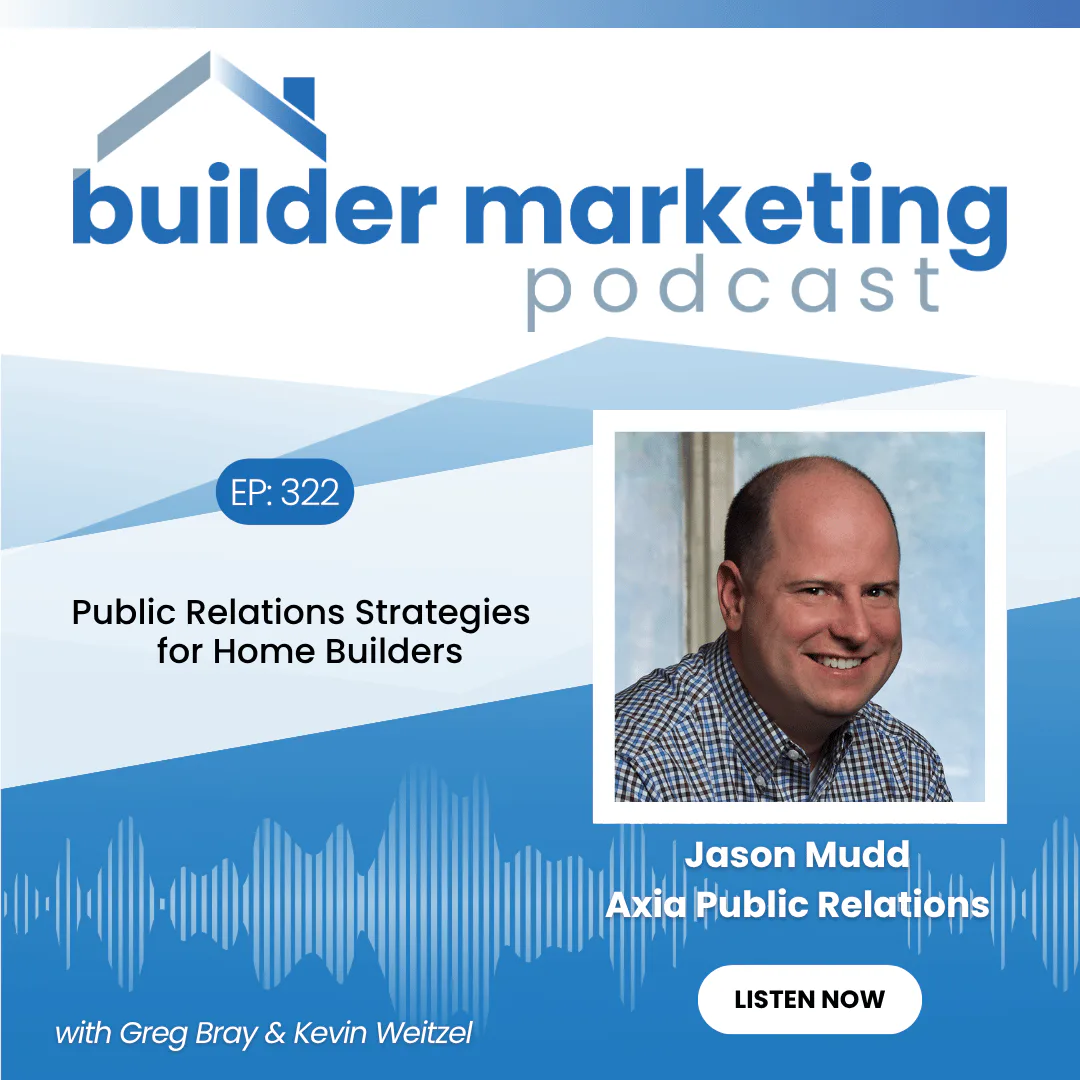
This week on the Builder Marketing Podcast, Jason Mudd of Axia Public Relations joins Greg and Kevin to discuss how home builders can boost brand visibility and strengthen reputation through effective public relations strategies.
PR is often seen merely as gaining media coverage and managing crises, but it's actually much broader. Jason says, “So, when people think of public relations, they're going to think of two things, and I like to express it as we help companies get in the news, and then we charge them twice as much to help them get out of the news. Right? And so, we're talking about media relations for earned media coverage and crisis communication management to help them look good in the media when they're going through an issue or a situation. But candidly, I think PR is so much more, right? It's about content creation and telling your story. It's about engaging with local communities. It's engaging with your industry and your professional peers, as well as the people who work for or are impacted within your organization.”
An indication of great PR is when people are excited to engage with your brand. Jason explains, “Good PR is when you're firing on all cylinders. It's almost like in the atmosphere, and you can reach out and touch it and feel it when you have good PR. So, when you walk into a room, people know who you are and who your company is before you even walk in. That's probably pretty good PR. When people are excited to hear from your company or learn from your company, that's what I would consider to be good PR or influence.”
A home builder’s credibility is the truest reflection of their public relations. Jason says, “Your reputation, I think, is a good indicator of your PR. So, if your company's got a good reputation, is the best place to work, a company that cares, a company that's growing, a company that gives back, those are all good signs of what I think ultimately your brand and visibility should be. So, I think a PR is reputation management, managing your reputation. And a lot of people, when they talk about reputation management, they're just thinking about online. And I'm saying, you know, man on the street, decision maker in your industry, and influencer in your space, as well as the people who work with you, work for you, and want to support your organization.”
Listen to this week’s episode to learn how home builders can enhance brand credibility and foster trust with prospective homebuyers.
About the Guest:
Jason Mudd is a nationally recognized public relations expert featured by CNN, Entrepreneur, Forbes, NPR, The New York Times, PRWeek, and The Wall Street Journal.
Named North America’s top PR leader by the World Communication Forum, he serves as CEO of Axia Public Relations — recognized by Forbes as one of America’s Best PR Agencies.
Jason has advised some of the country’s most admired and fastest-growing companies, leading campaigns for iconic brands including American Airlines, Budweiser, Dave & Buster’s, GE, H&R Block, Hilton, HP, Miller Lite, New York Life, Pizza Hut, Southern Comfort, and Verizon.
He’s also a professional public speaker, accredited PR practitioner, published author, entrepreneur, and host of On Top of PR with Jason Mudd — a podcast ranked among the top 2.5% globally by Listen Notes and a top 100 marketing podcast on Apple Podcasts. His guests have included leaders from Disney, Mall of America, Microsoft, Priceline, Southwest Airlines, Tyson Foods, and Wells Fargo.
Greg Bray: [00:00:00] Hello everybody, and welcome to today's episode of the Builder Marketing Podcast. I'm Greg Bray with Blue Tangerine.
Kevin Weitzel: And I'm Kevin Wezel with Outhouse.
Greg Bray: And we are excited today to have joining us Jason Mudd. Jason is the CEO of Axia Public Relations. Welcome, Jason. We appreciate you being with us today.
Jason Mudd: Hey, Greg, Kevin, great to be here. I'm glad to be here. Thank you for the opportunity.
Greg Bray: Well, Jason, for those who haven't met you yet, let's give them that quick background. Tell us just a little bit [00:01:00] about yourself and the kinds of things you've been working on.
Jason Mudd: Sure. So, I'm Jason Mudd. I'm the founder and CEO of Axia Public Relations. We work with some of America's most admired and fastest growing brands. My background in journalism and strategic communications helps guide these companies through thought leadership, AI optimization, and reputation management. I also have my own podcast called On Top of PR.
Kevin Weitzel: Which is much better than on top of old Smokey. That's just been overused way too much, especially in elementary schools. But anyways, you know, Jason, before we get into all this, could you please give our listeners an interesting factoid about yourself that has nothing to do with work or the industry that we're in at all.
Jason Mudd: Well, you know, that's kind of hard to do because I feel like our lives are so intertwined. You know, I have an interest in comedy and I've done some standup comedy, and I also enjoy, obviously telling stories through comedy. So, that sounds like something unique and different about me, but ultimately I can tell you exactly how that helps in [00:02:00] business and business relationships. I do enjoy traveling frequently, and that also intertwines business. The other thing I do is I walk three miles a day with my dog, Oscar. Sometimes that ends up being business related to, but sometimes it's absolutely just getting into nature and disconnecting from the rest of the world for an hour.
Kevin Weitzel: So, are we talking about like full-fledged rainbow suspenders standup, or are we talking more like Groundlings and SETV and improvisational groups?
Jason Mudd: Yeah, standup comedy. It's been a minute since I've done it actively, but yeah, getting up on stage and kind of doing a little, what I'd like to think is intellectual comedy, but, you know, observational and just kind of talking about what's going on in the world. And maybe, hopefully, making people think twice about some of their preconceived notions about life and or without offending the audience, maybe some of the double standards that they have.
You know, kind of make them walk away thinking challengingly and not really even realizing, no intent in any way of me offending them. But, you know, not realizing that really, you know, I was leaving them with some [00:03:00] thoughts to think about. So, that's a high standard and a high calling, which is why I don't do it professionally, but I do enjoy doing it amateurly.
Kevin Weitzel: Now, do you align more with like the Steven Wrights of the world or the Lewis Blacks of the world? What's your lane that you like to join in on?
Jason Mudd: The Comedy Club owner said that I remind him of Dennis Miller. I hope that's a compliment because a lot of people don't like Dennis Miller's style of comedy, but I certainly do.
Greg Bray: Well, Jason, for those who may not have really worked with a PR agency specifically, just tell us a little bit more about how your agency works and the kind of services that you offer.
Jason Mudd: Sure. So, when people think of public relations, they're going to think of two things, and I like to express it as we help companies get in the news and then we charge them twice as much to help them get out of the news. Right? And so, we're talking about media relations for earned media coverage and crisis communication management to help them look good in the media when they're going through an issue or a situation. That's the thing that people think of the most when they think of public [00:04:00] relations.
But candidly, I think PR is so much more, right? It's about content creation and telling your story. It's about engaging with local communities. It's engaging with your industry and your professional peers, as well as the people who work for or are impacted within your organization. So, it's about stakeholders and managing stakeholder relationships in many ways. I often tell people it's time we put the public back into public relations because people are so focused about media coverage and how they're positioned in the marketplace.
But right now, it's a great time to be in the PR business. Demand for our services is at an all time high. I've been doing this almost 25 years and with the immersion of AI and AI technology, the credibility and visibility of PR is at an all time high where companies realize that they need good PR to compete in the generative engine optimization, profession or, tactic. We're here for it. We're very excited to help companies and guide them through this process.
Greg Bray: Now you used the [00:05:00] phrase good PR. What does that mean for a builder who's maybe not really thinking about PR every day, what does good PR kind of look like?
Jason Mudd: Well, it's funny you mention that because that's a frequent question that I get asked by CEOs and business leaders is they usually say, I don't know what PR is, but I know we need it and I know when we have it. Right. And so, that's to me, a really telling sign. And it's funny because some of these executives feel like they have to whisper it like it's PR confidential or something, you know, where they're asking for my advice and they're afraid to say it publicly. But you know, I can understand why. It's not lost on me that the irony that the PR profession has its own identity crisis because most people don't know what PR is.
Greg, to that end, I would say that good PR is when you're firing on all cylinders. It's almost like in the atmosphere and you can reach out and touch it and feel it when you have good PR. So, when you walk into a room, people know who you are and who your company is before you even walk in. That's probably pretty good PR. When people are excited to hear [00:06:00] from your company or learn from your company, that's what I would consider to be good PR or influence.
Greg, you and I are members of Agency Management Institute and I was at one of the workshops years ago with other agency owners. We were talking about PR and they were asking me the same thing, you know, other agency owners you know, that practice digital marketing or advertising, and they asked me, they're like, Hey, what is PR anyway? I have a hard time defining it. I said, you know what? One thing that PR is today that all the tech bros and young pros are calling, you know, thought leadership and content creation, good PR and good PR professionals have been doing that type of work for decades, and we are just calling it PR.
Now there's a new term for it, and everybody's kind of latched onto those terms as being hot terms or buzzworthy terms. All the agencies that were with me at that table agreed with what I said, and many of them now kind of better understood what PR is. So, as I said earlier, you know, it's about storytelling and it's just telling your story in different platforms. It's about making a contact [00:07:00] and connection in the marketplace through various platforms, whether that's in person or whether that's through digital or traditional news media type platforms.
Kevin Weitzel: If good PR is firing in all cylinders. Is bad PR firing in all departments, you know, when you have these mass layoffs and firings, that's bad PR correct?
Jason Mudd: Can be for sure. Yeah. Unless you're only focused on what shareholders think. But yeah, I mean, at the end of the day, you know, your reputation I think is a good indicator of your PR. So, if your company's got a good reputation, is the best place to work, a company that cares, a company that's growing, a company that gives back, those are all good signs of what I think ultimately your brand and visibility should be. So, I think a PR is reputation management, managing your reputation. And a lot of people when they talk about reputation management, they're just thinking about online. And I'm saying, you know, man on the street, decision maker in your industry, and influencer in your space, as well as the people who work with you, work for you and want to support your organization.[00:08:00]
Greg Bray: So, from that standpoint, Jason, there's obviously a big overlap between marketing is trying to do storytelling, PR is trying to do storytelling. How do we get these stories in alignment so that we're telling the same story all the time?
Jason Mudd: Yeah, that's a great question. Cooperation and delusion of power and barriers, I think, is a key way to do that. It's interesting because often, the internal PR leader is looking for a seat at the table next to marketing, not inside of marketing. Some organizations put marketing under PR. A sewer majority of our clients hold a job title of chief, vice president, or director of marketing, not necessarily the same title for PR or communication. So, at the end of the day, you know, what's happening is that some companies are going to staff PR internally, some are going to staff PR externally by using a PR firm like Axia. Just kind of navigating through that space is important. But there's a third element of sales, right, Greg, that all of these need to be in alignment.
So, I was just working [00:09:00] on a LinkedIn post today explaining an experience I recently had where there's an incumbent company we've been doing business with for years. Great relationship. We were excited to be kind of elevating our position with them, meaning buying more from them, upgrading our services with them. But there's a new sales leader that decided to insert himself into the conversation. Suddenly we had a high pressure deadline that we had to make a decision by if we were going to move forward or not.
Otherwise, he basically gave a vibe that he could care less if we continue in our current package or if we move on to the next package. That gave me significant pause. Because of our long-term relationship with this organization we thought we were valued. Some new guy comes in with kind of a fomo, closed mentality of giving an artificial deadline that if we don't make a decision to move forward, you know, it'd be nice to know you and let you stay in your current package. I could tell from Kevin's facial expression, that's not the way to do business. Right? And that's how we felt.
So, we went from, hey, we don't do well with ultimatums. You know, here we [00:10:00] are thinking about spending more money with your company next quarter to now maybe we should shop around because suddenly we don't feel appreciated. Now if the marketing and PR department, or representatives or leadership knew that's what this sales leader was doing, would they encourage that? Would they want to intervene with that? To me, their short-term mindedness is causing long-term reputational harm.
Greg Bray: So, reputation is a little nebulous sometimes when we think about all the analytics type metrics and things we want to measure. How do you say, oh, you have a good reputation or a bad reputation? I mean, we kind of know it when we see it, right? But is there a way to measure it? We moved your reputation from a five to a six today or whatever. How do you guys kind of look at reputation?
Jason Mudd: Well, in the right scenario, the client has the budget to go out to the market and do some research and sentiment analysis and testing to see what the market says. But a lot of times there's either not time or not the resources to pull that off and do it the perfect way. So, the other thing we do is just measure [00:11:00] sentiment analysis of the messaging that we're able to get out of the marketplace and then look for other ways to measure the impact that it has through, ultimately, the impact on the organization, which is what we're always trying to prove, Greg.
As I mentioned earlier, there's some challenges to that. It's either budget or resources or the willingness to do that level of deep dive, the willingness to give us access to track those kind of metrics. I'm sure you see that as well. You know, we have some clients that come to us and the first thing they want to know is what's the ROI for our PR program? And then I asked them, okay, well. What are your profit margins on your different products and services? And they either have no idea or they say, they can't tell me that. Well, if you can't tell me what your profit margins are, it's hard for me to measure your ROI on PR. Right?
So, then we shift the conversation to return on value, right? So, in other words, you spent, you know, a hundred thousand dollars on PR in 2026. Here's the impact it had on your organization. And the best way for us to do that, again, comes down to transparency and access. So do we have access to their website [00:12:00] data, to their CRM, to their tracking data of the customer journey and all of those things. And if the company restricts us from being able to have access to those items and that information, then we have to explain to them how to set it up and how to configure it for proper measurement. But the easiest solution is for us to just be able to do it for them. That is a service we offer, but not every company has the bandwidth and resources to invest in them.
Greg Bray: Hey everybody. This is Greg Bray from Blue Tangerine, and I am so excited to let you know that the registration is now open for the 2026 Builder Marketing Summit. We're gonna be in Dallas, Texas this year on September 23rd and 24th, and we are working on an amazing lineup of marketing OSC and leadership content for you.
Please check it out@buildermarketingsummit.com and get your registration in today. Remember, there's limited seats available, so don't miss out. Again, builder marketing summit.com. Can't wait to see you there.
Kevin Weitzel: Okay, so from various industries, and this isn't just home building, [00:13:00] this is across all sorts of industries. Where companies will just make blanket statements based off of, this is a fuzzy kind of feel good that, you know, applies to everybody wants a home built on time, everybody wants a quality built home. Everybody wants a vehicle that's dependable. How do builders add credibility to the statements that they make?
Jason Mudd: Yeah. So, we work with companies that support builders and/or provide technology. So, we do some construct tech work. One of the biggest things I see those clients do or try to do that we persuade them not to, is they just make claims. You know, like we're the largest construct tech company to the home builder industry. And I'm like, okay. Based on what? Who said that? How are you attributing that? Or they'll say, you know, the most premier or something like that.
So, our argument is, let's come up with something that we can truly attribute to that's credible. So, that's according to this website, that's according to the number of users that we work with. That's according to our revenue. There's many different things that you can anchor [00:14:00] onto to state your claim, but if you don't have attribution or a citation of some sort, then that's hyperbole. It is a superlative without foundation. It's fluff. Consumers and buyers are very cynical and they don't want fluff. They don't want false superlatives. They want to know. So, if you're going to say you're something, you've got to tie it back to something else.
You know, sometimes the client is frustrated when we push for that because they say, well, our CEO likes to say it, or you know, this other sales leader is pushing for us to say it. And I'm like, well, if it's not true, let's not say it. And if it is true, let's explain it. Very easy, and it'll go a lot further along than saying that you're the premier provider of X or you're the top provider Y. Top provider based on what? It's a simple question, and they're going to ask you that eventually, or they're going to wonder it in the back of their mind, if you don't explain it.
Greg Bray: So, let's take that Jason and spin back a little more to the AI influence. You already mentioned it briefly. We're seeing as we study, you know, GEO and these other [00:15:00] terms for AI visibility that third party mentions of companies seem to have a huge impact on the AI results and recommendations and things when somebody searches in ChatGPT. I've seen some things where I'm looking for the best new home or show me the top home communities in this area, where you get into some of these superlatives, right, and you're asking the AI to do this comparison. How does the fluff kind of fit in in that context where now AI is being asked a fluffy question and has to kind of figure out how to process that?Any thoughts?
Jason Mudd: Well, yeah, I mean the three of us and a lot of your audience I'm sure have been doing this long enough to remember when, you know, the internet first arrived and had an impact on business and companies, and then search engines, of course, were part of that from the beginning. But what search engines have always tried to do is provide the most relevant experience, the most relevant information, the most credible information based on your search. It's not too [00:16:00] dissimilar of what's happening today with these AI engines that people are doing queries within or are prompting. At the end of the day, the best companies are going to give the best solution or the best experience to the person doing the prompting or doing the query.
So, throughout history, consumers have been motivated by word of mouth or by third party endorsements and credibility, right? And so at the end of the day, what's happening here is really no different than what's been happening for generations and decades, which is when someone is giving somebody else an endorsement, you tend to listen to it a little bit more than you would say, an advertisement that interrupts your feed or your experience.
To me, what that means is that there's some smart development happening with the idea of saying, you know, let's anchor to third party credible attribution or third party content, not just what the company's saying about themselves on their own social media or on their website, and certainly not what they're doing in their advertisements. So, I think that's a [00:17:00] smart move by anchoring towards a third party independent source and identifying the sources that are the most credible to back the responses or the citations that you're being served with and that your organization is serving to the users of your platform.
Kevin Weitzel: We have different builder sizes, different builder types. So, there's the larger regional type builders that have marketing departments, marketing firms, maybe some agencies that they hire in. Then you have this small builder that literally just builds and focuses heavily on their website and possibly even places some digital ads on, you know, Facebook, Meta, whatever. What are they missing when it comes to the AI side of the equation? Those smaller builders specifically?
Jason Mudd: Yeah, I mean, it's really easy for a smaller market to dominate in than it is in the broader marketplace. So, at the end of the day, what you've got to do is, first of all, there's research saying that 95% of AI citations come from journalistic, analyst, and PR type content. Now, what does that mean? That means [00:18:00] like the content that you put out there as far as getting earned media coverage. So, looking for opportunities to tell your company story, get quoted, featured in the news, or cited as an expert in the construction industry to your local hometown news media, whether that's television, radio as long as it's going to be on the web, and then print on the web as well as other local bloggers and other things, including if you belong to a regional home builders association, right?
Contributing to their newsletter, getting published on their website, getting interviewed and quoted on their website, appearing on podcasts like this. All of those things will help you build that reputation up in the marketplace. And those are all kind of things that you have to actively engage. It's called earned media, earned media coverage, because it's not paid media. You're not paying to be there, but you have to kind of earn it by participating in the news cycle, doing interviews, pitching yourself, or having your agent or your representative pitch you for inclusion in those opportunities.
But then, as you both know, there's things that they can do on their own website like making sure they're blogging frequently and they're [00:19:00] writing their content in a helpful way that is sharing and giving away their expertise. Answering questions that people might search for in a search engine, or might do a query or prompt in an LLM or AI platform like ChatGPT, Claude, et cetera, or even Google Gemini or the Google AI search option.
On their website, they can make sure their most important pages have three to six FAQs on them, frequently asked questions, and corresponding answers, making sure those questions are posed away that are real human might type those questions in making sure those answers are helpful and not focused on selling or marketing, but focused on being helpful and offering insights. And then ideally linking from that answer to a full blog post on that same topic within your website. And writing those blog posts, again, more like a journalist might write them and less like a marketing or salesperson might write them. Then, of course, you want to make sure that you have structured data on your website and other type of best practices that have been borrowed from and used by [00:20:00] search engine optimization professionals for decades.
Greg Bray: So, Jason, if I want somebody to write about my company or someone listening wants to, I can't just call up the publisher and say, Hey, you should do an article about us. What's the types of things that get noticed, get interest? When you're trying to get this earned media, are there certain things that are more likely to be welcomed by the journalistic contact that you're reaching out to?
Jason Mudd: Sure. Yeah. Yeah. For the next two hours, I'm going to start a lecture on this exact topic for everybody, but no. It is a little bit complicated, especially to, you know, somebody new to it. But, for myself, it comes down to a few simple things. So, Greg, first of all, it's understanding that it's about the audience of the outlet that you want to have yourself inserted into. So, it's not about whether or not I know the editor or not because just because I know the editor, if I don't have a good story that lines up with their editorial guidelines and their covenant with their audience, they're not going to cover it, right? So, you really want to think about why does the audience [00:21:00] care, how does this make their life better, and why would they even share or talk about it once they consumed it with others.
So, it's about approaching the outlet with an attitude of, I want to help your audience with X, and to do that, let me tell you about Y. And so a lot of times companies are thinking, oh, I need to tell them how quickly we're growing, how great of a place we are to work, how superior our products and services are, but none of that is helpful unless you're giving them more background information of why they should like you, trust you, want to know more about you. And honestly, why should they care and why would they share? So, if it doesn't help them do that, then that's the first issue.
The second issue I see is they're typically pitching or giving their information to the wrong person. So, earlier you mentioned it and you just said, I think publisher generically with a lowercase p, but for me, coming up in print journalism, the publisher is the top dog, the CEO. And so many times people want to pitch the publisher because they see the word publish in their job title. Publisher is a [00:22:00] glorified business manager. He's a CEO of that news outlet. And so when you're pitching a publisher, you're pitching to the wrong person.
I saw a statistic, I think it was 80% of all media pitches go to the wrong person. In fast paced newsrooms, there's not time to be like, oh, let me send this to Greg because this is my interest, Greg. There's a, I had to make a quick judgment call. I decided no, so I hit delete and I'll never see Greg's email again, or I'll never see Kevin's email or Jason's email again. In smaller newsrooms, you might find that the pace is a little slower and they're a little bit more collaborative and helpful.
But most journalists are telling us that 90% of the media pitches they get are either off target and they're never going to cover it, or whatever it might be. And then 10% they might actually use. But again, let's just say they only get a hundred media pitches a day. That's right. Only a hundred, right? That means if 10% are good, then they have to pick one out of those 10 per day. If their quota is writing one news article a day.
Some journalists are going to write one, two, or three [00:23:00] stories a day. Others are going to do one a week. Some are going to do one or two a month. It just depends on their exact role and how detailed their style is, the stories they write, and things like that. Some journalists have almost zero autonomy, so you're wasting your time, potentially wasting your time pitching them because they've got to go to an editor to approve it. Sometimes you're pitching an editor and the editor's like, look, I don't give assignments out. I just edit the work. My journalists are responsible for coming up with their own stories, and if they're down a wrong path, I'll correct them and rebuke them onto the right path.
So, those are just kind of three key points here. If you have episode notes or something, Greg, I'd love to share with your audience something I wrote earlier this year called, I think it was the top 10, but it was basically X number of reasons why your news release fails and that marketing directors are going to hate these because they go against what I see most marketing directors doing. Right.
Greg Bray: Happy to include a link to that, Jason. For sure.
Jason Mudd: Yeah. And a couple of the things that happen there that are kind of provocative or contrarian or unique of what a marketing person is thinking [00:24:00] is, the best news releases actually don't have the company name. I'm pausing there to let that sink into your audience because it is contrarian to what you've been taught, trained, or thought works. Instead, what works is a headline that's really interesting. So, unless your company is, you know, Nike, Tesla, Coca-Cola, or Disney, nobody's standing by waiting to see what you're announcing today on a press release or on a newswire.
So, instead, you've got to get their attention quickly. The way you get their attention is the story is in the headline, not necessarily the company name. The story is in the lead, not necessarily in the company name. So, two provocative things there are don't put the company name in the headline, don't put the company name in the lead. Describe the company, describe the news, and then in your second paragraph, you can name the company by name.
Most marketing directors are probably having a panic attack right now. They're either saying, one, we've been doing it wrong this whole time, or two, there's no way this is true, Jason. What kind of reference or resource are you using? This goes against every practice [00:25:00] that we see on a daily basis, and it takes educating our clients and demonstrating to them what works. So, what you have to do is not make it about you and your company. You have to make it about the audience the journalist is trying to serve first, and then they will become a loyal contact for you to trust you as a source that they can come to again and again.
Greg Bray: When you look at some of the visibility metrics and things there, do you need to have the whole story be your story that you put out there, or is it okay to just be the expert that got quoted where you're just getting one little sentence or two that they reference as kind of a background or backup to what they're writing?
Jason Mudd: That's a great question, Greg. I would say the answer to that comes down to this, which is, in my experience, anecdotally, the phone rings more often when the client is quoted with their expertise than when their product or service is featured. So, Greg, believe it or not, what happens is this, when a company is featured in the news that generates sales calls coming to [00:26:00] them, and I don't mean leads, I mean people trying to sell something to them. So, Greg, I saw your company featured in the Wall Street Journal. I think it's great you're doing X, Y, and Z. Could you use some copy machines? We've got some new software that would really change the way you do business, right?
The opposite effect is Greg, when you're featured in the news and quoted as an expert on home building, then suddenly your people are like, Hey, I read where you said this and it really caught my attention, I'd like to know more about your home building company or your homes that you have for sale. Or you gave me a tip on, you know, five things you're not thinking of when you're looking for a new house and that really was very credible and helpful to me, so now I want to do business with you, or at least I want to tell people the good impression that I had on you. And so, I can tell you anecdotally from my own experience, when your company is featured, you get solicited too. When you're sharing your helpful thoughts and all you are is quoted, you will also see people appreciate that and want to come back to you for that.
The other thing I saw early in my career is that I could have a client and a story that's [00:27:00] this long and I know people can't see us, but a long feature story, and people aren't going to really commit to reading that whole story. But when you can be mentioned in a series of briefs, shorter kind of news summaries or topics, what they call news briefs inside newsrooms that are 150 words or less, people are more likely to consume that entire content than they are to read a full feature story. So, our clients who have actually seen business come from media coverage directly and immediately have almost always come from short little blurbs that have happened.
One quick example I'll share with you is that we had a client whose CEO was based in Jacksonville, Florida, but the company itself was based in Nashville. So, this was before it was cool to work remote. And so, this CEO was based in Ponte Vedra Beach, Florida. The company was based in Nashville. They were a logistics company. So, we're doing PR for this company. We're doing a great job. And I just said, Hey, since the CEO is based here, let's pitch based in Jacksonville. Let's pitch the Jacksonville newspaper and business [00:28:00] media outlets about this company's announcement. We'll hook it to a local angle of saying the CEO lives in Ponte Vedra Beach.
You know, comes like, Hey, that sounds great. So, we did it and it appeared in the local daily newspaper in Jacksonville, Florida, the Florida Times Union. Another CEO, who was also based in Jacksonville, saw that article, saw where the CEO was quoted, saw that he lived in Ponte Vedra, invited him to lunch, and then handed them their transportation and logistics business because he liked them, trusted them, and wanted to do business with them. And so, even though the company's based in Nashville localizing that national news story or that Nashville news story to a local tie in the Jacksonville metro market ended up being a $1.5 million piece of business annually for our client. That's kind of a big deal.
Greg Bray: Yeah, for sure. And hard to track, but it's great you're able to see that connection so clearly. That's awesome. Well, Jason, this has been fascinating insights today. Any last words of advice or thoughts to leave with our audience before we kind of finish up?
Jason Mudd: We're done already. This was [00:29:00] so much fun. Thank you for the opportunity. I don't know if I'm getting the hook here or what, but no. Greg and Kevin, this was great. I appreciate the opportunity. I'm doing my best to share really helpful information on LinkedIn. So, if there's, you know, anybody here that wants to connect with me on LinkedIn or follow me based on what we talked about today? Of course, I've got a podcast as well called On Top of PR. I'd leave your audience with this message. We tapped in a little bit talking about AI and what we call AI relations, so there's media relations, public relations, investor relations. There should be a category of a profession called AI relations, in our opinion, because this is such a big deal.
But the thought I want to leave with your audience today is this, that we're seeing AI grow really quick, adoption grow really quick, the technology evolve quickly and becoming a bigger and bigger role in our daily life. If you think it's slowing down, then keep doing what you're doing today. But I don't think there's any way it's going to slow down. I think it's only going to go faster and it's only going to do more quicker. And so, if I were your audience today, and [00:30:00] I'm not thinking about what AI can do for my business, including and not limited to marketing, that's going to be a shame and you're going to regret that moment.
And it's reminding me today of the companies in 1998, 1999, and 2000, who were like, oh, I'm not worried about the internet, it's not going to impact my business. My business is just local, my business just a neighborhood, blah, blah, blah. How many of those companies are no longer with us? Right. And it's not because it's been, you know, 30 years, it's because the tables have turned, business has evolved. People are now looking to do business with a dry cleaner that has an app and the ability to either pick it up at my house or me to drop it off inside a robotic type machine. You know what I mean? So, everything is moving very quickly. I don't know what the future looks like, but I guarantee you it's AI.
Greg Bray: Well, Jason, thanks so much for sharing so freely and such great examples that we can all learn from. We really appreciate it, and thank you everybody for listening today to the Builder Marketing Podcast. I'm Greg Bray with Blue Tangerine.
Kevin Weitzel: And I'm Kevin Weitzel with OutHouse. Thank [00:31:00] you,