EP: 267
Home Builder Customer Engagement AI Tools
With Mike Bills
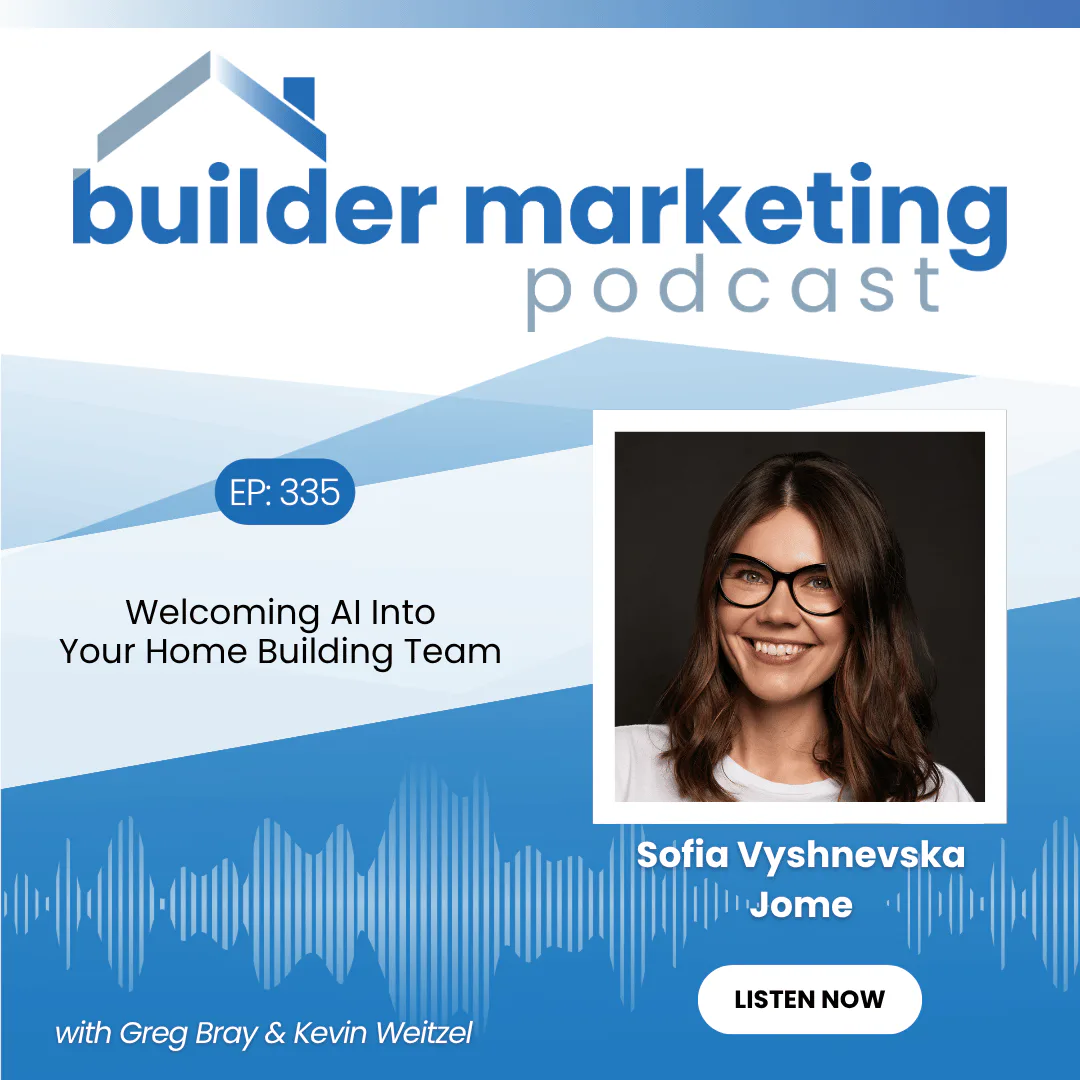
Can offloading your routine follow-ups to AI actually make your home buying experience feel more human? On this episode of the Builder Marketing Podcast, Sofia Vyshnevska of Jome joins Greg and Kevin to discuss how welcoming AI into your home builder team can improve lead management and free up salespeople to focus on building real human relationships, ultimately creating a transparent, seamless journey for home buyers.
As marketing budgets shrink across the home building industry, many home builders are struggling to keep up with the critical task of long-term lead management. Sofia says, “The biggest problem that we see today, especially on this market, builders have less and less budget, less and less money for marketing and also for their internal sales teams. So, sales teams, salespeople mostly focus on walk-ins or, you know, ready-to-go leads. There are lots of leads that went silent, not because they're not interested, but maybe they didn't get the information in time. They were not patient. They were not ready at the time, right? We all know that following up and nurturing is the most important thing in real estate.”
Technology can help salespeople with repetitive tasks, allowing them to focus on building real human connections with home buyers. Sofia explains, “So, salespeople, on-site builder salespeople, they're stressed, they have lots of leads to work through in their CRMs. They have all of these KPIs as well. And then when the person even walks in, very often they don't have energy or capacity to provide this high positive energy to the other person. I truly believe that AI should take all of these routine, you know, follow-up and so on tasks, and leave space for the humans to do very human things.”
The push for digital transformation isn't about replacing people, but about using technology to create a seamless experience for the home buyer. Sofia says, “Don’t be afraid of AI. Don't be afraid of some magical AI substituting everything and people. Our primary goal is the same, to make the journey really, really nice and transparent for the buyers. That's why implementing AI correctly, and where actually it's needed and not forced, is something we're trying to accomplish. So, don't be afraid. Be curious and embrace.”
Listen to this episode to discover exactly where to implement AI in your home builder business without losing the human touch.
About the Guest:
Sofia Vyshnevska is the founder and CEO of Jome, a proptech startup that helps home builders sell more homes with AI. After more than a decade in real estate, including building and running a tech-enabled brokerage with 100+ agents across 30+ markets, Sofia kept seeing the same problem: builders sit on thousands of leads their sales teams can't get to.
So she built Jome AI, sales agents that call and text every lead the moment it comes in, re-engage the ones that went cold, answer inventory and financing questions, and book model home tours, all working alongside the builder's own team.
Trained on 100,000+ real buyer conversations, Jome's AI doesn't just answer questions, it makes buyers feel understood. A Ukrainian-born entrepreneur, Ukrainian-born entrepreneur, Sofia believes people still need people for a decision this big. Her conviction is that AI's role is to empower them, making the experience seamless for buyers and the builder's team alike.
Greg Bray: [00:00:00] Hello, everybody, and welcome to today's episode of the Builder Marketing Podcast. I'm Greg Bray with Blue Tangerine.
Kevin Weitzel: And I'm Kevin Weitzel with OutHouse.
Greg Bray: We are excited today to have joining us, Sofia Vyshnevska. Sofia is the founder and CEO of Jome. Welcome, Sofia. Thanks for joining us today.
Sofia Vyshnevska: Thank you so much. Thank you. Thank you for having me. I'm so excited.
Greg Bray: Well, for those who haven't had a chance to meet you yet, let's just get that quick [00:01:00] background, and tell us a little bit about yourself.
Sofia Vyshnevska: Yeah, sure. So, I'm Sofia. I'm founder and CEO at Jome. I was born in Ukraine. I've spent over the last decade in real estate, basically in tech, in proptech, and the last seven years I've been building Jome. I'm based in Austin, Texas, so really hot right now here. My whole career, you know, comes down to, like, one question: why is buying a home is so hard and stressful for the buyers, and also it's so hard and stressful for the builders to sell homes?So, we started with building tech-enabled brokerage first, but then with the whole era of AI evolving, right, we made a pivot as, I think, lots of companies, and I hope to share more today on this podcast.
Kevin Weitzel: All right. So, Jome, Ukraine, Austin. Lots of movement. New company. However, before we get started in any and all of that, can we find out one interesting factoid about you that has nothing to do with work, family, [00:02:00] or home life whatsoever?
Sofia Vyshnevska: Okay, only one?
Kevin Weitzel: Only one. All we need is one.
Sofia Vyshnevska: I think the most interesting fact is that I'm... It kind of related to family, but I became a mom when I was 17. So right now I have a son who is going to college in a year, and I'm joking that that was my first startup, you know? And so moving around so much was quite hard, I would say. But yeah, I'm super happy that that happened.
Kevin Weitzel: And you have, like, a master's degree. So, with a master's degree, that means you two could have technically gone to school at the same time.
Sofia Vyshnevska: No.
Kevin Weitzel: Oh, okay. No.
Greg Bray: Well, Sofia, let's understand just a little bit more about Jome and what the company is doing, who you serve, and a little bit more about the services you offer.
Sofia Vyshnevska: Yeah, sure. First of all, Jome stands for Joy Of New Home. I really like our name. Today, Jome helps home builders to sell more [00:03:00] homes and for the home buyers to have an amazing home buying experience.
The problem we solve is quite simple. We realized that every builder is sitting on thousands of leads in their CRMs and in their systems. People who are their leads ask different, questions, right? They wanted to know more information, but because of the scarcity of the resources inside the builders' teams, it's very hard to process all of them timely.
So, today we deploy our AI agents to the builders, to help to nurture all of the leads, answer all of the questions instantly, and being an extension to their online sales teams. And on the other hand, we want to provide a great experience for the buyers by digitalizing this process of the home buying journey. So, that's like in short.
Our bigger vision is basically to create a seamless experience [00:04:00] of the home buying journey, and to put the buyer in control kind of, so they have the full transparency, the full information, and instant answers to their questions. But it doesn't mean that we don't believe that the humans should be involved, and I think we will talk about this a little bit later.
Kevin Weitzel: See, the accent kind of got me. You don't believe that a human should be involved?
Sofia Vyshnevska: No, I do believe that humans-
Kevin Weitzel: Oh, do believe. Okay, okay. Just wanted clarification 'cause if I didn't hear it right, maybe our listeners didn't as well. All right.
Sofia Vyshnevska: We should have humans in the process, for sure.
Greg Bray: So, Sofia, then, tell us what is it about home buying that you feel is harder than it should be? Why is it kind of a challenge that you guys decided to focus in this particular market with the technology versus somewhere else?
Sofia Vyshnevska: Yeah, sure. So, we just started in 2019, actually, when we were [00:05:00] accepted to Techstars Austin Acceleration program, we realized that the new construction vertical of the industry is, like, really underserved.
For the buyers to find all of the information, they can't go just on Zillow, let's say, because there is no information on floor plans, under-construction homes, right? Like, what will be my final price on this? What will be my monthly pricing? As AI evolved, so I'll be talking a lot about AI today, but people want the information faster. They now ask ChatGPT, you know, to help them find homes.
The real problem is that even with ChatGPT and everything that we have, the buyer who makes the biggest purchase in their lives, right? It's super vulnerable moment. It's the biggest purchase. They know the least. Lender knows more. Real estate agents, if involved, know more. Builder knows more. [00:06:00] As a buyer, I sometimes don't know even, like, till the end how much are the closing costs or should I pay them now or, you know, later, and so on.
So, we realized that, okay, we want to solve it. Because if we solve this, more people actually would be able to become homeowners. The entrance will be easier. Then we interviewed lots of first-time homebuyers. They had no idea how the process looks like, and that was something very scary, very stressful, and lots of them just dropped this idea to become a homeowner and continue leasing just because of that, just because they didn't have enough information or because they don't know how to approach it. So, this is broken in our opinion, and we can fix it with AI, but this is a long and tedious journey.
Greg Bray: So,when you are talking to a builder, are you [00:07:00] going after their educational content and saying, "Hey, we need to make this better?" Or are you more about how do we answer buyer questions in the moment? What are some of the areas that you help builders with?
Sofia Vyshnevska: Sure. This is a really good question, Greg. Actually think about Jome.ai, you know, as an amazing sales AI agent who has already built-in sales skills and nice conversational skills, objection handling, and so on.
Then what each builder has different, right? It's the brand, it's tone of voice, it's their inventory, their financial tools, like sometimes the buyer journey. That's what is applicable differently for every builder, right? So, we create the knowledge basis based on all of this builder's information, and then we combine that or inject into the Jome.ai [00:08:00] agents. So, we help basically from the beginning when the lead is captured, and we can help, let's say, with the incoming calls, where the lead is calling. We can answer any question because we already built with the builder, the knowledge basis for all of this.
Then when we are talking about the lead nurturing process, we are doing outbound calls, texts, emails, because we are following up within all three channels to make like the best cadence, and then we can see transparently which cadence works and where are the best conversions.
The biggest problem that we see today, especially on this market, builders have less and less budget, less and less money for marketing and also for their internal sales teams. So, sales teams, salespeople mostly focus on walk-ins or, you know, ready-to-go leads. There are lots of leads that went silent, not because they're not interested, but maybe they didn't get the [00:09:00] information in time. They were not patient. They were not ready at the time, right? We all know that following up and nurturing is the most important thing in real estate. That's what we are doing in a tone of voice and with all of the information from the builder's knowledge base.
Kevin Weitzel: So, let me ask you this and keep in mind, I am a firm believer in technology and all the different digital aspects that get interwoven with our processes, but there's certain aspects that have not changed. People still object to the three Ps: people, product, price. That's very simple. People still seek out what they're looking for, and they still have those objections. Those have been fixed. Those are not changing. Those are tangible facts in the process.
What have you seen since 2019 to today in just how people are researching homes? What are the differences that are making your platform and other types of digital aspects relevant or necessary?
Sofia Vyshnevska: Yeah. That's a grea, question, Kevin. [00:10:00] Actually, the basics won't change, right? Because people want to become homeowners. They want to be comfortable with their decision, at least, you know, knowing that they have a good deal or that's the right step to make.
Back in 2019, or let's call it like pre-AI era, pre-ChatGPT era, people were using mostly like portals, filtering the homes, going on Zillow and just looking, like, what's there. They were also using real estate agents, still working with real estate agents, and MLSs, when the agent does like a better probably job on finding, like, some homes and something like where MLS.
I think today, before people even think about committing to a real estate agent or starting real research, they go to ChatGPT, Claude, I don't know, and they start, you know, asking questions like, "What are four bedrooms homes are there in this neighborhood? [00:11:00] Maybe you can advise me a better neighborhood. I have two kids, I have this." You know, and they start just, like, chatting.
Research, in my opinion, changed a lot with that. Before people were, like, looking just for homes, again, on portals. Right now, they are looking for the assistance in their decision-making process. You know, like, is it even a good time right now to buy a home, or for me particularly to buy a home? Am I, like, in a good position? And still affordability is the biggest challenge and the biggest question every potential home buyer asks. So, they're asking this as well. But there are lots of issues with this research, as well.
Greg Bray: [00:12:00]
Hey, everybody. This is Greg Bray from Blue Tangerine, and I am so excited to let you know that the registration is now open for the 2026 Builder Marketing Summit. We're gonna be in Dallas, Texas this year on September 23rd and 24th, and we are working on an amazing lineup of marketing, OSC, and leadership content for you.
Please check it out at buildermarketingsummit.com and get your registration in today. Remember, there's limited seats available, so don't miss out. Again, buildermarketingsummit.com. Can't wait to see you there.
So, you hinted at this earlier, Sofia, but this balance between AI support and the human, whether that's the online sales counselor or the on-site salesperson for the builder. Help us kind of understand your thoughts on where those lines are. Where is AI good? Where should it not be in the process, and some of your thoughts in that direction.
Sofia Vyshnevska: Thank you. I truly believe that people's behavior is changing. But people want other people, and they want this human, genuine connection. We are talking about the biggest [00:13:00] purchase, So, I really want someone to help me, you know, or even support me that I'm doing this right, that I'm doing the right step. So, in my opinion, everything that can be searchable online and that the answers I can get easily, that will be AI.
And also, like, speed to lead, right? If I want to tour, I don't want to wait a day or even couple of hours for this tour to be confirmed, because why can't I just book a tour right now. If I want to get the price for this house, why should I call and chat. Or I can call, but I want to have the instant reply. People hate IVRs, and I hope that we will, you know, move on from this technology. And actually, voice AI agents can absolutely perfectly substitute that. So, again, where speed is so important, AI should [00:14:00] handle it.
Everything that is on-site, I truly believe that, of course, there are people who want to tour themselves and just go on their own. But mostly people will just need someone in that model home or in that community when they're touring just to help to imagine or dream. Imagine how you can put here the Christmas tree, you know? Or like, look how light goes through the windows, or like, here is the porch, you can do this and this here. This is only genuine, human connection. It's not about AI.
So, salespeople, on-site builder salespeople, they're stressed, they have lots of leads to work through in their CRMs. They have all of these KPIs as well. And then when the person even walks in, very often they don't have energy or capacity to provide this high positive energy to the other person. I truly believe that AI should take all of these routine, you know, follow-up and so [00:15:00] on tasks, and leave space for the humans to do very human things.
Greg Bray: So, when you are advising builders in implementing an AI tool, whether that's a chat or a verbal phone type of agent, a verbal conversation, do you recommend that they are open about, "Oh, this is AI answering you," or do you make it pretend to be a person and try to trick the buyer into thinking they're talking to a person when they're not? What are the best practices that you recommend?
Sofia Vyshnevska: That's such a good question. I'll be honest with you, we hear lots of objections about that from the builders, you know, that we don't want our brand to be associated with AI, or we don't want to have robocalls. The thing is that once AI becomes so natural, and I think that in a year, you won't be able to differentiate it from the human's voice.
I don't see the problem right now [00:16:00] that people drop off or disconnect because that's AI. We present it as the digital assistant, and our voices are very natural. Some people don't even understand, even though we are telling them upfront that this is the digital assistant, and when they're asking, "Is it AI?" We say, "Yes."
I want to share one really cool example we had with one our clients, one builder. One lead wanted to leave the review to the management for the AI salesperson, and our AI agent said, "But I'm like digital assistant. Do you want, like, me to connect you with a human?" He's like, "No, no, no.You did great. You listened to me. I talked about everything I wanted." Our whole team was celebrating this because we are basically the management of this AI agent.
So, I think that in general, the market and the human's perception is changing [00:17:00] because two years ago, those were robocalls, right? We don't like it because they're not helpful. That's the thing. With AI, it's not just about that this is AI. But if it works really well and it answers your questions and, you know, it fulfills its responsibilities, then I like AI. People are using ChatGPT as crazy. They have it as their therapist, doctors, teachers, you know, because it's helpful, and they can be very open and straightforward with this.
Kevin Weitzel: Greg, I know for a fact that Sofia's onto something here, and I'm going to tell you why. I worry every day of my life that Tina, my girlfriend, is going to leave me for her boyfriend, I'm using finger quotes, her boyfriend, Bob, who's the name that she gave her ChatGPT agent that she uses to answer all of her questions, because apparently my answers aren't good enough anymore. So, you're onto it. I think that that buyer wanting to leave a review for the AI agent, that's completely realistic.
Sofia Vyshnevska: Yeah, yeah. And you haven't asked me this [00:18:00] question, but I will reply, you know. Should we be scared of AI, how builders sales team should be scared of AI? I think that no, it transforms, for sure, how we work and how we do things. But I truly believe that there is no magic. We have AI and it will solve everything. No.
Kevin Weitzel: Philosophical aspect of that, because I hear you, and I do hear the language of it's not here to take your job, it's here to enhance your job. What do we tell to the people that look back at phone operators that don't exist anymore? Or carburetor technicians that don't exist anymore, because now electronic systems have completely revamped and automated phone systems. So, do you think that they're dumbfounded, or are they legit in their worry that their potential job could be taken over?
Sofia Vyshnevska: Yes. I think that I'm quite the right person being Ukrainian. So, I think that AI [00:19:00] definitely is taking over some jobs. It's inevitable. The only thing is whether we embrace it and change, or we continue complaining or trying to be blind that it is not happening. No, it is happening. It has already happened and I'm in tech, right? Lots of software engineering job has been taking. But I want to tell you this, it's about this embracement.
So, yes, we will have bugs and glitches. It's not perfect. We need to work, for example, together with a builder in our world to make it work. Lots of things are very fundamental and basics that AI can do. To create, like, a really good workflow, to understand and, like, teach AI how to handle this or that situation. Lots of new jobs appearing. For example, prompt engineering or, like, how we make the AI, like, behave, you know, in this or that, situation. So, I would say that being open [00:20:00] and really understanding the reality, and trying to be positive about it, at least trying to be, because I am positive. I like changes, you know, in general. So, it can get us, and especially builders, to a different level.
Because let me tell you also this. Again, I'm from tech world mostly, so I didn't have any broker's license, real estate license. I never did that. I was always in the tech world. So, there is such a gap between the real estate industry and the tech world, the possibilities and capabilities that are there. But there is not enough expertise in the real estate world that I think this is our second mission, to just merge step by step this gap. It's a hard work. It's a challenging and hard work.
Greg Bray: So, Kevin, I do need to say, though, that you should fear Bob. You need to fear Bob. You need to step up your game because Tina's worth [00:21:00] it, and you can't let Bob get in there.
Kevin Weitzel: Brother, I've even tried coming at the angle of Bob can't give you a hug. Bob won't rub your feet while we watch a movie. Bob won't do that. But you know what, though? I'm worried that AI's going to figure out a way to give out hugs. Who knows? Should I worry about that or, or is my hugs factor still a safe factor?
Greg Bray: Those active listening skills, Kevin.
Sofia Vyshnevska: I still want hugs, you know? I don't want a robot to give me hugs.
Kevin Weitzel: I still have value. All right. Fair enough.
Greg Bray: All right. Awesome. Well, Sofia, this has been great conversation. We appreciate your insights that you've shared today so freely. Any kind of last thoughts or words of advice for builders that you'd like to share before we kind of wrap up?
Sofia Vyshnevska: Don't be afraid of AI. Don't be afraid of some magical AI substituting everything and people. Our primarily goal is the same, to make the journey really, really nice and transparent for the buyers. That's why implementing AI [00:22:00] correctly and where actually it's needed and not forced is something we're trying to accomplish. So, don't be afraid. Be curious and embrace.
Greg Bray: Well, thank you again, Sofia, and thank you everybody for listening today. I'm Greg Bray with Blue Tangerine.
Kevin Weitzel: And I'm Kevin Weitzel with OutHouse. Thank you.
Sofia Vyshnevska: Thank you so much.