EP: 137
Creating and Posting Social Media Content
With Kelly Borgen
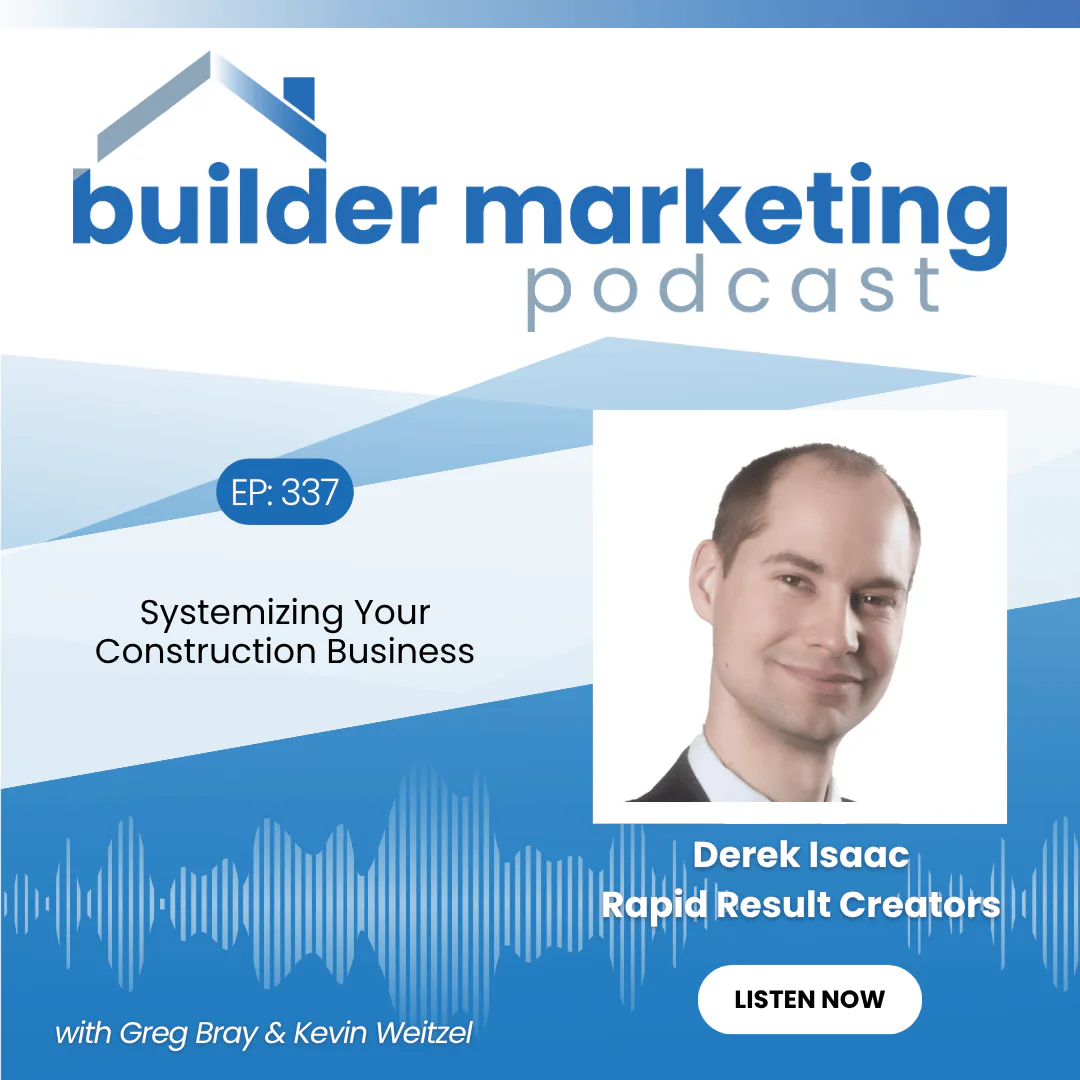
Is your home building business growing by design, or are you just surviving each day as it comes? On this episode of the Builder Marketing Podcast, Derek Isaac of Rapid Results Creators joins Greg and Kevin to discuss how home builders can systematize their businesses to scale true growth and enjoy more freedom.
Some home builders mistake being indispensable for being successful. However, constant overwork usually signals a structural issue that caps business growth. Derek says, “The time aspect, I guess is the biggest flashing alarm. If you're spending over 40 hours in your work because you have to, essentially you are the bottleneck of the business. You are the superhero. That's great for a little while, but obviously it doesn't last, and you burn out, and you realize that you're usually stuck because you're not making the money you want to, and you're working a lot more than you should be.”
Construction business owners must resist the urge to do everything themselves and instead build a team of specialists. Derek explains, “Do what you're good at but realize that you're going to have a temptation to stay there and not focus on the other areas like you mentioned. Could be marketing, finance, and I would hire competent people for those positions. You should learn and understand it, read some books, get a coach or mentor in those areas, hire an agency, whatever it is. But find someone who is good in those areas and utilize them is what I would suggest.”
When home builders feel overwhelmed by the pressure to scale, the best path forward starts with pacing yourself and seeking outside support. Derek says, “Just take a breather. Realize that you'll get to where you want to go. Don't over-push yourself just to grow a bigger business or have larger revenue, those kind of vanity things. Realizing that it's okay for things to be a bit off, but take those first steps, prioritize, stay focused, and keep moving forward. Reach out for help. There's more help nowadays than ever from many different types of people. So, if you're struggling in one area, pick up a book and read about it, reach out to help, somebody you know in your network or, you know, agency, coach, what have you, and look for a solution. Business is a team sport. Lone wolves don't make it very far. If you want to be successful, it's going to take other people.”
Listen now to scale your home building business without increasing your workload.
About the Guest:
Derek Isaac is a business systems coach who helps general contractors transform owner-dependent operations into organized, profitable companies that run with clarity and control. With over 20 years of experience in construction contracting and real estate investing, he understands firsthand what it takes to scale without chaos.
Derek specializes in installing practical systems that improve operations, financial visibility, and team accountability so contractors can grow without being trapped in daily firefighting. Through coaching, programs, and live training, he helps builders reclaim their time, increase profitability, and build businesses that work, even when they step away.
Greg Bray: [00:00:00] Hello, everybody, and welcome to today's episode of the Builder Marketing Podcast. I'm Greg Bray with Blue Tangerine.
Kevin Weitzel: And I'm Kevin Weitzel with OutHouse.
Greg Bray: And we are pleased to have joining us today Derek Isaac. Derek is the founder at Rapid Result Creators. Welcome, Derek. Thanks for joining us today.
Derek Isaac: Yeah. Thanks, Greg. Glad to be here.
Greg Bray: Well, let's start off and just get a little bit of that quick background. Tell us a little bit about yourself and things you've been working on.
Derek Isaac: Mm-hmm. [00:01:00] Definitely. So, been in the construction industry over 20 years now. Started on the tools cleaning up and moving lumber and whatever else they needed done, and worked my way up from there. Learned how to frame and build houses. Like any good entrepreneur, figured I could make a business out of it, so I ventured off onto my entrepreneurial journey. Started a subcontract framing company, moved into remodels and home building and general contracting. Had some good success, had some good failures. Through everything, lived and learned.
I hired a bunch of coaches myself and learnt as much as I could, and just picked up a lot of information along the way. Started coaching some local business owners and realized how much you pick up and how much people don't know when they're starting out. And even if they've been in business for quite some time, there's just so much to learn. The big differentiator for us was systems and processes and bringing some organized professionalism to construction businesses. So, that's what we [00:02:00] do now. We help contractors get organized so they can get some time back, a little peace of mind and put more money in their pocket.
Kevin Weitzel: Well, that's a lot. And before we jump into all that, let's get a factoid about yourself that has nothing to do with the home building industry, work, or family.
Derek Isaac: Definitely. So, I enjoy getting outdoors. I like to dirt bike and snowboard, anything a little extreme. Getting a little older now, so I can't, you know, push it like I used to, but still like feeling the adrenaline rush and getting out there.
Kevin Weitzel: Now are we talking like mountain bikes, like specialized track? Are we talking about like motorcycles like Bull Taco and Husqvarna and KTM and stuff like that?
Derek Isaac: Yeah. So, motorcycles, dirt bikes, off-road vehicles. I don't race track or anything, but I like to go out on trails and up the mountains and around. Then in the winters, a lot of snowboarding. And other than that, you know, some camping and the odd fishing trip and things like that. So, definitely enjoy the outdoors.
Greg Bray: Derek, At Rapid Result Creators, you already kind of hinted at what you do, but give [00:03:00] us a little bit more about the services specifically that you provide and kind of who your audience is that you're trying to work with.
Derek Isaac: Yeah, definitely. So, a typical client will come to us, normally, they're doing roughly 2 to 5 million in revenue. They're a general contractor. They're probably building a handful of homes a year or doing some larger remodels, and they've essentially limited out on the size of their business, what they can handle. Maybe they've hired a project manager, they've got a small team, but running around wearing all the hats and just don't know how to put proper process and systems in place. That's where we come in.
We've built out many general contracting businesses. We've got the templates, we've got the structures. We will customize those to the builder. We will utilize their software if it's good. If not, we'll suggest that they get on something else. But essentially, we bring processes and systems into the business. The way we do that is very prioritized. So what is the big pain point? What [00:04:00] is the low-hanging fruit, if you will? Normally, making sure the pricing is right, financials are strong.
Because there's no reason to grow a business if you're not making money because you're just going to make not much more money. The bigger you grow, and it's going to probably get harder than easier. So, typically, they're at that point where they know they need some help with getting structured and enabling them to then unlock more growth as they scale up to, you know, 10 plus million or so. That's a normal trajectory, and we work with contractors in those ranges typically.
Greg Bray: So, when you are talking to this owner for the first time, what is kind of the big flashing alarm that says, "I need help. I'm the problem. I'm causing my company to not be able to move forward"?
Derek Isaac: Yeah. The time aspect, I guess is the biggest flashing alarm. If you're spending over 40 hours in your work because you have to, essentially you are the [00:05:00] bottleneck of the business. You are the superhero. That's great for a little while, but obviously it doesn't last, and you burn out, and you realize that you're usually stuck because you're not making the money you want to, and you're working a lot more than you should be.
Kevin Weitzel: So, let me ask you this, how hard is the conversation to have with an owner that maybe the owner is the problem? Maybe the owner doesn't want to allow enough delegation responsibilities on operations, or doesn't see through the clouds to see that, hey, I need to start marketing my company differently than I have been.
Derek Isaac: Definitely. Usually by the time we have a conversation with someone, they have realized that they do need some help or at least need to have a conversation around it. So, a majority do understand that there is a knowledge gap or a competency gap, leadership gap, whatever it may be, that they need to solve, and that just putting their head down and working harder is not going to get them to the finish line where they want to go.
We do run into the odd time where the owner maybe understands that, but doesn't [00:06:00] really own it, and they feel like they need to get their people on board or change personnel or their clients aren't good or whatever. There's 101 reasons. So, in those situations, we typically wouldn't work with those clients because they don't really see the value, and they haven't really put two and two together that they may be the issue. They want to fix everybody else or everything else around them, but not work on themselves and take that step to actually get proper help.
Greg Bray: Have you found, Derrick, that the owners that we're talking about... And again, we have the utmost respect for these people. They're trying to create a company and a business. So, I don't want us to come across that we're, like, ragging on them, that they're just the problem. The reality is, is that as you grow, there's only so many hours. Even if it's more than 40, there's still a limit to how many you can do.
These folks that are kind of hitting that, they're good at the building part, they're good at the product because that's where they kind of came from. And then now, they have to understand, oh, well, I [00:07:00] have to deal with accounting, and I have to deal with marketing, and I have to deal with sales, and all these other things that are outside of what I enjoy, which is the creation of the product. Which of those things tend to be the ones that get in their way first? Is there one that's more than the other or is it kind of just all over the place?
Derek Isaac: Yeah. Thanks for making that distinction, Greg. Not ragging on, you know, contractors or anything like that. The industry is extremely challenging and very difficult. The reason I was kind of going on with that is just, like, as an owner, doesn't matter what business you're in, you need to take ownership for your boat, if you will, and get everybody working in the same direction.
Now, yes, typically, I was the same way. You're good at what you do. You technically know how to build or whatever trade that you do, and you're good at that, so you tend to want to stay in that even when you start a business, and I think that's also where people go wrong is, like, that's your comfort zone, right?
Getting on site, talking to guys, scheduling trades, [00:08:00] managing projects. That's your level of, you know, expertise of genius, and often why new business owners, or even experienced ones, will shy away from learning the financials or understanding marketing or some of the other, you know, more administration side of the business. Not that they need to know all of that necessarily, but that needs to be a focus and there needs to be some systems in place there.
Now, ones that I often see lacking is the financial side of the business, with not really understanding the numbers. Maybe you get your P&L, profit and loss statement, at the end of the month or you check it every now and then. But often there's just a disconnect with really understanding what those numbers mean. It's going up and down every month, so how to actually view the numbers and the trajectory that's happening.
Check out your balance sheet, accounts receivable, understanding the finer tuning of your business, and how that translates into your pricing and your estimating, that whole [00:09:00] system, I find, is usually a little bit unclear for contractors, and one of the reasons why sometimes you'll get to enter a project or end of the year and ask yourself, like, you know, where the money goes. It's not in my bank account, so what happened?
Kevin Weitzel: I've got a two-parter for you. Part one is I've always kind of thought business ownership, because I've owned my own businesses as well. Business ownership is kind of put into four tiers. You've got the administration/accounting. You've got your sales. You have your marketing, and you have your operations, and they're all four different beasts.
And I think that people tend to, kind of like a personality trait, they tend to go toward one of those four points in that square, or maybe two of them. Do you think that they should, one, find out what they're good at or get maybe some guidance as to what they're good at or what they have passion for and then hire in the rest?
Derek Isaac: I think playing to your strengths always makes the most sense. You do need to shore up maybe weaknesses, or it may not even be a weakness. It might just be you don't enjoy that part of your business or doing that thing. So, I would [00:10:00] suggest if you're good at sales, stay in sales. If you enjoy doing the project management, I mean, eventually you're probably going to want to pass that off.
Do what you're good at, but realize that you're going to have a temptation to stay there and not focus on the other areas like you mentioned. Could be marketing, finance, and I would hire competent people for those positions. You should learn and understand it, read some books, get a coach or mentor in those areas, hire an agency, whatever it is. But find someone who is good in those areas and utilize them is what I would suggest.
Greg Bray: [00:11:00] Hey, everybody. This is Greg Bray from Blue Tangerine, and I am so excited to let you know that the registration is now open for the 2026 Builder Marketing Summit. We're gonna be in Dallas, Texas this year on September 23rd and 24th, and we are working on an amazing lineup of marketing, OSC, and leadership content for you.
Please check it out at buildermarketingsummit.com and get your registration in today. Remember, there's limited seats available, so don't miss out. Again, buildermarketingsummit.com. Can't wait to see you there.
Derek, as someone's trying to grow, there comes a point where word of mouth doesn't do it anymore, just the general kind of I'm out there, my happy customer told their friend. It's just not where you can get. You have to start building a sales and marketing engine to really do that. So, let's peel that back because it doesn't matter how good you are at building, if there's nobody calling to buy, it just doesn't matter. How do you start teaching an owner who's ready to grow? What do they do first from a marketing and a sales standpoint with those types of systems?
Derek Isaac: So, just a quick touch on the mindset. The place where you want to be is having high demand, and you want to cap your production so that you're not always trying to just meet demand and take on every project that you can get, but you're actually scheduling them farther out in your pipeline.
I made this [00:12:00] mistake. We grew fast, tripled our revenue in one year, and didn't make any money essentially, because we pushed things too far. Pricing was off. But we made that mistake of focusing on lead gen and marketing, and then felt like we needed to push every sale and get every job done as fast as possible.
The reason you want to spread things out is so that you've got a pipeline ideally lined up for six months, 12 months, maybe farther, so that you're not stressing about minor ups and downs in leads. Because it's going to happen with any marketing system, I've found, is there's always seasonal or economic reasons for things to go up and down.
Now, as far as the systems go, everything stems from that ideal client profile, so getting really clear on who you're working for, what kind of projects you want, having your branding on point, your messaging on point. So given that you have that, then a good CRM system for tracking leads, getting them in your system. I like to have some nurture sequences set up with emails.
[00:13:00] Whatever can be automated that makes sense to have some automation around there, and then having warm touch points for anybody that reaches out. If they send you an email or a phone call, making sure they're on the phone or they're getting an email from a human as quick as possible. Speed to lead is a common saying in the industry and that's important.
And then just having the playbook for it. So, if someone reaches out, who calls that person? What do they say? What questions do they ask? What differentiates a good lead from a not so good lead? Who is the next person to touch the lead as far as, like, do they move to a consultation call, discovery call? Is it an in-home visit? Just having that all dialed in so that to the person reaching out, it just feels like a really warm introduction, and that they're just sort of on this conveyor belt that's just bringing them along in the process of, like, "So happy you called. Next thing is talk to, you know, our rep," or the estimator or design person or whatever. And you move them along so that they just [00:14:00] naturally progress towards wanting to work with your company.
Greg Bray: With the idea of building out a marketing and sales engine, when is the time to hire that dedicated marketing resource that's in-house versus trying to keep doing it yourself or possibly bring in some type of an outsourced agency or partner, in your opinion?
Derek Isaac: Mm-hmm. Yeah. Typically, there's a progression there. It'll also be a little bit of preference in the business as far as if you want to use, you know, in-house marketing or hire a professional agency. Probably both is the best approach for most builders because you can hire some good in-house people, but they're not going to have the wherewithal or the capacity of a good marketing agency that works with a lot of different companies.
That said, I like to usually start utilizing the people that are in the business, which is most of them will have some sort of office staff, and you probably have someone that can create some basic social media posts or put some, you know, blog articles [00:15:00] together with input and insight. So, creating a process and system there again that maybe you as the owner are suggesting topics or materials because you're closest to the clients, or if you've got a salesperson answering questions or what's top of mind or content that you think produces well.
So, you're kind of providing the raw materials as far as ideas or maybe video, pictures, what have you, and then someone in the office can put that together into content and get it out to the different channels. I think that's probably one of the easiest kind of systems to set up and have in-house marketing.
As far as the more technical aspects like websites, SEO, paid advertising, normally I would outsource that to an agency, or at least someone competent that can set that stuff up for you. Because you'll probably burn through a lot of money and not get the best results through a lot of trial and error. That's what I usually see and things that we kind of help our clients with as far as, like, getting that internal content machine [00:16:00] going.
Greg Bray: What are some of the biggest mistakes you see in this whole kind of lead nurture sales management process where you want to just scream when you walk in and you see some of these things that are like, "Oh my goodness, what is going on here?"
Derek Isaac: Mm-hmm. There's a number of them. Things that I see often with my clients is one of the first things is that refining process of you're offering too many services to too many people in too many areas. Even though you may continue to work with a wider range, at least the marketing and the ideal client profile should be set so that there's some consistency and clarity there. So, that's one, is just offering too much, too many services to too wide of an audience.
The other one that I see quite a bit is just a lack of coverage, I guess, in the online world. Like, you can be on every social media platform essentially for free. [00:17:00] Email marketing is more or less free. There's all of these low cost ways to at least be in those spaces without a whole lot of input, and you can put content out across many different channels. So, something to that degree, of just getting out there more.
And then also dialing in their website. Physical marketing is always a big one, too. Look professional. You don't have to have, like, fully wrapped vehicles, but you should have a nice at least logo or decal on it. Have some nice shirts. Have your signs out on every property. Make them look like signs of the type of clients who are actually going to be appealing to work with you and those kind of things. So, just being exposed on all the different areas is a big one. There's lots of low-hanging fruit available in marketing.
Greg Bray: In today's AI world, what are some of the ways you're seeing some of your clients leverage these newer tools to get more efficient and do a better job with their marketing?
Derek Isaac: Yeah. So, I think copywriting, like [00:18:00] writing the actual copy for blogs or social media is huge. Of course, you need to at least run it through a few times. Typically, it's getting better and better, but it starts to sound all the same, which you don't want to be. You want to be unique and specialized. So, having that ideal client profile, and having that documented so you can provide those branding materials, the messaging or whatever guidelines to the AI, so that it is using your voice or writing style. So, that's a huge one.
There is lots of opportunity for, like, chatbot kinda things even though it's AI. If you have an overwhelming amount of outreach or social media messages, they can kinda curate some of that, which I've seen. Although, I don't like to just let AI loose on conversations with clients. Especially, like, if you're in the home building world, where you're probably not getting, you know, 30 leads a day or anything like that. So, you should be able to have a human to [00:19:00] handle it. Plus, the average project size are quite large, so it's worth having a human touch.
But the way I look at AI is even if you can figure out a process where it can save you a minute or two a day or even a couple minutes a week, if you're doing any sort of repetitive work, typically you can utilize AI to just get those little things off of your plate or your people, as well. It makes life a lot easier essentially. I think copywriting's still the strongest.
Kevin Weitzel: So for clients you've worked with, there's a fork in the road. You've got those that are growing successfully and practicing what they preach, and what you preach I should say, or what you consult. And then there's some that just fall by the wayside and just continually just step on their own shoes, get in their own way. What is the factor that differentiates those that succeed and those that are just never getting out of their own way?
Derek Isaac: Great question. If I could boil it down to one thing, it boils down to leadership and being able [00:20:00] to lead a team is what's the big differentiator. The guys who are kind of, I would say stuck, but some of them are, as much as they may not like working the long hours or dealing with the headaches, they're kind of okay with where they're at. They're making money. Yeah, they work a lot, but they've kind of come to grips, if you will, with whatever sort of level that they've reached.
And then there's the ones who do want that freedom and that larger success, who want to build out a team, who want to level themselves up as a leader and a manager of their company. Those are the ones who are willing to put in the work that will enable them to get there with building out structure, hiring proper team members, delegating to those key team members, allowing those team members the space to do their jobs and responsibility to take accountability, but also being very clear with checks and balances, team meetings, and leading from the front, instead of pushing from the [00:21:00] back.
I see that as kind of the big differentiator is, changing the hard work from managing the business to the hard work of, like, becoming a better leader and using your skills as a leader to build that team that can do what you do on the day-to-day.
Greg Bray: And Derek, we all wish that we could just wave a magic wand and become something better and different and all that, and sometimes that can be a little overwhelming. Can you boil that down to maybe just one thing to look at first, you know, for that person who's looking, "Oh my goodness, this is all great. I wish I had it all, but I can't do that today. I'm too busy"? What's like one first step that they could consider?
Derek Isaac: Yeah. Just to prep that, that process can take years. This is definitely not an overnight thing. It takes years, and it's one step at a time. For me, the first step to most anything, if you want to go from A to B, whatever that B is for your future, is prioritize and focus.
I've come to [00:22:00] realize that in my life and many of the other successful people that I know, essentially they're very focused, and they prioritize what matters most. Determining what that is and blocking out the noise can be very difficult, especially when you've got a lot going on. But realizing what is the priority, what is the one little thing that I'm going to work on that is the most important, even if I can only carve out one or two hours a week, I'm go that one thing. Keep going until that's in a good place, and I can move on to the next thing. So, prioritizing and focus.
We do this with our clients when we first onboard them. We have a big assessment of their business, where they're at, where they want to go, and then we set very clear priorities. We let them know that, yes, there's a lot of problems that we need to solve or a lot of opportunities to put solutions and systems in place, but we're just focusing on this area. We'll tie up a few loose ends if we need to, but we're very focused in one area. Let's get [00:23:00] that running to a good level, where the flywheel can start to turn, and then we'll move on to the next, you know, function of the business or next system.
Greg Bray: Thanks, Derek, so much for the time you spent with us today. Any last thoughts or words of advice that you'd like to share with the audience before we wrap up?
Derek Isaac: Definitely. Just take a breather. Realize that you'll get to where you want to go. Don't over-push yourself just to grow a bigger business or have larger revenue, those kind of vanity things. Realizing that it's okay for things to be a bit off, but take those first steps, prioritize, stay focused, and keep moving forward. Reach out for help. There's more help nowadays than ever from many different types of people. So, if you're struggling in one area, pick up a book and read about it, reach out to help, somebody you know in your network or, you know, agency, coach, what have you, and look for a solution. Business is a team sport. Lone wolves don't make it very far. If you want to be successful, it's going to take other people. So, those are the things to focus on for me. [00:24:00]
Kevin Weitzel: And a lone wolf can't pull a sled very well either. You need a whole bundle of huskies. So speaking of reaching out for help, if somebody wants to get ahold of you, like a listener or a, you know, builder or remodeler, what's the best way for them to get in contact with you?
Derek Isaac: Definitely. So, head over to our website, rapidresultcreators.com. If you Google us, it should come up as well. And from our website, we've got tons of good information there, bunch of free stuff. We've got links to book a strategy call to get on a call, and we can talk through what's going on in your business and show you what our programs can do for you.
Greg Bray: Well, thanks again, Derek, and thank you everybody for listening today to the Builder Marketing Podcast. I'm Greg Bray with Blue Tangerine.
Kevin Weitzel: And I'm Kevin Weitzel with OutHouse. Thank you. [00:25:00]