
EP: 241
The Value of Data Management
With Kyle Lintala
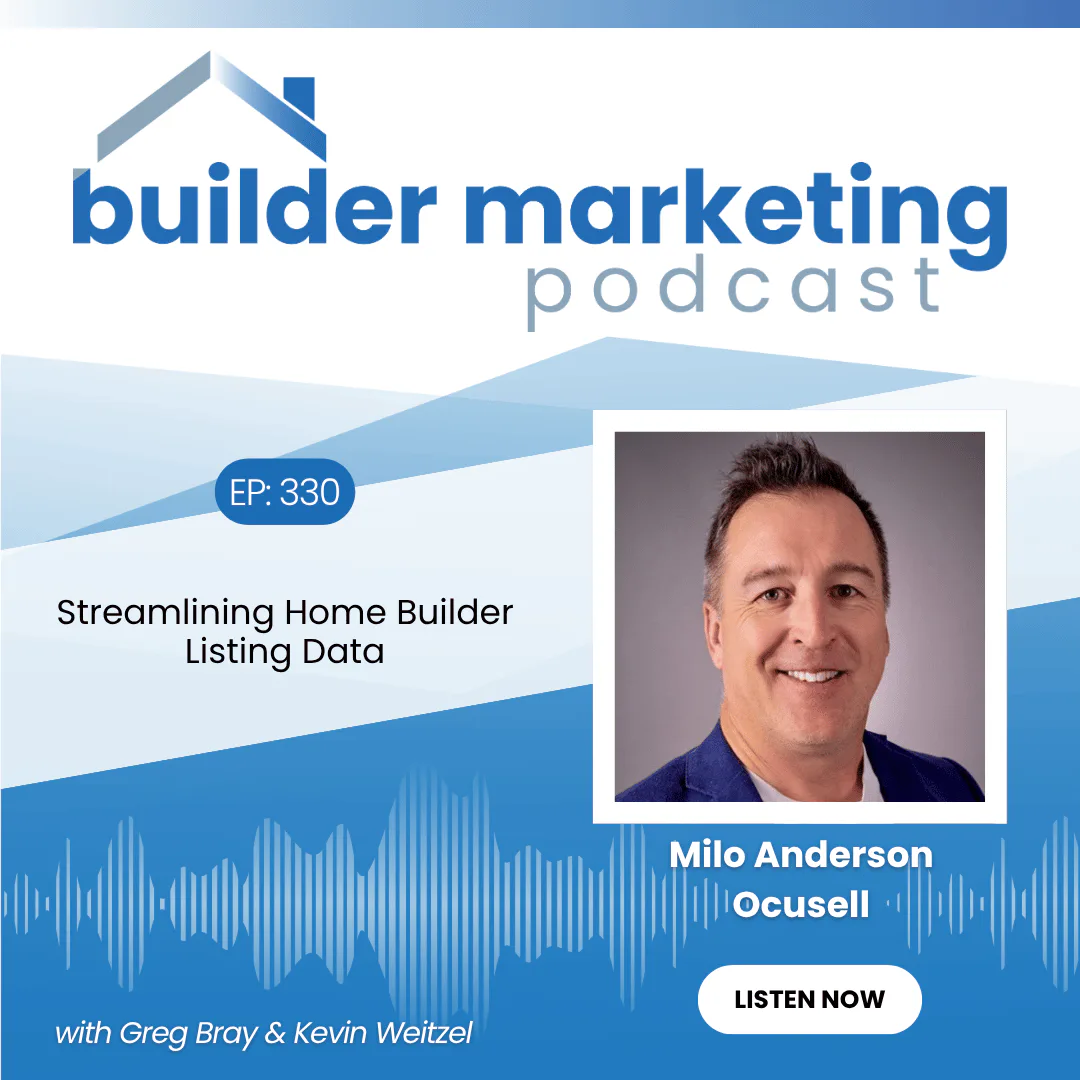
Tired of entering the same listing data over and over again? On this episode of the Builder Marketing Podcast, Milo Anderson of Ocusell joins Greg and Kevin to break down how home builders can eliminate duplicate data entry, protect data integrity, and streamline marketing workflow without duplicate work.
At its core, efficient home builder data management bridges the gap between operational efficiency and consumer satisfaction. Milo says, “How does it make it easier for their customer base to get those listings on and manage them correctly, and do it efficiently, do it quickly? Because fundamentally, the audience is the consumer, and the consumer needs accurate data, they need it efficient, they need it searchable.”
The real challenge for builders isn't a lack of organization, but rather the highly fragmented rules and interfaces of different listing platforms. Milo explains, “So now, picture each one of those MLSs has different data requirements. A lot of similarity, you know, bedrooms, bathrooms, square footage, but some differences as well. Even the terminology, like I said, rancher, bungalow, those kind of things. And then each one of those MLSs may have a different provider, so the UI is also different. And so, they have to train different people on different MLSs of how to do different things. So, I think for builders, it's a lot of work. Builders already have their data at a very high digital level. They're using ERP systems or custom databases and so forth to manage and build.”
The ultimate goal of modern real estate technology is to eliminate the friction, cost, and mistakes caused by manual data entry. Milo says, “Well, if builders could really change one thing about how listing data moves through the real estate ecosystem, I think it should be that data should only really be created once. Every time a builder enters the same information in another system, they introduce cost, they introduce delay, and potential for human error, period. I think the future that they should really be looking at is, "How do I make this a single source of truth feeding every channel automatically?" And there is now solutions to do that.”
Listen now to discover the tools you need to eliminate duplicate listing work for good.
About the Guest:
Milo Anderson brings over 23 years of experience as a real estate agent combined with more than a decade working directly with home builders on their marketing, sales and technology workflows. His career has spanned organizations such as Constellation, Re/Max, and eXp with a focus on understanding how builders bring inventory to market and how operational decisions impact buyer engagement and sales performance.
Having worked closely with production and regional builders, Milo has firsthand insight into the challenges of managing listings across multiple MLS systems, coordinating internal teams and maintaining consistency between sales, marketing and public-facing data. He has seen how inefficiencies in these processes can slow down sales, create confusion in the market and impact overall performance.
Milo’s perspective bridges the gap between on-the-ground sales realities and the operational systems behind them, offering practical insight into how builders can improve listing visibility, streamline workflows and ultimately increase market exposure and sales results.
Greg Bray: [00:00:00] Hello everybody, and welcome to today's episode of the Builder Marketing Podcast. I'm Greg Bray with Blue Tangerine.
Kevin Weitzel: And I'm Kevin Weitzel with Outhouse.
Greg Bray: And we're excited today to be joined by Milo Anderson. Milo is the director of home builder development at Ocusell. Welcome, Milo. Thanks for spending time with us today.
Milo Anderson: Oh, thanks for having us on. Really excited to have a conversation with you guys today.
Greg Bray: Well, Milo, start out by just giving us that quick introduction. Tell us a little bit about yourself and your [00:01:00] background.
Milo Anderson: My name is Milo Anderson. Been a long-term realtor, about 23 years. I've also done a whole lot of software development with companies as far as Constellation Software, and now with Ocusell. So, what I do with Ocusell is I lead the builder initiative there. Our focus is helping builders kind of streamline and manage their listing data, and then help them connect it to MLSs and brokerages and just ultimately make it easier to market and sell their homes at scale, I guess, is a good way to put it.
Kevin Weitzel: All right, we're going to jump in all that. But before we do, we need an interesting factoid about yourself that has nothing to do with family, the home building industry, or your job in general
Milo Anderson: Can it be a promo? No, I'm just kidding.
Kevin Weitzel: That's funny.
Milo Anderson: Are you familiar with Monty Python and Search for the Holy Grail?
Kevin Weitzel: Absolutely.
Greg Bray: Of course.
Milo Anderson: Milo Anderson is the author of the next version of that movie coming out. So, if a director's out there and wants to find out about that script, it is published and available, and we're looking for the next level. So, in Canada, where I'm from, [00:02:00] the Holy Grail is known as the Stanley Cup. And so I've merged the initial Holy Grail with the new Stanley Cup Holy Grail. So anyway, if you want to see it one day, let me know. I got the script for you.
Kevin Weitzel: You're, like, pushing this out, trying to find some investors.
Milo Anderson: 119 pages.
Kevin Weitzel: Wow.
Milo Anderson: Scripted, ready to go, written over the last couple years with a colleague of mine. We're ready to go. It's kinda the next fun step for me.
Kevin Weitzel: Do you need a right wing or a defenseman with sideburns that's overweight to be one of the key players?
Milo Anderson: There is some characters in there that actually, believe it or not, represent more like Lord of the Rings on the orc side as well as elves. So, you could choose one of those sides if you want to, I guess.
Kevin Weitzel: I'm more like an orc. Possibly a goblin. I guess the dwarf would be about the best.
Milo Anderson: Okay. So, not what you were expecting, I'm sure.
Kevin Weitzel: I do like that it tied back to hockey, you know, being that you're a Canadian. I do appreciate that, and the fact that it's not letter Kenny based, right?
Milo Anderson: Well, it's got some humor in there for sure.
Kevin Weitzel: Right.
Milo Anderson: Yeah.
Greg Bray: Well, Milo, give us just a little bit more detail about Ocusell, the exact services you guys are offering [00:03:00] and how you go about helping builders.
Milo Anderson: For sure. Ocusell is essentially a listing management and distribution platform. And so a lot of brokerages are using it to have the ability to list once and distribute to many. That's really where our main focus is. So, you can actually put the data in once and put it on multiple MLSs at the same time. You're not having to reenter data. It reduces the amount of human error, those kind of things. So we're basically ensuring that listing info is accurate, it's compliant, and it's distributed to those MLSs or potentially other marketing channels related to builders. But our main focus is working with the MLSs across North America.
Greg Bray: All right, so MLS has been around since I think housing began, it seems like.
Milo Anderson: Yep.
Greg Bray: From my perspective, is not the most technologically advanced industry. So, what's happening in today's MLS world that's kind of making this possible, what you guys are doing, and [00:04:00] how should builders be paying attention to that?
Milo Anderson: Well, I think MLSs have realized that technology obviously is going to be a key impact to where they're going next. There's a lot of changes in the MLSs. MLSs are amalgamating. There's different software systems powering each of the MLSs behind the scenes. I think the MLSs are having to adapt what they're doing for brokerages and the requirements for consumers.
So, MLSs used to really be viewed upon as just a place to post the listings, but today it's become a critical data source. It powers really the real estate agent's visibility. It's still the number one consumer portal that people go to. I mean, there's a lot of other ones out there, third-party ones, but people still rely on the multiple listing service. The search is good, and they really, I think, dived into a lot of analytics. AI, I know a lot of them are really looking at as kind of driving home some of that search experience.
Greg Bray: So, is MLS just about posting listings, or is there more to it than that at this point?
Milo Anderson: I think there's a lot more to it now. Like I said, the data side is really starting to come into it, providing extra services to those brokers. [00:05:00] Looking at things like our technology, Ocusell. How does it make it easier for their customer base to get those listings on and manage them correctly and do it efficiently, do it quickly? Because fundamentally, the audience is the consumer, and the consumer needs accurate data, they need it efficient, they need it searchable.
And so, they work with even groups like RESO, the Real Estate Standard Organization, to ensure that the data sharing across MLSs is consistent. I'm even part of what's called a builder dictionary. We're trying to define particular terminology that can be added to an MLS that makes builders' lives easier and more cooperative within the MLS environment. So, they're definitely in a change mode right now and pivoting and doing what they can.
Kevin Weitzel: And it's not DOS-based anymore, right?
Milo Anderson: Well, I mean, the joke, I've been a real estate agent 23 years, and I did not have to open up a book to find the listings to actually go and visit them, so I was a little after that. But yeah, I mean, technology, and when you're changing that large of an industry, it's hard to just make a change overnight. But I think the companies behind those MLSs that are [00:06:00] providing the software that they function on have been doing a lot of work to make sure that they have a good high level of technology behind it. Definitely not DOS-based, so yeah.
Greg Bray: Do we need to define DOS-based, Kevin, for some of our listeners who may not know what you're talking about?
Kevin Weitzel: Actually, there's probably millennials and below that just went, "Phew." It's not even remotely a funny joke, so.
Milo Anderson: Yeah. Well, worked for me. I got it. I got it.
Greg Bray: Milo, one of the things that I've seen is it feels like the MLS world is very fragmented. Like, there's a lot of small ones out there, almost like at the county level sometimes. Is that changing, or is that still the case? What's your experience as you guys are out there talking to them?
Milo Anderson: Well, I think back in 2016, if I remember correctly, there were 800 and some MLSs in the US with all the various regions, small, large, et cetera. I think they were down to 490 plus, and I think that's really from just amalgamating and merging of some of the MLSs. Different groups offer different things. Each MLS has specific terminology that they use. It's custom. I mean, I smile, for example, as a Canadian. [00:07:00] It's a bungalow in Canada, but it's a rancher in, you know, Arizona.
There's all those terminologies, and that's really difficult to just smoothly make across all of North America. And so each MLS handles that themselves, but it does make it difficult for the builders, because the builders have to somehow mesh into that MLS world. They're trying to make it easy for real estate agents, and so it's tough. They've got a number of bosses to try to make that happen, so.
What does the future look like right now? We're not sure. Obviously, we don't know where it's going, but it looks like MLSs are continuing to look at smaller MLSs and begin to merge. And this is where our data, for example, actually helps. In Ocusell, because we can connect to multiple MLSs, that interaction to be a member of different MLSs is a lot easier using Ocusell.
Greg Bray: So ,you talked about this idea of a builder dictionary that you're working on. Tell us a little bit more about some of the things that you're learning as you work on this dictionary, about where are some of the confusion points and differences that need to be addressed. [00:08:00]
Milo Anderson: Well, for example, I guess, when you get to a new construction home and everybody thinks, "Well, it's a home. You just use Google Maps, and you just post it on." Well, that's great on a resale home because it's already been plotted by Google Maps. A brand-new home is not.
The analogy I'll start with, because I think we can use this later in the show, is that the home builder is really like the mother of the child. This is the birthplace of that particular home. There's no birth certificate. There's nothing about this person, right? And so this home ends up with a title registration. It's got a location, latitude, longitude, all those kind of things. Google Maps may not even have the community on Google Maps, and so the builder's really leading that as well. Well, that creates a challenge then when you go to MLS to be able to plot that information, and the MLS has to be somewhat functional to that.
So, in the data dictionary group, we're doing things like, you know, is it a new home? Yes or no. And if it is new, what are the categories? So then there's, to be built, in construction, basically, and then quick possession or a quick move-in home, and [00:09:00] trying to define what does that mean and does it mean the same in all the regions. Consumers really want to know that info. Well, is the MLS prepared to put some of that information up? And that's where RESO is trying to help standardize that, and that's part of why I'm on that panel.
Greg Bray: That's fascinating that they're kind of moving in that direction because I think my experience at least has been that typically with builders we're just dealing with inventory, you know, those quick move-ins that will fit in the MLS once there's an address. And if MLS is actually trying to find ways to list, you know, to-be-builts, I think that's a pretty big change.
Milo Anderson: Yeah, and whether every MLS is ready for that yet or not, but that's part of what we're addressing. And then the other thing, just since we're on it is some of the MLSs I've spoken with are actually asking about historical info. Now again, that mother of the child, right? It's why would an MLS want a home that was listed before? Well, not all the homes for a builder get listed on MLS, so there's no history for that MLS, for that home.
So, five years down the road, that real estate agent goes to list that home, they have no [00:10:00] information on it, right? They have to try to potentially figure out who is the builder. If the homeowner goes, "I don't have the paperwork anymore. I don't know where it is. I don't remember how many square feet it is." Now the real estate agent's having to create that from scratch, pull title, do a number of things to try to pull that data together.
Well, one of the things that potentially in the future could be is that that MLS creates an historical database, or we work with them to do that, where the realtor can reach out and go, "What was the original birth certificate," I guess you could say, "of this particular home?" And they don't have to start from scratch, and then you also end up with consistency of data and accuracy in the future as well.
Greg Bray: That's really interesting. I haven't ever thought about that. Kevin, is that new to you, too?
Kevin Weitzel: It's actually not, because on the automobile side, that is actually how cars are established. The automobile manufacturer creates a MSO, and that MSO is the birth certificate, per se, of the vehicle. So, I'm very aware of that being an issue in the home building side.
Milo Anderson: Yeah. Yeah, and that's where I think MLSs and builders working together could really make something like that happen, [00:11:00] especially for the consumers. I joke over the 20-some years of real estate, whenever I wanted to figure out which builder it was, because some MLSs post who the builder name is and some don't.
In our case, it wasn't at the time when I first started, and you'd go underneath the stairs, and underneath the stairs, they usually had a stamp of the builder's name on the stair, and that's how I knew who the builder was. Or perhaps they had a icon in, you know, a window, the front door or something like that, you were able to figure it out. But normally it was the real estate agent, I was trying to piece those pieces together. This is where I think MLSs can really, really help the builder world.
Kevin Weitzel: And just out of curiosity, monsters or anything like that, or goblins underneath the stairs? Because under the stairs used to scare the crap out of me as a kid.
Milo Anderson: Well, the only scary one under the stair might be the real estate agent himself. That's all.
Kevin Weitzel: Oh, I got you.
Greg Bray: So Milo, let's talk a little more about the data management side of all this in today's world. We've talked about some things that we hope are coming soon. But today, where do builders get stuck, especially when they're working with more than one MLS?
Milo Anderson: Well, I'll give you an example. One of the builders we were chatting with, [00:12:00] 67 MLSs that they utilize. Sixty-seven, that's right, yeah. So now, picture each one of those MLSs has different data requirements. A lot of similarity, you know, bedrooms, bathrooms, square footage, but some differences as well. Even the terminology, like I said, rancher, bungalow, those kind of things. And then each one of those MLSs may have a different provider, so the UI is also different. And so, they have to train different people on different MLSs of how to do different things.
So, I think for builders, it's a lot of work. Builders already have their data at a very high digital level. They're using ERP systems or custom databases and so forth to manage and build. I mean, when they're building 8,000 homes, they need some operational system to do that. They now have to kind of downgrade and get that manual data to somebody to manually put back in to put back into a high data format.
And so, one of the things we're doing with Ocusell is creating a system called Ocusell Build that'll actually take that data automatically from their system and transpose it into automatic [00:13:00] listings that already create all the information they have digitally, and then they have the opportunity to enhance it by adding whatever that local MLS may need.
And then the second part with our technology is that it allows them to then post it on multiple MLSs at the same time, so they're not having to reenter potentially down the road, the goal would be instead of entering 67 times, they can enter that floor plan once, the community once, and maybe they define the specific address to specific MLSs and list it. It's a challenge, and I think that's why builders typically only list their spec homes, and they typically only list a few of them because it's a lot of work and a lot of effort to get that to happen.
Greg Bray: [00:14:00] Hey, everybody. This is Greg Bray from Blue Tangerine, and I am so excited to let you know that the registration is now open for the 2026 Builder Marketing Summit. We're gonna be in Dallas, Texas this year on September 23rd and 24th, and we are working on an amazing lineup of marketing, OSC, and leadership content for you.
Please check it out at buildermarketingsummit.com and get your registration in today. Remember, there's limited seats available, so don't miss out. Again, buildermarketingsummit.com. Can't wait to see you there.
Do you feel that there's kind of this feeling though that if I list it in the MLS, I'm kind of giving away this commission to a realtor, as opposed to other marketing which might drive the buyer to the sales office or to my own website instead? Do you feel like that comes into play at all as you talk to builders?
Milo Anderson: I think it depends on the builder and the size of them. Most small builders are already utilizing an external broker anyway, and the broker is really important to their role because they're focused on building the home, and the broker is focused on selling the home.In the mid-level side, there's a mix. They've got internal salespeople, external. If they've got internal salespeople, obviously having those people sell it for them can be cost efficient.
But I believe the stats show that something like 90-plus percent of the homes that are sold with builders typically come from some real estate agent bringing that deal through. [00:15:00] Now, it might be their own broker of record, because they, again, they have their own licensed agents, but it was a fairly high percentage. So, could you save some money? I guess. But do you get the true market share? Kevin?
Kevin Weitzel: The answer is yes.
Milo Anderson: Yes, you can.
Kevin Weitzel: The role of the realtor is not as plugged in as it used to be, nor is it even necessary in a lot of cases, if you ask me, but I'm just a regular guy.
Milo Anderson: I think it depends on the real estate agent. There's a lot of AI factors out there. You can search and get a lot of data. A lot of that data's coming from the MLSs themselves. But I'm not sure if AI can negotiate, and a lot of people I don't know are as comfortable on negotiating.
Now, this is where I think the smaller builder, I don't want to deal with the negotiation. You go take care of that. The midsize builder may have a team that can do that. The large builder has their in-house marketing, their in-house sales team. They're trained to do this. So, it does make sense for them to probably not utilize that real estate agent as much. Again, I think it comes back to the size of the builder and what they're trying to accomplish
Greg Bray: What does a builder need to do to [00:16:00] have a better relationship with MLS? Sometimes I see it kind of tied to that individual salesperson who's got the license, right? And they're the ones that have the account, and it's almost like it's in their name sometimes instead of in the builder's name, especially for that smaller builder. What does a good MLS relationship look like, in your opinion?
Milo Anderson: Oh, that's a hard one, a little harder one. I think it's really communicating with them what they need. I think a lot of builders are just, "Okay, fine, this is the MLS, these are the rules, I'm going to deal with it, and that's that." But the MLS doesn't know necessarily what they're requiring. So, you know, technology to be able to put the listing in. How do I avoid duplication? Do you have technology that allows me to put it on multiple MLSs when I've got 62 or 67 MLSs to list on? And having those conversations with the MLS so they're aware of their concerns, I think would be a big one. If they have an existing broker of record, becoming part of those boards or, you know, managing with it.
Kevin Weitzel: I am blown away that this isn't an automated [00:17:00] process in today's day and age. So that said, let me ask you this, Milo.
Milo Anderson: Yeah.
Kevin Weitzel: What role does AI have in all this? Is this going to ramp up and speed up the process of this being automated?
Milo Anderson: Well, it is sometimes shocking that data is not automated right away, but it's really important for compliance to be correct. The MLS is really like the dictionary of info. If it's wrong, everyone's getting it wrong, and so it's really, really important to have that. The gatekeepers of that, of course, have been the real estate agent and requirement for their compliance to do so. But AI has the ability to quickly interpret that data and move it along. The question is, though, can AI move that data accurately into all these various custom fields that all these MLSs have, right?
So, we utilize a lot of AI within our own platform to help with things like for example, a builder can list all of their pictures, and then they can use an AI assistant who can actually review the [00:18:00] pictures and from that define the description of the actual home just based on those pictures. AI will help them actually organize the pictures, so it actually creates a bit of a tour so you don't have a mix of pictures in the wrong order, that they're actually associated to the right rooms. All those kind of things are making everybody's life easier. Will AI sell the home? I guess we'll see where that goes in the future. That I can't say.
Kevin Weitzel: And my follow-up to that is, you know, you said that MLS is the dictionary. Is it more like the thesaurus? Because you know, the listing fields in Tallahassee are different than the listing fields in Taos, New Mexico. Why is there not a standardization on the dictionary itself that would make this process a lot easier?
Milo Anderson: You're probably right. A thesaurus is a better a comparison. Each region has their own requirements. They really do. Like I said, some of them builder info is important, some are not. Date of build is important, some are not. It all depends what that region has wanted and what's been required. I don't know if that'll ever fully align, because there is regional differences and regional requirements. To be honest, the real [00:19:00] estate agents and the groups within there look for that info, and for them to just standardize right across the board with every MLS being the same, I think they're going to lose some potentially core info that's important to that particular region.
Kevin Weitzel: Yeah.
Greg Bray: When you are working with a builder trying to kind of get them up and running, what types of data gaps do you run into the most often that people should be kind of thinking about?
Milo Anderson: It's not that they're not aware of the gap, it's that their technology, when a builder has an ERP system, it's about building the home. So, bedrooms, bathrooms, all that stuff relates to supply and inventory and invoicing and all those kind of things that they have to do operationally. Typically, it's not meant to be a marketing engine. So, things like what schools service that particular community, what is the real estate agent commission, you know, services, mortgages, parks, all those kind of things may or may not be within their digitized system. At that point is when their marketing group is really taking over and they're providing that.
So, if it goes on MLS, they're having to provide that info onto the real estate agent to [00:20:00] make sure that it's loaded and more complete. But some of those fields in MLSs are also optional. They're not mandatory. So, when it's not digitized, what happens to the listing? You get all of the mandatory fields, and no one takes the time to add the additional fields because it's just an extra level of work. And so then, unfortunately, the consumer gets a good piece of info, but not the full picture. So, this is where I think, you know, some of the technology can really improve that and make it more efficient.
Greg Bray: Well, and I would say the other thing I've run into with the ERP integrations is the imagery management, right? That typically is not found in most of the ERPs, at least the pretty marketing images that they want to show at the home. Have you seen that as well?
Milo Anderson: Yeah, and then there's also the branding of it and so forth. I mean, within MLSs, there's certain rules about what images can have and whether you can have any kind of a watermark on it, those kind of rules that come with it. So, we review that within our technology. We also can create custom flows. So the builder can go in, once the [00:21:00] listing happens and it's created in a draft version, they can immediately notify, for example, their photographer of record. Their photographer can actually log in and load those pictures onto our system automatically for them, so they're not even having to do that step. They're going right to the source.
With the integration of ERP, it depends on the ERP. I find that some builders will put pictures on their ERP, some don't. They leave it in a custom database for marketing, or they put it on their website. And that is one of the advantages we have. We can integrate to an ERP, we can integrate to a website, a custom database. It doesn't matter what the source is, we can pull the data in and utilize it.
Greg Bray: Yeah, that's been my experience, too, that typically the website is the place where all of the marketing information comes together and ends up, you know, coming from different sources, but the website tends to control all of it.
Milo Anderson: Well, and interestingly enough, some builders actually power their website by the MLS listing. So they use the IDX feed coming out of the MLS to then route to their website to create the website, but that also means that every home they have on their website has to be on MLS. Well, then [00:22:00] there may be other homes that they are selling, but they don't put it on their website because it's too hard to manage and keep it up to date. So, using some of this technology, they can put all their homes on if they wanted to.
Greg Bray: Milo, have you been spying on some of our client calls?
Milo Anderson: No. Is this bang on? Right on.
Greg Bray: The issue is they don't want to have to enter it twice, and because they have to enter it manually into MLS anyway, why do it on the website? Let's pull it, right?
Milo Anderson: Right.
Greg Bray: Because most of the time, an individual MLS is not really making a data upload very available to what I've seen so far.
Milo Anderson: Yeah.
Greg Bray: At least the ones we've worked with. And so sounds like you guys are filling a gap here that I've run into over and over and over again over the last 20 years. That's awesome.
Milo Anderson: Yeah, for sure. We had a few discussions with some website companies like yourselves, and you already have a lot of that data, and you're already distributing it out to some of these third-party channels that are out there, but MLS is just not one of those. The reason I jumped over from the company I was with before into Ocusell was for that reason. They were the one [00:23:00] solution that would allow a builder to have actually one place that they could get to all the marketing channels, including MLS, and that was why I was excited about the company.
Greg Bray: Well, Milo, if somebody's listening to this and they haven't really been paying much attention to MLS, they've just been letting, like, their agents post stuff, you know, for specific homes, what's the big rethink or the big consideration you'd like to kind of challenge them with today?
Milo Anderson: Well, you kind of want to know more of what's going on because perhaps you've got 10 listings on there and you've got lots of views on it. Well, then why don't you have 20 on there? And what do you do to make that more efficient? Can you work out with that real estate agent perhaps a better deal on listing that, but you're listing more homes? So, I'm going to automate the process and I'll put more homes on. I'll pay you maybe a little bit less for the listing, but you're going to get more listings, which means you're going to get more buyers and be able to expand your business. It's a win-win for both. I think they really want to challenge it. How many are on there?
The other question is, how many are inaccurate? How many fines are they getting because they have the [00:24:00] wrong info going in? So another piece of MLSs is the compliance, and I think this also maybe drives builders a little bit crazy on MLSs is, I posted all the right info for this MLS, but this MLS, it was incorrect, and now I'm getting a fine. Like, you know, it has to be listed within 24 hours. Well, this one was 48 hours, and all those kind of rules. That's, again, where we pull those compliance and the rules of each MLS together, and we embed that into the interface and what they're experiencing with Ocusell.
Greg Bray: Well, Milo, it's been a really interesting conversation. Thank you for sharing your time with us today. Any kind of last thoughts or words of advice you'd like to leave before we wrap up?
Milo Anderson: Well, if builders could really change one thing about how listing data moves through the real estate ecosystem, I think it should be that data should only really be created once. Every time a builder enters the same information in another system, they introduce cost, they introduce delay, and potential for human error, period. I think the future that they should really be [00:25:00] looking at is, "How do I make this a single source of truth feeding every channel automatically?" And there is now solutions to do that. So, I'd love to have builders reach out and happy to show them how we can do that.
Greg Bray: One last question, Milo. If a builder wants to invite their MLS into the 21st century, is there a way for them to kind of put some pressure on? Is there, like, an up vote button somewhere or something they can go look at? How do they get involved on that side?
Milo Anderson: We are in discussions with all of the top 10 largest brokerages in North America. Some of them have said, "Look, we want Ocusell technology." They've gone to their MLS and said, "Are you aware of this? We want this happening." If the builder can carry that kind of clout in with the MLS, we'd be happy to meet with them and show that MLS.
And again, I think a lot of these MLSs are looking for that opportunity to work closer with the builders. I think they do see them as a value. I think the technology and the ability to put the data together is what's always created the negativity between the two. So yeah, I think absolutely.
Greg Bray: Well, what's the best way for someone [00:26:00] to reach out and get in touch if they want to learn more and connect with you?
Milo Anderson: Well, if they want to email, I mean, we have ocusell.com, O-C-U-S-E-L-L.com or they can email me direct, Milo, M-I-L-O, @ocusell.com would be the easiest way to probably reach me and go from there.
Well, thanks again, Milo, and thank you for everybody, for listening today to the Builder Marketing Podcast. I'm Greg Bray with Blue Tangerine.
Kevin Weitzel: And I'm Kevin Weitzel with OutHouse. Thank you
Milo Anderson: Thanks, Greg and Kevin. Appreciate it.