
EP: 280
Using AI Tools in Home Builder Marketing
With Meredith Oliver
Have you noticed website traffic dropping—but no one can quite explain why?
Are leads softer, even though marketing hasn’t stopped?
Are sales teams working harder, following up longer, and still converting less?
You’re not imagining it.
In this episode of Head-to-Head, I’m joined by Greg Bray, President of Blue Tangerine and co-host of the Builder Marketing Podcast, for a deep, honest conversation about what’s really happening to builder web traffic—and why sales teams are feeling the impact first.
This isn’t a conversation about chasing algorithms or tweaking tactics.
It’s about understanding how AI-powered search, buyer behavior, and visibility have fundamentally changed—and how those changes quietly affect lead flow, appointment rates, forecasting, and ultimately sales performance.
In this episode, we unpack:
Why your traffic may be declining even when nothing is “broken.”
How AI-driven search experiences (like Gemini) are reshaping how buyers research before sales ever get involved
Why fewer clicks doesn’t mean fewer buyers—but does mean fewer opportunities reaching sales
How lead quality, conversion rates, and sales pressure are all connected to visibility
Why SEO alone isn’t enough anymore—and what builders need to understand about GEO
What real alignment between sales, marketing, and leadership looks like now
Sales teams often feel the pain first—but the root cause usually lives upstream.
If you’re a sales leader, this episode will help you diagnose what’s impacting your numbers.
If you’re in marketing, it will help you understand how visibility directly affects sales outcomes.
If you’re in builder leadership, this conversation connects traffic, investment, and revenue in a way that matters.
This is a full-length, conversational episode—and it’s worth listening all the way through. The clarity comes from the connections, not just the sound bites.
Watch the full episode, then bring this conversation back to your team.
Because when visibility disappears, sales always pays the price first.
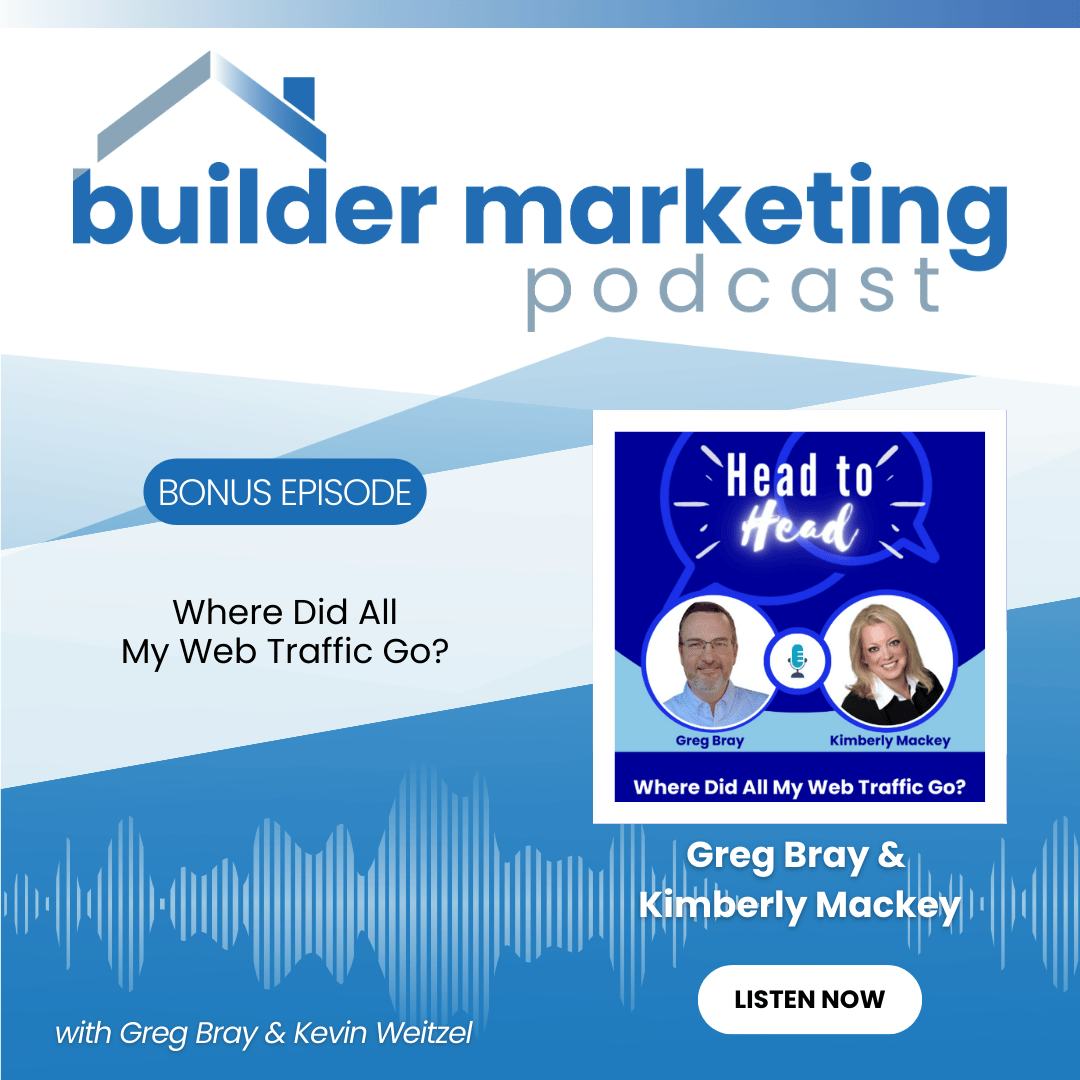
Intro: [00:00:00] Head to Head starts now. The home building industry's go-to stage where top leaders bring real solutions you can use. Now powered by New Homes Solutions Consulting. Today's headline, "Where Did All My Web Traffic Go?" with Greg Bray from Blue Tangerine. Here's your host, Kimberly Mackey. Listen anywhere, watch on YouTube, or join live @newhomesolutions.com/headtohead.
Kimberly Mackey: Hello, everybody. Fantastic. Happy New Year. Anybody else feel like they've been shot out of a cannon since January whatever day we came back? I lost track of the days. I took 10 days off so it was like, whew. Everybody needed something everywhere. Anybody else feel that way? Get that chat going. We definitely want to hear from you. So, oh, they're really coming in. It's like a mad dash.
Greg Bray: Did you promise snacks?
Kimberly Mackey: [00:01:00] It's bring your own snacks. I figured out how Zoom should have that as an app, shouldn't they? That should be part of it. A snack fest. As most of you know, I'm Kimberly Mackey. My company is New Home Solutions Consulting, and everybody always says, what the heck do you do, Kimberly? It's so confusing. It's really not. If you want consistent, persistent, and profitable sales, that's what I do. I come in and I help you behind the scenes and make sure all your systems and everything are in line and your sales team is doing what they need to do with their sales process that we're managing our KPIs, all of those things.
So, I always say if you want sales to be the engine that drives the train rather than running it off the tracks, then I'm who you call. So, if I can help you with any of that, I know it's confusing and understanding what's behind those KPIs, what's behind the numbers, that's a really big deal because there are some really great predictive factors right now, particularly if you are pipelining or can banning your views. We can get out to [00:02:00] about two or three months of full prediction on sales if we have the right tools. So, if I can help with any of that, give me a shout. And then without further ado, Greg, let me turn it over to you. Tell us about what you do, Blue Tangerine, and even the Builder Marketing Summit that's coming up.
Greg Bray: Well, Kimberly, thanks so much for having me. I'm a little intimidated about this all head-to-head concept. Is this a beating that I'm about to take? I'm not quite sure, but I'm excited to be here. Blue Tangerine, for those who aren't familiar, we are a website development and digital marketing agency. Our goal is to help home builders create sales generating websites. So, we help with website design, development, hosting, support, maintenance, and then we help you drive traffic. Things like searching and optimization, Google ads, social media support, both advertising and content. we can help with email marketing.
And then, our biggest kind of tie it all together is the analytics and reporting piece to help you understand where this traffic coming from, what's converting, what's not. How do we optimize your budget and exposure there to get the best [00:03:00] traffic and the right traffic. Not just more, but the right stuff that actually turns into leads. We don't care about quantity, we care about quality. That's who we are and what we're about. Excited to talk more about some of the things that are happening in the world of web traffic today.
Kimberly Mackey: These are the people that then get it to us so we can convert it into those sales. So, it's fantastic. Let's touch on the Builder Marketing Summit you have launched with OutHouse and what's coming up for it. I know it's a little early in the year to be talking about it, but it's never too early to go ahead and save the date out there.
Greg Bray: Yeah, it is never too early and it has been in the past, the Home Builder Digital Marketing Summit. We are simplifying this year and going to Builder Marketing Summit. So, just for people who are going toa get confused, we're changing the name up just slightly. Still same great content, same great experience, everything else. We're going to be in Dallas this year, September 23rd and 24th. We are not yet open for registration, but please go ahead and plan on your calendar for your training, planning, and budgeting and everything else.
We're really excited. Going to [00:04:00] have a great leadership track led by Kimberly. Again, we're going to have an OSC track with Leah Fellows from Blue Gypsy again. For some breakouts, we're going to have lots of great marketing content with a definite focus on digital, but we wanted to make it a little easier to maybe bring in a topic or two that wasn't completely digitally oriented here with a little bit of a name change there. But we try really hard to make this a place where you don't just learn from presenters, but you learn from each other. Lots of networking opportunities. The round table conversations are really popular, so we're going to, of course, have those again.
For the people who have been there before, please plan to come back. And for those who haven't yet, make sure you put it on your plans. We'd love to have you join us and we'll have some more great content, and we'll see you there. So, buildermarketingsummit.com is the place to keep an eye on for the information as it comes out and comes available here over the next few weeks.
Kimberly Mackey: And in the post show notes and on the video, we'll make sure that we put that website up on the screen for you. It's a phenomenal thing. I took part in it last year. I did [00:05:00] the leadership summit for the first time and I got as much as I gave. I loved it. I loved the conversations that I was having with people. Everybody came, they were so thoughtful and intentional and like really wanting to grow and the conversations around the room and the round tables were, Man, it is like the time was up and you're going, wait, there's so much more we can talk about here. So, if you haven't been, check it out. Check out the testimonials from people, and Steve says he's coming this year, and Heidi says it's her favorite event of the year. So, we're going to hold you to that, Heidi. We need a testimonial on it.
Greg Bray: I'm holding Steve to that because I think he promised to be there last year and he didn't make it. So, I'm calling you out, Steve. You better be there. All right. I'm putting that on my plan, so.
Kimberly Mackey: All right. The other thing that I do want to just put a little line in, if you are coming to the International Builder Show and you're planning on arriving on Monday, builders shoot me a line, send me an email on that and I can [00:06:00] send you an invite. We're going to have this really great Builder Connect event that has happened for the last few years. It's phenomenal. We're doing it at Topgolf. It's going to be a lot of fun. So, anybody who's going to be there on Monday, shoot me an email. I'll send you a link.
This is a builder event. It's called Builder Connections. We have great sponsors working on this. So, you're coming in, the show starts on Tuesday. You got to be there bright and early, so just come on. It starts at like five o'clock on Monday. So, I hope to see everybody there. Alright, let's move on. Let's get into this topic because I don't know that we can even get through all of our show notes that we did. There's so much to talk about with this.
Web traffic, again, Gemini changed everything. So, everybody went from, you know, all their SEO work for all these years to try to get to that page one, page one, you gotta be on page one, and now you're on page two or three because Gemini takes up all of page one. So that's part of it, right? At the same time, we had a weird market. We had a government [00:07:00] shutdown, we had holidays. We had, we had, we had. IT was very distracting. So, boy, it was like, it just fell off a cliff around September.
Greg Bray: Kimberly, the impact of what's going on in the SEO world over the last 12 months is just crazy. So much changing, so much to keep up with, and it's definitely driven by external factors. New tools, tools that are changing all the time. People discovering those tools and still figuring out how to use them. And we're still figuring out all the implications of what that means from a digital marketing perspective as well. And there's some great people out there running experiments. It's not like anybody publishes and says, here's how it works. You know, we have to kind of test and try and experiment.
And so, hopefully everybody's doing their own experiments as well. But yeah, it has changed a lot over the last little bit. And so, it's just, it's okay to take a breath and say, I'm not quite sure what just happened be cause we're all still trying to understand what's [00:08:00] happening. And unfortunately it's not done changing. It's not like we finished and we checked the box and, okay, now we know the new normal. It's still evolving, it's still changing. And what that new normal's going to be is going to be very different a year from now, and even beyond that.
Kimberly Mackey: So, what I'm hearing you say is we can't sit and wait on it to ever be done with all this because it's never going to be. Right? This is always a whip, it's a work in process forever, and at lightning speed right now because of the advent of AI, right?
Greg Bray: Yeah, absolutely. I mean, I've seen some interesting numbers that talk about how long it took people to adopt the internet or, you know, how long did it take Facebook to get to certain milestones of users and things like that? And we're just blowing those away as far as adoption rates on tools like and Gemini and things like that, where people are embracing these so much faster than they did some of these other, like, technology revolutionary moments in the past.
And so, again, the rate of [00:09:00] change and acceleration of change is kind of daunting and overwhelming and stressful, frankly, to keep up with. And so, there are those people that just say, then forget it. I'm ignoring it all. I can't keep up, so why bother? You know, it's not real. I'm just going to pretend it doesn't really exist. And, of course, that's not a great way to run a business, in my opinion.
Kimberly Mackey: Well, ostrich with the head in the sand is probably never a good idea. I mean, I remember, back in the downturn in 2000, 8, 9, 10, 11, we still had people denying that social media was going to have an impact on their business at all. Or that, you know, this internet thing is a fad. I literally heard builders say, and I'm like, You kidding me? So, learn from that because obviously you've seen the internet thing is not a fad and AI is not a fad. It's not hard, but it does move at lightning speed, and I think the speed is what really is the terrifying [00:10:00] and challenging part of it.
Greg Bray: Yet there's a lot of opportunity right now. It's actually the kind of thing that is, in my opinion, equalizing some of the playing field, so to speak, because there used to be all this fighting over keywords. And all of that is still a thing for sure. SEO is not dead and we can get into that.
Kimberly Mackey: I was holding the funeral for it.
Greg Bray: Yes. But the idea now that because these tools understand better what people are actually asking and the intent behind the language that we use and all of those things better than ever and continuing to get better. It's going to be much more of an opportunity to just have those conversations and be part of a conversation as long as we are providing the inputs that these tools need to know about us.
Kimberly Mackey: You said something really important there. I don't want to just pass over it. And this has always, I think in our industry, been a big [00:11:00] challenge, is understanding, being part of a conversation as opposed to pushing a message. I think that's always been a bit of a challenge for us. We're always a little nervous about being part of an intentional conversation out there in the public view, and I don't know why because what we do is really cool.
Greg Bray: And I think to that point, Kimberly, probably just assuming, I'm making some assumptions here, but you've got certain people on a sales team who are very much pushing a message, pushing a sale, and then you've got those who are more of that consultative, helping someone find the right home for them and having a conversation about what is the right place for you and your family and your situation right now. And maybe that's not us and that needs to be okay.
And so, when you think about this conversation moving into this AI world, recognizing that now it has to even more be about how do we help people find that right fit of the right home for them and be part of it when it's the right [00:12:00] fit. And we can't fake when it's not the right fit the way that maybe aggressive or well-trained person might be able to kind of push somebody down a path that they're not totally comfortable with. I'm not saying that ever happens ever, but I think that's where this is really going when these conversations are happening outside of the sales office and in the chat.
Kimberly Mackey: I think we have to understand that the consumer has changed and their expectations have changed. And we talk about this all the time, the Amazon effect and the searches that people are doing now and the answers that they expect to have at their fingertips, which they now do because of AI.
They get deep answers on questions that aren't necessarily just your sales funnel path of, you know, Hey, I'm the best builder in X, Y, Z area, and we build homes from 400 to 700,000 and da, da, da, and we're in these communities. People are asking questions beyond [00:13:00] that, and we have to position ourselves really to be the experts on the kinds of questions that people are asking early, early in their process. You know, like how hard is it to get a mortgage? How much money do I need to put down?
I'm a first responder. Are there special programs, special incentives for me? You know, how far from work am I allowed to be as a first responder? Like, if we were just using first responders as an example. I work from home part-time. What are some work from home options that don't take up a lot of space? These are questions that are solving problems. We've got to identify the problems that our buyers have and solve these problems and kind of demystify this whole building process. Do you agree?
Greg Bray: Absolutely. And this is where sales and marketing working together is so critical for doing this because it's the sales team that's having these conversations. They are getting these questions, and some of that's the [00:14:00] online sales as well. You know, what are the questions people are asking that they aren't finding answers to or traditionally haven't found answers to on the website or before they come for that visit? And how do we now elevate that content out to make it more available to these chatbots and AI tools so that when those questions happen in ChatGPT instead that we're not left out.
If they don't look to us and can't find the answer on our website, then it pulls that answer somewhere else, and maybe that then pushes that consumer toward that particular brand or builder instead. Not that we didn't know the answer, not that we don't have the answer, but we didn't make it available in that context.
I mean, Kimberly, here's the thing, the website's job is changing. In some ways it's reverting back to where it was in the beginning. So, for those who don't know me well, I come from the computer science background. I was a programmer and [00:15:00] a computer nerd guy, and I had to kind of discover how to talk marketing because the website is this really interesting mix of it and marketing, right?
So, I used to always have this kind of fight. Like, no, it's an information system. It's not a marketing brochure. You know, and we'd have these back and forths because it doesn't matter what it looks like. It doesn't have to be pretty, it just has to have the answer, you know? Because that's what computer people, that's how we are. The marketing people convince me that pretty matters. Emotional connection matters. I bind into all that. I completely embrace it now and understand it.
But at the same time, we're actually swinging back the other direction now. Because it's not just enough to have beautiful lifestyle imagery anymore if you don't have some of the more statistical, important content on your site. When someone says, I'm looking for a four bedroom home with 300-square feet in this whatever area and your website doesn't make it clear the size, the square footage of your homes because for whatever reason, you just didn't put that on there, ChatGPT is not going [00:16:00] to answer that question with your content when it doesn't know it matches the question.
So, now we're moving back to this balance of we need to have the lifestyle, we need to have all the emotional connection, but we still need the data that might drive somebody's question. And that has to all be, tagged in schema datas and all kinds of things behind the scenes that are probably beyond the scope of today's conversation. But it's the idea that we need to be looking at both audiences now, right? How do we feed Chat? How do we feed our in person buyer? Because there's going to be some slightly different needs along the way there.
Kimberly Mackey: Absolutely, and I think about this when you're giving that as the example, people who don't put pricing. There are so many builders who do not put pricing on their website or even what is included in that price, especially our custom, and I know we probably have a lot of custom builders on here. They're like, oh, well it just depends on what they want. Well, you should have a baseline specification and baseline [00:17:00] pricing based on if you have certain plans that you can then customize, or if you're more semi-custom or at least a starting point.
I understand that some people do the whole back of the napkin, take it to the architect, you know, and totally price it out from there. But you've got to have some pricing. How much is it going to cost for me to build a home on my home site that I just purchased is literally a question that somebody might ask Gemini with no other specifications or any other information in there. Now hopefully, Gemini will educate that buyer. Okay, it depends on how big it is. It depends on, you know, what you want in your home. It depends on, it depends on, it depends on. But you got to have somewhere where you are the resource that explains what does it depend on?
Greg Bray: No. Absolutely. That's a great blog article or content piece to put on your site right there, right? All the things that drive the price of a custom home, and making sure that you are the one that's providing that type of basic educational content and putting it out there. [00:18:00] Because the AI is not going to make that up. Well, it does make some things up, but it's getting better and better at not making stuff up and actually looking for authoritative sources for that information and things there, so.
Kimberly Mackey: How long have we been saying we need content on your website and we need regular consistent content? I feel like forever.
Greg Bray: When was, when was Google invented? 1990. So yeah. Some people are like, oh, SEO's dead. Now it's GEO and AIO and AEO and all these other acronyms that we're still trying to figure out which one's really the right fit. And somebody said it's all SEO because it's search everywhere optimization now. But this idea of content and good content and quality content and authoritative content is absolutely what Google has been begging for forever and has always been the ultimate driver. Regardless, whenever the algorithm things change and people's little tricks and things get swapped and all of that, the good content holds [00:19:00] true and still holds true and is still at the core of everything that needs to happen. Now, what is good content and what type of content is needed, I think is broadening as we do this. And Kimberly, not to go into the weeds here, but can I go into the weeds for a minute?
Kimberly Mackey: Dive right into the weeds. I've got the weed whacker ready.
Greg Bray: Yeah, so over the last six, eight months I've been doing a lot more study about some of these, you know, folks who are digging in deep, and what we're learning is that when AI started, it just answered based on its historical learning data that was all in there. And now, over the last few versions, it's very much layered in a live web search, and we'll see that when it's starting to expose its thought process to you more and more as it goes through the answer and you're waiting for your answer. And you'll see this search happening where it goes out and searches the web.
What is happening behind the scenes that we're learning is they're calling it Query Fan out. And it's this idea that we're taking the search or the question and the chat is turning [00:20:00] that into 10 or 15 other related questions and search queries that it is searching for to find your answer. It's pulling all of those results back and looking for the commonalities between those searches. And if the same source is showing up for all of these different searches, it gets elevated in its importance, as far as what is the citation that gets cited in that answer. And it's also pulling all of that information back and kind of summarizing it all and putting it into the answer.
And so, when we talk about SEO as a critical part of it, it's now like beneficial to be able to rank. If you can rank for all 15 of those searches or whatever number there were for that particular question, you are going to be the one that gets cited in the answer. And that's what we're after, is the citation and have our information put out there, hopefully, our link as they're looking for more.
But the other piece to this is that these queries that [00:21:00] AI is doing, we're discovering, are not keywords that anybody's ever been paying attention to in the same way. They're not high volume searches in the past, and they're not necessarily visible in the same way through like some of the traditional like Google search console tools and things like that. So, it's really changing this idea of what is the content? Now, if we can understand what these fanout queries look like, it gives us direction and what should we be writing about?
What are the kinds of questions that we do want to rank for that? And especially the ones that some of the other folks are not ranking for, especially like the larger builders that have better budgets and more resources and things. Maybe there's opportunities for us, and if we can get two or three of those where all of a sudden when it's looking at these 10 different sets of results and it's trying to merge themem all together. If we can be in two or three of those, we can suddenly bump up to the top. It's hard to be in all of them, of course. So, I'm sorry if that was like way deep down into technical stuff.
Kimberly Mackey: That was fascinating, and I'm struggling as [00:22:00] I'm talking to my builders because I'm not a marketing company. I rely on folks like you. I can have all of these great ideas of what we need to do and content strategy, but that's where I've been, is trying to define our audience, like who's our audience and what are the top 15 things that they are going to ask? And then asking for long form vlog or vlogs that then that becomes the base. So, there's your content on the website, but then we go a step further and apply those blogs or vlogs as the link back, right?
So, we're organically driving back, but we can use these in from the desk of emails. So, from the desk of, in your automation drip campaign, a short form blog, a social post about it with some photos. Maybe we can change it into an article format, a short article for a newsletter that's coming out when you just got those marketing qualified [00:23:00] leads that can actually spark queries that other people didn't even know they had.
If you create this content one time in this long form, there's so many other applications and ways to use it that then keep driving back to it, that also then benefits you because Gemini does see. Then again, I don't know the technical, how we make all this happen, but I do know when people go to your website and they're hitting something, it gets found more and more and more and more, or the algorithms start to identify it and see that. So, we have to help it out. Am I saying this in a very stupefied way?
Greg Bray: You're absolutely right. If you can break down this content, reuse it, absolutely. Where we want to go, and related to that, is finding the places beyond just your own website to put it. Putting it on YouTube, for example. Potentially press releases are growing in importance now again. Which is interesting, you know, because these are looked at as [00:24:00] authoritative sources by these chat tools.
Reviews are growing. Well, they've always been important, but they're even more important as well because these AI tools are dealing with the same problem that people deal with, right? Is that the volume of information when you do a search, you're like, oh my gosh, there's 10 million results, I'm going to look at three. But now the AI tool is going, oh look, there's 10 million results, I'm going to look at a million of them. It is processing all this stuff.
Kimberly Mackey: Turn an answer in three seconds. Yeah.
Greg Bray: It's still looking for those patterns in that external validation of what is real. Because everybody knows there's not real stuff on the internet and we have to filter through that and find, and do that trust of is this quality information or not. They're still figuring that out and still working on that, and they will continue to get better. Two years ago, I heard a quote that said, today's AI is the worst it will ever be. That's still true, right? The way it works today is still not going to get any worse. It's only gonna get better [00:25:00] at how it does this.
And so, as we prepare and start working on answering these questions, putting this content out there, putting it in different places, it's only going to get better at sorting out the garbage. So, don't put out the garbage, just put out the good stuff because we might have to wait a little bit and maybe somebody will choose the system in the short term, but they don't want the garbage either, and they're going to keep working to filter that out.
Kimberly Mackey: So, content absolutely matters as much, if not more so than it ever did, and these queries that people are putting in and trying to understand what those are. You know, and again, using it in multiple places. There's an illusion that I think our owners as people are seeing their website traffic going down, they're going, well, the marketing's not working, the marketing's not working. Let's dive into that a little. Because yes, web traffic is down, which means actual traffic and contact forms and all those conversions that we're looking for are also down. But [00:26:00] let's kind of break those down if you can, and talk about that. Because I know a lot of people, that's where they're stumbling as they're trying to explain this to their company leadership.
Greg Bray: Yeah. And just so we're clear, this is not a home building industry issue, right? This is like across all types of industries where we saw major traffic declines in raw traffic to websites, and it's been an interesting journey to kind of analyze what that is across e-commerce, across, you know, home builders, et cetera.
And what people are starting to see is they're actually able to categorize the type of traffic and the traffic that is declined the most is what we kind of call that research traffic. Where I'm investigating and learning and studying and trying to figure out the answer to what I'm looking for and what I want. And of course, in home building, that's a big part of the journey. Which camera should I buy as a little bit of a different animal than which house should I buy? You know, there's still some research that goes into that, but it's [00:27:00] not nearly the same time and effort that I'm going to put into a house. And so, we're doing a lot more of the research as consumers in these tools.
Once we move past research and we're into the next kind of part of that engagement and ready to maybe talk to a person, maybe ready to actually buy all of those, we still come to the website as that next step to do that. Well, I can't speak for everybody, but most of us will, you know, based on the things we're learning and seeing in the research that's out there.
And so, when those leads come, there's a lot fewer because how many of those leads where people just asking those initial questions. They weren't ready to buy, they weren't what we would call a hot lead ready to move in in 30 days. They were somebody who was like, Hey, do you guys have a pool at this community? And that was the lead because they couldn't get the answer and who knows if it's the right place for them or if they're ready to buy or not.
They're asking that question in a different place, and so you're not getting, now granted, we would love to [00:28:00] have those so we can nurture them and reach out to them and follow up with them and do all of that. But if you probably look at the types of leads, you're probably, I would expect, see that type of pattern that you're missing those leads that we counted them as leads. We were excited about the leads. And look, we got 20 of them. And we got a name or and contact, which was good. But they weren't like at that serious point, they were still in their research phase of shopping. And that's the part that it appears to be is moving the most, is that research piece of the shopping.
And that's why we have to feed that information to a different place because they're having those conversations somewhere else without us, and we don't get to control them the way we'd like to. But once they click through to the website, we are seeing, for a lot of places, a better conversion rate of actually, you know, having more of that conversation and moving forward because they're educated in a whole new way. We thought they were educated before because they'd been on the website a little bit. The education level is just continuing to skyrocket.
Kimberly Mackey: The big end of the [00:29:00] funnel is really narrowing for us because people are able to cast that net more broadly and ask Gemini and get the answers, rather than having to go to a specific place. So, at the point where they were identifying themselves as a marketing qualified lead, we didn't know a whole lot about them, we just had contact information is now further into that funnel that we used to visualize that we know is not quite as linear as we would like it to be. Right.
Greg Bray: That's my opinion about what's going on right now and the things that I'm seeing. I'm sure that, you know, your mileage will vary in individual situations, maybe, you know, a little different. And of course, everybody's a little different in what's out there, in what they're exposing. Now, they're there very well could be people though that are actually losing the leads because you're not showing up in the research conversation in these tools.
Kimberly Mackey: Oh yeah.
Greg Bray: Again, this ideal scenario, they're doing this research, they're finding our stuff and getting our answers to those questions. And so, [00:30:00] therefore we're on the possibilities list for when they're ready to move forward. If they've moved that research and we don't show up and we're invisible, then we never get the lead at all later.
Kimberly Mackey: Yeah. Because you're on page two or three. And who scrolls to page two or three of anything? Nobody. Everybody has ADHD.
Greg Bray: It's the famous joke, right? The best place to hide a dead body is on page two of the Google search results, right? Nobody ever looks there, so.
Kimberly Mackey: I worked with a systems builder, so they were a timber frame high end, it's basically modular is what it is. So, everything is assembled in a factory, put on a flatbed, driven out to the home site, and then assembled on the home site. So, you know, it could be a log cabin. They didn't do log cabins, but it could be like a log cabin. It's that kind of thing where it's built in the factory and then, but not a manufactured home. One of the things that we found with that buyer is that they were not identifying themselves until well into the process. And so, this is a real [00:31:00] life application that with a builder that I worked with up in New Hampshire. But they were really educating themselves and consuming all of the videos that we put out there.
Because one of the misconceptions is you buy a home like that because it's going to cut down on the build time. Well, sure, on site it does cut down on the build time. There's a year in the making oftentimes of, you know, as you're designing, planning, getting that floor time on the manufacturing site, getting it delivered out, finding a builder, like there were all these steps. So, there were so much education that went into it. By the time the buyer identified themselves, price was third or fourth on their list. We had to identify which funnel they went in. So, we would narrow down by price, and we're not talking, these are not cheap homes. So, most of the time these are approaching a million dollars and up for these homes and these people knew their stuff because of that education. [00:32:00] That's where they spent all of their time.
The builder had recognized this earlier, so he literally wrote the book on timber frame. So, you can look it up, the guy wrote the book on timber frame. So, he started before internet on writing the book of how you do this and the process and the workmanship that goes into it and why it's important to people, and then it went from there. And they spent all this time on vlogs and video blog about the process, about all the questions that people would have and you know, even how to schedule a factory tour and you know, I mean everything.
That to me was my eye-opening moment where I saw how qualified we got to the point with anybody who would come in with our Kanban view in their CRM, which happened to be Salesforce. Not that that's really relevant, as long as you have that Kanban view. We could predict, I could predict up to 90 days out with about 80% certainty because of how qualified, this is why this matters people, because people were identifying themselves at the point where they'd already [00:33:00] self qualified enough that we could predict what our process was going to be.
And when we were going to write those purchase agreements for them to even go into design, they didn't even know we wrote a purchase agreement before they ever knew what the final price was going to be. Like, that's how good we got at being able to predict it. But a lot of that was based on the fact that people were self qualifying by going through all this self-education that the company had spent an inordinate amount of time, and putting it out there and getting that information out there. And buyers loved it. They just ate it up. And they would always reference, I saw this. I didn't even know I was looking for this until I happened upon blah, blah, blah. That's where onsite builders like, why are we so behind the curve on this? We need to do this stuff.
Greg Bray: That's a great example. But it also highlights the fact that it's not a five minute fix. You can't just run home, write a blog article this weekend, and boom, it's all better.
Kimberly Mackey: Oh, it's a strategy. Like, yeah, so that's where I'm having a hard time with marketing. Marketing [00:34:00] companies are like, no, no. I'm like, look, I'm not trying to tell you how to do your job. I'm just giving you the content strategy. Here are our audiences that we're trying to attract, and this is not hard. But it does involve a concentrated effort and it involves consistency. Right?
Greg Bray: There's also a little bit of a different topic focus than maybe we've always had. Another blog article about color of the year, I don't think is going to move the needle on what people are doing when you think about the questions that they're asking to AI. Again, the AI bot is a different audience than maybe that consumer on the website. And so, we do need to recognize that we're going to have to serve kind of both of those audiences, and they overlap in many areas.
There's certainly a future coming where we're going to have our own AI assistants that go out and do these searches for us. Where we're going to give it, you know, the parameters. This is the kind of home I'm looking for. This is the locations I'm looking for, this is my [00:35:00] price range I'm looking for, and it's just going to go out there and do the hunt for us and bring back the collated results back. Which is going tobe a little bit different than where we are today, where it's more of the conversational question back and forth in a session.
But again, if it can't find those parameters, if it can't find the explanations that validate, oh, does it meet these criteria or not? I mean, again, there's even people talking about, and then it will ask the builder's website bot the question, which we'll then answer and say, you know, well. There's all kinds of, you know, bot to bot commerce that people are talking about right now that's going to be really interesting to see how this plays out.
Kimberly Mackey: You can train your own GPT with the information that you are writing for the public. Like now your GPT is searching it and finding it out and going back to your website.
Greg Bray: Yeah, and of course accuracy of information is critical, all of those kinds of things. If it can't find what it's looking for, sometimes it makes things up or it pulls somebody else's [00:36:00] information and merges it with yours and things like that. So, there's still a lot of growth and learning that's coming behind all of this as well. But we've got to be providing the content. I think we're hammering the content. We're going to have to retitle the event here today to talk about why you still need to provide content.
Kimberly Mackey: Thank you to Kevin and Tammy for chiming and Kevin's right? Like each builder, everybody is a little different. So knowing your unique selling proposition and what's important there, I think is key. Felicia, she had a buyer search and a copied and pasted the response from AI and sent it to her. Now that's really interesting and asked, is this true? And I've never thought about this. What's this? You know, like. It can open up these person to person dialogues. So, Felicia, did that work out? Did they end up buying a home with you? So, I'd be really curious to know where that went. That's very interesting.
Greg Bray: Kimberly, there's a perfect example of, there's maybe a new topic to add to the site that might not be there, is explaining the answer to that question. If one person has a question, there's probably [00:37:00] somebody else that has that question.
Kimberly Mackey: I love it too. Yeah, appointment made. All right. Keep us posted on that one. That's great. All right. Getting back into this whole SEO versus the GEO thing and going more so people do understand a little bit of the technical without going straight over my head, so, which I know is easy to do. But how do we optimize after we do all this work on this content? How do we make sure it gets found? Do we start with that first or do we worry about content first and then optimization? How does all that work?
Greg Bray: You got to do all of it. So, you might as well get started on all of it, right?
Kimberly Mackey: Oh, okay.
Greg Bray: Here's the thing. There's been a lot of builders who still have not done anything in the SEO world because I have these conversations with them. I think I need to start doing SEO and I'm like, I think you needed to start doing SEO 15 years ago. I don't say that bluntly, and I have no offense to anyone.
Kimberly Mackey: You just did.
Greg Bray: Again, SEO is not going away. The volume of search queries on Google is still [00:38:00] ginormously more than the chat volumes that are happening. People are still going to Google to do searches, but as people continue to use these other tools, and Google is continuing to push the AI in front of folks as well. It's going to be an interesting balance to see how that plays out with the paid ad portion of Google because they don't want to cannibalize their paid search results too much because that's their bread and butter of revenue. So, there's going to be a balance there, right? So far ChatGPT has not been putting ads inside, but there's certainly folks talking about the day that ads show up or people are paying for placement in those results, and it certainly will be an interesting thing to watch how that evolves and influences the results there.
But back to your kind of question. Sorry, I got a little sidetracked there. SEO is still critical. The foundational pieces of what you do for good SEO from a technical website structure, things like site maps, schema data, internal linking keywords in your links, heading tags, all of that [00:39:00] is still absolutely applicable for the traditional SEO that's still happening and helping the AI bots understand.
There are some things that it appears that the bots like better. One of those is very clear question, answer question and response type of content. So, the traditional FAQs that we talk about, but making sure it's tagged very clearly with some schema data around it that says, Hey, these are questions and answers. Because that seems to be something that it really likes if it happens to line up with a question it's trying to answer and it finds that question and the answer, it seems to really like to pull that type of content as well.
Again, we talked about data, like things like square footage and addresses and driving distances and all of these types of things. Making sure that type of content is there, is still part of good SEO and this AI optimization. It's really about just doing the basics first. If you aren't [00:40:00] doing any of those basics, now we're layering on more stuff to do and extra things.
I'm sorry, Kimberly, but this can be self-serving because I'm a guy who sells some SEO services. Right. Your SEO budgets need to go up. You need to spend more because there's just more going on, and you need to spend more on the research side of what content matters. We need to spend more on creating that content. We need to spend more on monitoring and there's more places to test and things there.
There's new tools that are coming out. We still don't have a great visibility in behind the scenes in some of these AI tools. but hopefully those tools will continue to get better so that we can understand, you know, what are people asking, what are we getting? But again, the variety and the length of these queries is so different than traditional search world of what's a keyword string somebody typed in that it's really going to be interesting to see how it evolves. I'm sorry if I'm still kind of wishy-washy, but we're in a dynamic environment.
Kimberly Mackey: But the key here is if you're not showing up on regular search, you're definitely not showing up on AI [00:41:00] queries.
Greg Bray: Here's the tip of the day, Kimberly. It isn't that hard to figure some of this stuff out. Just go in and ask. AI will tell you why it answered the way that it answered. So, start with the simple query and go into the Google in AI mode, the Gemini AI mode on Google and just say, tell me about and put in your builder name. Tell me about A, B, C builders and see what it has to say. See what it says. What does it know about you?
And if there's something there that's not accurate, that is the place to start. Oh, we build in Dallas. It's like, we closed that Dallas community three years ago. We don't build there anymore. Okay, that's going to confuse people. And then ask it, Hey, this isn't accurate. How do I update this? And it will tell you some ideas about how you can educate it better. It's incredibly helpful. It wants to be accurate. Just ask it. You can do the same thing about asking it about your competitors. Tell me [00:42:00] about, you know, competitor number one and competitor number two.
You can ask it to do a competitive analysis and say, Hey, if a home buyer's looking for these homes and considering these three builders, what are the pros and cons for each one? And see what it tells you, and you will get some amazing insights, especially if you don't agree with the answer. Gosh, how do we put this content out here that says, oh no, this is why we're better than that competitor. And you look at what they're doing, you go, oh, wow. Yeah, that's a good idea. I hadn't thought of that. We can just start asking it. Now, this is very manual. You can't do this for every possible search and every possible query and things there, but this will give you some really easy low hanging fruit things to go look at and start with first.
Kimberly Mackey: Felicia, you've given us good stuff. She said they did this and found out that their blog couldn't be found because they were calling it Get inspired and didn't have the word blog in there.
Greg Bray: The AI will tell you, and you can also ask it for its sources.
Kimberly Mackey: You can still get inspired on your blog, but yeah, it's simple things like that, you [00:43:00] know, they mean something to us. We get used to it, but buyers don't know.
Greg Bray: And buyers who are less sophisticated in using these tools, as marketers, we're playing with these for our own use a little bit more. You know, I look at some of my family members who are just planning a trip or asking for recipes or doing some of these things where they're not necessarily using it at work all the time. They take the stuff that comes back as gospel truth. They don't do any type of filtering on, you know, hallucinations and things like that. If, the AI said this home's not available, they're not going to question it and go, wait, no, I think it really is. Unless, of course they saw the sign driving down the road the other day or something. But we've got to be the ones making sure that accuracy's there and finding those flaws and helping educate it.
Kimberly Mackey: As people do more of these personal queries on it, then they get better and better at asking and getting things back. So, let's talk about conversion a little bit as we finish out. Because, of course, all these leads are great, but if they don't convert, I know your version of conversion, my [00:44:00] version of conversion are two different things, but there is a middle ground here. So, you know, when somebody identifies themselves to us to meet, that's a conversion, right? That's a web conversion.
Greg Bray: I'll accept that definition.
Kimberly Mackey: Okay. that's where I start. I'm like, they're just noise out there until they identify themselves to us in sales. So then, how do we get better at qualifying our leads before, my online salespeople are probably going to all chime in on this one, but how do we make sure that we are really dealing with whatever we determine as a quote, good lead?
Greg Bray: I mean, that might be above my pay grade, Kimberly, actually. Because I don't actually talk to the leads. Right. I just help get them to fill out the form, so.
Kimberly Mackey: You're done with it. Once they fill out, that's on you.
Greg Bray: Yeah. Hey, hey, hey. That's a sales team's problem. But again, if they're not qualified because we're discovering that oh, they thought we had a home for $50,000 and we don't build in that price range, then obviously there's a content gap there that can be identified and said, okay, look, we don't want people [00:45:00] to think we are in this price range or think we're in this location. Why is that information coming up? where is that coming from? How do we replace it with the correct information and things like that? So, if we're getting bad leads that are expecting something from us that we don't offer, it comes back to the whole content education piece of the puzzle
Kimberly Mackey: Yeah, I had a builder in Ohio that we were getting renters, we were getting all these rental inquiry forms and so that was a beast, and that was before we had all of these AI tools that were refined the way they are today. So, to try to track that down and figure out, all of a sudden there was this big rash of, I don't know that we ever fully got to the bottom of it, or at least that the web company owned up to, but all of a sudden they stopped.
But you do get these weird things out there sometimes, and now these tools, I think can help us better identify where that stuff is coming from. But you have to pay attention. You know, sometimes we're just like, oh, we dismiss it. Right. Oh, that's junk, that's spam, and we don't pay [00:46:00] attention. Bad information can still tell you stuff, right?
Greg Bray: Oh, absolutely. And I think one of the things that I would encourage everybody if they're not doing it already, is to make sure that you have your Google Analytics configured with a custom report that will show you traffic coming from AI bots. You can see if the lead came from ChatGPT. It'll be in there, but you have to do a little bit of custom setup in your analytics reports to be able to see that easily. So that you can understand that, hey, these are leads that are coming from somebody who's already had some type of deeper conversation, and be able to better recognize that.
Now, that's only if they click the link from within the chat to come over. It doesn't mean they didn't have the conversation do another search, you know, a week later and find the website and come to it. But if you don't have that little piece of tracking in place, that's a simple first step to make sure that you can see what's happening. And it's a great thing if you're getting leads from there because it shows, hey, they're finding answers and they're wanting to know more and come over. [00:47:00] If you're not getting anything, maybe you're invisible, and that gives us a whole nother opportunity.
Kimberly Mackey: That's a whole other project to work on. Do our CRMs, are they sophisticated enough to pick up on if we're giving that as sources, if we're assigning that as sources? Are we there yet?
Greg Bray: You should be. I mean, it might require a custom field or two that you have to put in place, but you certainly want to be following the source to the website all the way into the CRM if at all possible. The web company has a role to play in that and passing that data through. The CRM company has a role to play in that and having a place to put it and see it, you know, later on. So, so this is one of those integration, paths that requires some people to all be friendly and talk to each other and figure it out. But it's very doable and should be done, in my opinion.
Kimberly Mackey: So, and Felicia's saying 30% of their leads are coming from ai, so obviously they're tracking it. So, you certainly can too. We've got one minute left. So, what's your parting best advice that you want to give people to get them started?
Greg Bray: I think my parting best advice is don't fear this [00:48:00] change, recognize the opportunity. There is a huge opportunity, especially for those who move a little bit faster and get out in front of it. There's still people out there that aren't paying attention at all. Sometimes we get stuck in our own little world of people do it like I do it so therefore no one else is doing it because I don't do it or everyone's doing it because I do it this way. Recognize that that's not true, right? People do it different ways.
But there's real opportunities to optimize, to start answering the questions, and don't overthink it. Just recognize that what is it that your buyer needs to understand to make the choice that you're the right home for them, and let's put it out there in a much more public way than we ever have before and not expect to only have voice conversations about that. These chat tools are having those conversations. Let's help them be our best advocates and recommend us. It's not enough to be visible. You want to be recommended and that's where we really want to get to.
Kimberly Mackey: I totally agree. And I would say strategize this out. Get with your sales management [00:49:00] consulting, get with your marketing company, storyboard this stuff out, and create a timeline to accomplish this. You know, sometimes as builders, everything's important. It's everything everywhere, all at once, right? We're like, oh, we gotta do it all. We gotta do it all. No, you don't have to do it all. You need to have a plan to do this a bite at a time and just do it so it isn't overwhelming.
But also because you can make adjustments as you go. If you find out that's not really working, you know, then you don't have to correct it everywhere. So, you know, there's a lot to be learned as we go through this process, I think. And work with these outside experts because sometimes it's hard to see the forest for the trees, right?
We had a huge number of people who stayed with us. Thank you for everybody on the chat. Thank you, Greg, for always, I mean, you just break this stuff down. You're so calm. You just have this wonderful calming presence, which is why the partnership of you and Kevin is always very interesting. So, Kevin from OutHouse, thank you, Kevin for all your comments and for supporting [00:50:00] this. We'll get the recording out.
Felicia, thank you. Yeah, we'll get the recording out and again, for those of you who don't know, this is available as a podcast now. So, once the recording is available, we'll also get it up, so you'll be able to search Head to Head by New Home Solutions anywhere you get your podcast. So, check that out if you are one of those people who just want to listen to it while you're getting ready in the morning or when you're driving into the office. So, thanks a lot guys. It's Greg. I love that. Thanks John. Alright. Bye everybody. Thanks Tammy. Bye-bye.
Outro: Thanks for listening to Head to Head. Please subscribe in your favorite app. Visit newhomesolutions.com to learn more.