
EP: 237
Leveraging AI in Home Building Marketing
With Jason Rhoads
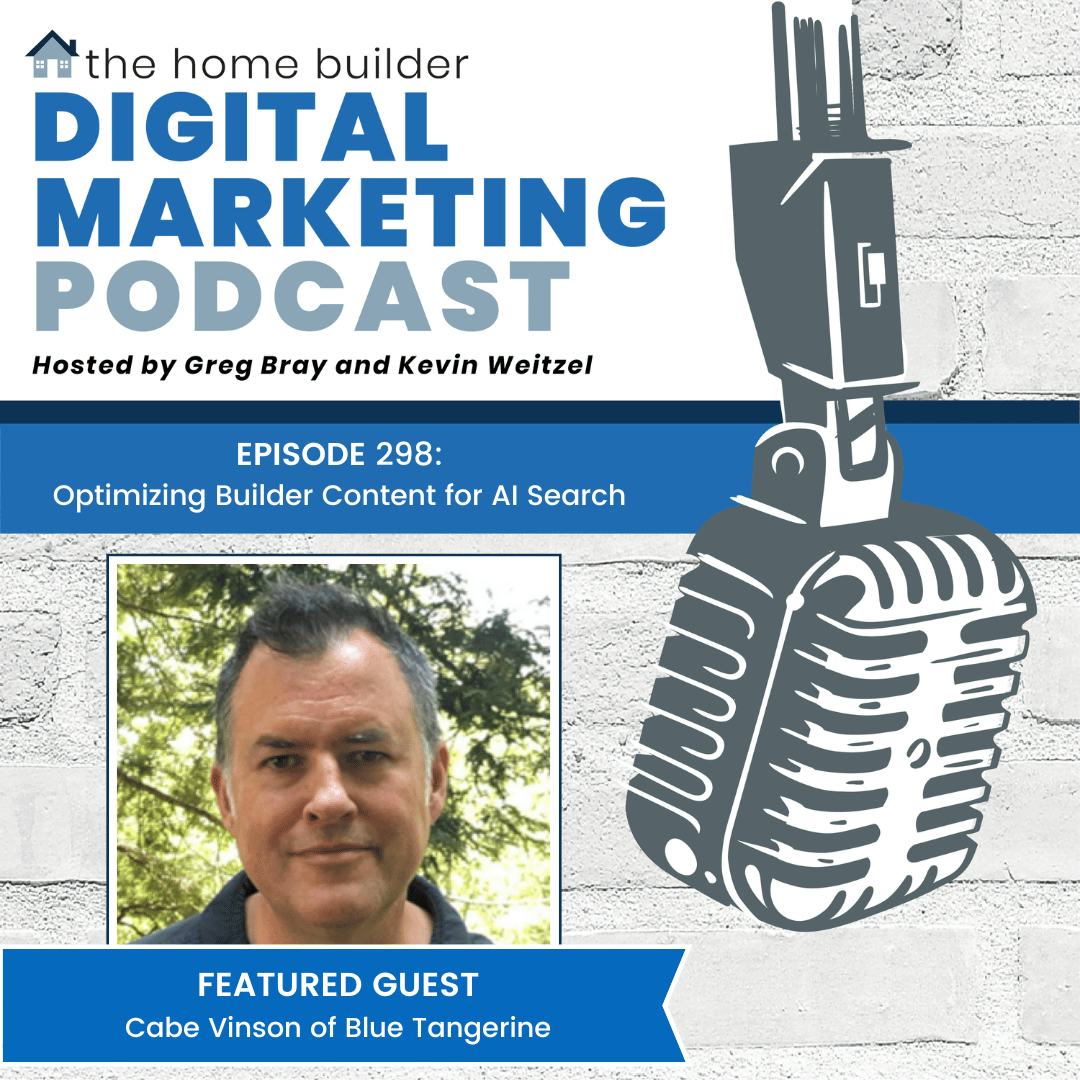
This week on The Home Builder Digital Marketing Podcast, Cabe Vinson of Blue Tangerine joins Greg and Kevin to discuss how home builders can optimize their online content to appear prominently in AI search results.
The shift from traditional search engines to large language models marks a distinct change in how home buyers are looking for homes. Cabe says, “The way that people are searching is very different. And the large language models, the way in which they retrieve information for people is just very different from a traditional sort of Google search engine. Those are big changes in the way that people are searching and the way that those results are coming to those individuals.”
To be visible and prominent in the AI-driven search landscape, home builders must produce relevant content across a broader range of formats. Cabe explains, “Large language models, they're not search engines, so they don't have stored text from file storage. They're working off of a very different method of finding and synthesizing information and answers for the end user. They're also very multimodal, and so those generative engines are not just reading webpages. They might read a passage on a page. They're getting into video, text, music, you name it. And so, you need to have your content kind of stretch across more modalities, otherwise you're going to be kind of invisible in that flow.”
To succeed, home builders must expand content strategies, not only creating more content but also optimizing it to be discoverable and usable for generative AI models. Cabe says, “A lot more content, and think about interpretability and accessibility. You want that content to be in formats that the large language models are going to be able to find and synthesize easily. Websites are going to need to be visually pleasing and you're going to want to emotionally inspire and connect with a potential buyer, but you're also going to need all those sort of technical underpinnings to the site. We work on that really hard with our platform. But I think going forward, having as much information in the right kind of places so that these engines can find it is super critical.”
Listen to this week’s episode to learn how home builders can make their online content stand out in AI search results.
About the Guest:
Cabe Vinson, Blue Tangerine’s Sr. Strategist, is a Search Engine Marketing professional, widely recognized for his meticulous management of complex assignments. A paid search and home builder SEO expert, Cabe oversees digital marketing programs of all sizes. With experience spanning numerous verticals, including apparel, B2B, health & wellness, electronics, and food & beverage. For the last 10 years, Cabe has specialized in working with home builders. An experienced growth strategist, Cabe is passionate about delivering results, achieving client loyalty, and providing unwavering attention to the complexities of his SEM initiatives.
Greg Bray: [00:00:00] Hello everybody, and welcome to today's episode of The Home Builder Digital Marketing Podcast. I'm Greg Bray with Blue Tangerine.
Kevin Weitzel: And I'm Kevin Weitzel with OutHouse.
Greg Bray: And we are excited to have joining us on the show today, Cabe Vinson. Cabe is the SEO director and Senior Strategist at Blue Tangerine. So, welcome, Cabe, thanks for being with us today.
Cabe Vinson: Hey, guys, thanks for having me on again. Great to be here.
Kevin Weitzel: I don't know if that intro is good enough, Greg.
Greg Bray: Please continue.
Kevin Weitzel: Cabe is a two-time speaker at The Home Builder Digital Marketing Summit. In the [00:01:00] Phoenix edition, he had the award for the most questions; we had to go minutes, minutes, and minutes, many minutes past his session. And I can tell you on a personal level, all joking set aside, I 100% admire Cabe because he brings real data to people, he brings real issues to people, and presents it in a manner that is digestible. So, buckle up, listen in. I promise you, you'll not be disappointed with today's session.
Greg Bray: No pressure, Cabe, no pressure.
Cabe Vinson: High Bar. High bar. High bar.
Greg Bray: Well, Cabe, for the people who have not gotten to know you as well as Kevin, why don't you give us just a little bit of your background and intro for those who haven't had a chance to meet you yet?
Cabe Vinson: Yeah, sure. I've been working at Blue Tangerine for quite a while now and sort of came to the home builder industry from an e-commerce background originally, and so I did a lot of paid search and search engine optimization. But pretty much working with home builders for many, many years now. Super challenging. I enjoy it. I guess that's why I'm here [00:02:00] today.
Kevin Weitzel: Well, before we dive into your topic today, give our listeners one interesting factoid about yourself that doesn't include work, the home building industry, or family.
Cabe Vinson: Hmm. I guess what a lot of people don't know about me is I'm a little bit of a thrill seeker, and have lots of sort of outdoor interests. I just spent a week, or almost a week, up in the Outer Banks, kite surfing. So, I like to get outside and sort of push my boundaries a little bit when I'm not staring at a computer all day. Maybe that's something that's sort of a fun tidbit about Cabe.
Kevin Weitzel: That is super cool. You don't have a wingsuit, do you?
Cabe Vinson: No, that's too thrilling. Too thrilling for me.
Kevin Weitzel: That's beyond thrilling, that's like practically knocking on death's door.
Cabe Vinson: Exactly.
Greg Bray: So, we're not all the way to skydiving and bungee jumping yet, or is that on the list?
Cabe Vinson: Oh yeah, maybe on the list, but I do like to be outside and kind of push my limits a little bit, so.
Kevin Weitzel: That's cool.
Greg Bray: Awesome. Well, Cabe, one of the reasons we wanted to have you on is not too long ago at The Home Builder Digital [00:03:00] Marketing Summit, you did a presentation about where builders should be paying attention from an SEO standpoint in today's AI world. Right. And so, I think today our goal is to kind of pick your brain a little bit in that area and kind of understand a little more, because everybody's worried about what AI is doing to search and SEO. So just in general, big picture, what is AI doing to SEO and search in general right now?
Cabe Vinson: Yeah, I'll use a recent sort of real-life example. So, I was looking for an under-sink reverse osmosis water filtration system. I found the system that I wanted pretty much exclusively using ChatGPT. You know, I sort of had my requirements. It needed to be tankless, it needed to have certain certifications. There was a price cap. I kind of started with a fairly conversational, [00:04:00] lengthy submission to ChatGPT, and it just kind of flowed through a fairly long conversation until I found a unit that was a good fit before having even visited the website of the reverse osmosis system. You know, I didn't go to Google by that traditional means.
So, it was interesting to go back now and sort of look at why did this come up as the most recommended. And some of my research was that this particular unit was in more recent videos. It was widely, widely discussed recently in Reddit and a few other sites like that. Interestingly, one of the two competitors had thousands more Google reviews, but yet this one was one that came recommended. And so, you know, it was just a very sort of conversational search. You know, I didn't search for what's the best under-sink reverse osmosis system.
So, thinking about home builders, we think about somebody searching for something [00:05:00] like, you know, new homes in Orlando. Whereas more and more people are searching for something like, What's the best neighborhood to buy a new home in Orlando with good schools in a short commute? The way that people are searching is very different. And the large language models, the way in which they retrieve information for people is just very different from a traditional sort of Google search engine. Those are big changes in the way that people are searching and the way that those results are coming to those individuals.
Greg Bray: I think it's great that you use such a personal example to illustrate that, because sometimes people are out there like, Oh, I need to game the system, or I need to trick the engines to show me first, instead of stepping back and just thinking about how do I personally go about finding information and looking for things. And when we step back and think about like you just explained that example, it's like, Well, [00:06:00] that makes perfect sense that you would've done that type of research, and how these tools make that easier to do than just putting it in Google, where you have to dig through all these different sites and pull up all this different information and digest it individually.
Cabe Vinson: Right. I might have spent several days in the evening, maybe a few hours with that research, a few years ago. Whereas this was maybe 20 to 25 minutes, where I had the AI really do a lot of the heavy lifting of going through could have been hundreds, thousands of sites to help me find the system that I needed. And so, yeah, I think it has perfect correlation to how people are going to search for homes in the future and all kinds of interesting topics and things to consider and think about in terms of strategy, which I'm sure we'll get into.
Kevin Weitzel: Alright, so I'm going to start up a water filtration company, and I need to build a website. How is my [00:07:00] website going to vary as compared to what I would've done five years ago to be visible on Google and be able to be searchable on Bing, versus today, where I need to be viable and findable on AI?
Cabe Vinson: We could start by talking a little bit about how the large language models or like a ChatGPT, would work a little bit differently from Google. And so, in the past, someone enters in a keyword, they get 20 blue little search results, and they click on one of those search results.
Large language models they're not search engines, so they don't have stored text from file storage. They're working off of a very different method of finding and synthesizing information and answers for the end user. They're also very multimodal, and so those generative engines are not just reading webpages. They might read a passage on a page. They're getting into video, text, [00:08:00] music, you name it. And so, you need to have your content kind of stretch across more modalities, otherwise you're going to be kind of invisible in that flow.
From a website perspective, I think a lot of the same strategies are still there, sort of foundational, sort of SEO strategies that have been tried and true for 10, 15 years, are still relevant. But there's so many more little nuances to how we might structure a website in the future for large language models to more easily access your pages and optimize. But it's really more to today, about how do you get into the conversation as opposed to how do I rank for a particular keyword? And that really gets beyond just the website and really thinking strategically about the website and information retrieval, AI, PR, messaging. And [00:09:00] so, it's really more of sort of a holistic strategy now when we think about how do we ensure our websites are going to be visible in this new world.
Greg Bray: So, Cabe, you've used this term a couple times, large language models, sometimes we say LLMs. Let's define that for everybody really quick, just in case they're not totally comfortable with what we're talking about when we say large language model. Can you do that for us?
Cabe Vinson: Sure. So, you know, we're talking about like Perplexity or Gemini or ChatGPT. One of the examples that I read recently that I liked was think of latitude and longitude and coordinates. Basically, in a large language model, each word or concept is turned into what's called a vector or a list of numbers. We can think of those sort of in a latitude and longitude coordinates, but instead of just two or three numbers, there might be hundreds. And those coordinates are in a multidimensional space, and the meaning is captured by the distance between those [00:10:00] numbers.
That's how a large language model might understand the relationship between, you know, a man and a woman, or a king and a queen, or something that simple. And so, it works off of this mathematical space, which allows it to kind of create meaning and generate natural responses to the person that's using it. And so, this is a really different way of searching, and it's very much more conversational. So, that would be where I would start in sort of describing maybe the difference between a large language model and like a traditional search engine. Does that kind of get at what you were asking?
Greg Bray: Well, and I think too, just as we use that term, recognizing that ChatGPT is not the only player in this game, it's kinda like Kleenex versus facial tissue. You know, ChatGPT might be the one everybody's most familiar with in kind of a general standpoint, but there are others. Google, of course, having a big one, but Claude and Perplexity and some of these others. [00:11:00] So, when we talk about optimizing for LLMs, we're talking about all of these as a group, not just ChatGPT. Is that fair?
Cabe Vinson: It is fair. You could even come up with some new acronym and some new name. And I know that some people are, you know, search engine everywhere. We're kind of thinking about it synergistically between SEO and answer engine optimization, which would be, you know, things like AI assistance are showing up in AI overviews. And then, the generative engine optimization, and that's sort of synonymous with the answer engine optimization. And that's thinking about how these generative models interpret it and display content. And then more specifically, how do they do this in our particular niche?
But some of these large language models are going to have a little bit different way of working. So, some might place a little bit more value on a particular PR source, or maybe one might place a little bit more value on [00:12:00] Reddit than another. And so, there are some nuances that I think we need to understand and pay attention to between some of the models. But you know, at a high level, I think a lot of the strategies that we're trying to get in place are consistent between the different engines.
Kevin Weitzel: Do all of the LLMs out there, do they all just fill in blanks whenever they feel like it? I forget what that term is called.
Greg Bray: Hallucinating.
Kevin Weitzel: Hallucinating. Do they all hallucinate like that? Because, just a case in point, I hate charter schools. Can't stand them. I think they're horrible. That's just my personal opinion. But I made a donation to my girlfriend's daughter's school because it was a brand new school and needed some help. And then I asked Gemini if it was a charter school or not, and it said yes. And I said, It's not public, it's a private school? And they said yes. So, I was furious, completely inflamed in rage and anger that I contributed to a charter school. And then, Tina, my girlfriend, [00:13:00] gets on and she's like, No, it's not a charter school, it's a public school. So, she looks it up and on ChatGPT and boom, it tells her, no, it's a public school, here's how it was funded, yada, yada, yada. So, why is there such a disparity from one LLM to another? Maybe that's a bigger question than this room needs to be concerned about, but I'm just curious why there is such a difference.
Cabe Vinson: Yeah, that's a really good question. I think I'd start by saying that there are not really a lot of large language model experts; we're all just learning how they work. But in that scenario, it may be that one is doing some different, what they call query fan outs. And so, you might, you know, ask a question, and one might have a whole subset of other queries that it's going to research to find some additional information, and maybe anticipate some additional questions that you might have, and one might have a different subset of queries or subqueries, and maybe pulling from some different sources to generate an answer. But they're certainly not infallible. I get a [00:14:00] lot of errors.
Kevin Weitzel: So, the long and short of it is you can't trust everything you see on there.
Cabe Vinson: Probably not. I try to validate by doing a little bit of manual research of my own, and not just fully rely on everything that I get back. But, you know, the large language models are also really good with providing references and links from where they're getting their information. But I do find mistakes.
My biggest issue right now is when I'm using a model to maybe summarize a decent amount of data, maybe it's quite a bit of data, and sometimes I don't have a level of trust that I would like in terms of what I'm getting back in terms of the summarization of that data. And so, they make mistakes. You know, we can't give it all over. We still have to use our own expertise and real-world experience, and lived experience to inform what we're doing because the large language models they don't have that.
Kevin Weitzel: So, you mentioned validation. With being able to validate what you do on your website with Google [00:15:00] Analytics, you know, GA4, you actually can see, you know, here's what we did, here's what we changed, here's the results of it. How are builders able to see those change in results of the efforts that they're doing for being visible in the LLM side of the house?
Cabe Vinson: Yeah, that's a really good question and one that we're all trying to answer. We do see traffic. You can set up Google Analytics in your reporting, you can set up some reports where you see ChatGPT and Gemini traffic and whether that resulted in a conversion. So, that's one way. I think a lot of it still is very manual. There's traffic that's coming to the site that is also unassigned, and so it may not have that attribution in Google Analytics 4, but if you go into unassigned, you see that, oh, I had actually more traffic from ChatGPT this month than I understood.
And a lot of that's just not attributable at all. And so, I think we're kind of scrambling and developing new and different ways to measure, but I think it goes [00:16:00] beyond just simple clicks and Google Analytics 4 attribution to understand that impact. And so, that's certainly a process right now.
Greg Bray: And I expect, Cabe, and you tell me if you disagree, that we will have better tools in the future than we have today to be able to view some of these things. I think that's the natural evolution. I heard one speaker say, You know, when we're going to get the best tools is when they start selling ads inside these tools. Because then people paying for placement are going to demand the ability to see what's going on. So, we'll see.
Cabe Vinson: 100%. I've done several reviews for some clients. There are some pretty good tool sets. SimRush has a paid tool that they've really been working on, and it gives some visibility into the type of conversations that you're showing up in, the type of questions that you might be showing up in, in a particular large language model, your perception in those large language [00:17:00] models, who your competitors are. And so, there are some tools. They're growing and they're changing and they're improving every day. But yeah, I think we're a long way away from really having a good sense of how we're performing there and what that impact is really on a much larger scale than just basic numbers.
Greg Bray: So, Cabe, let's kind of connect this then to some of the things that builders should be thinking about and doing. SEO traffic has been dropping since ChatGPT kind of came out. Is that a concern, or is that good? Do we care? Why or why not?
Cabe Vinson: We should be concerned, and we should care. You know, for a lot of clients and people that I talk to in our industry, their traffic numbers are changing. They're seeing a lot more impressions. Anytime you're in an AI overview in Google, that's an impression. But it very frequently does not lead to a click because a lot of those AI overviews are giving somebody the answer they need, and so they move on [00:18:00] to some other question. And so, we're getting more impressions. Maybe our click-through rate is lower, and our traffic looks lower.
And so, understanding where that shifting, I think, is really important. Ultimately, it may not be a negative thing. We just need to be forward-thinking about. If more and more individuals are going to be using these large language models, then how do we really measure that impact? But it certainly has had a huge impact on the numbers that we're seeing on the websites that we work on. And a lot of that has to do with Google and people using these large language models to do more of their research.
And the good news is, is that each month for a lot of our clients, we see pretty substantial increases month over month, and certainly year over year, because a lot of folks maybe didn't get really much traffic at all last year, but month over month, the numbers are really incredible. But also, that traffic is typically a good bit more qualified, and so it converts at a high level.
And so, they've already researched, I need [00:19:00] a two-bedroom home in this price point, near a good school, in this particular location, with a home builder that has really good ratings. If they're coming to you where they started with a search like that, they're highly likely to convert. And so, we see really good conversion rates coming in from those different sources.
Greg Bray: So, Cabe, let's talk about content needs related to this. There used to be an argument, well, I think there's probably still some people that feel that way, that, Hey, I don't want to tell the prospective buyer everything because I want them to have to call my salesperson. I want them to have to visit. I don't want to give them all the information. But I think now we have a different audience that's looking for information. What are your thoughts on how much information is really needed on the website in this new world that we're in?
Cabe Vinson: Yeah. I think more information is certainly needed. And there's ways to provide that information. Structured data, for example, has been really important in SEO for a number of [00:20:00] years. It's even more important now because those large language models are going to read that structured data to find information for that end user that's researching. And so, that is a way to sort of fill up a Rolodex of really good information to Google to a large language model about your floor plans and building specs, prices, all of that stuff, you need to be available to these crawlers and engines that people are going to use to find what they want. The more that information you're able to provide, in a way that those large language models can easily retrieve and synthesize all the better.
And so, I think websites are going to need to be really robust in terms of the information they provide. And that may not necessarily be on the page that the end user is going to see all that information. That's going to be, you know, structured data on the back end of the page. But also, these large language models are [00:21:00] looking at passage-level content. So, they might not even look at the entire page. They may be looking for a passage or take a passage to inform a result. And so, thinking about how you structure your content and maybe consolidating a lot of really important information into one passage on a page, as opposed to spreading it out. So, there's lots of different implications to how we might structure websites and think about the amount of information we want to make available.
Greg Bray: I think about the example that you just shared earlier for your own personal search. What was it you were looking for again?
Cabe Vinson: The under-sink reverse osmosis water filter.
Greg Bray: That's a pretty long name. You had certain price ranges, you had all kinds of these extra things that you probably would not have put in a traditional Google search to start with you.
Cabe Vinson: Correct.
Greg Bray: You would've narrowed it down, but you put all of that in there. The manufacturer who has that product, who wasn't putting pricing on their website, who wasn't putting some of these [00:22:00] features on their website, even though they had them, may have been excluded from your analysis because the language model had no knowledge or information about that. And I can envision the same thing happening for a builder as somebody's looking for a four-bedroom home this close to this school. If I don't have any school information, can they figure it out? If they're looking for all of this type of stuff, it feels like there's a need for a lot more content.
Cabe Vinson: A lot more content, and think about interpretability and accessibility. You want that content to be in formats that the large language models are going to be able to find and synthesize easily. Websites are going to need to be visually pleasing, and you're going to want to emotionally inspire and connect with a potential buyer, but you're also going to need all those sort of technical underpinnings to the site. We work on that really hard with our platform. But I think going forward, having as much information in the right kind of places so that [00:23:00] these engines can find it is super critical.
Because, you know, like you said in my example, you know, one of my requirements was I wanted to know the type of materials used for the different types of filters. I wanted to know what type of plastic was used. I wanted a manufacturer that was really transparent about all the little inner workings of that filtration system. I wanted to know what type of materials were used. And so, the one that I ended up going with was super transparent, whereas a number of other ones weren't.
Now, I could have reached out to them and gotten that answer, but because this manufacturer was really transparent upfront, it ended up at the top of my list of recommendations from the AI. And so, just an example of having more information. It really informed that buying decision.
Greg Bray: So, Kevin, you may not know this or believe this, but there are still some builders out there who are not doing any SEO at all. I know it's going to come [00:24:00] as a shock to you. Okay.
Kevin Weitzel: They might be the same builders that are still using stick drawings for renderings.
Greg Bray: They could be. They could be. So, Cabe, for these builders that haven't even touched SEO yet, and now we're throwing all this new stuff at them, how do you keep them from just throwing up their hands, saying, forget it. I don't even know where to start. Where do they even start?
Cabe Vinson: Well, you know, I think for a lot of folks, you just got to start with the things that are still relevant and tried and true strategies. For SEO, things like having really good quality content. Having your content in as many places. Are you having images and PDFs, having more video? How do we optimize for this new world in ways that are sort of synergistic with overarching marketing and business objectives?
Alright, so maybe you need to do some digital PR because you've moved into a new market. You've just moved into San [00:25:00] Antonio, and your San Antonio division needs to do some new digital PR. Why not think about the types of digital PR that's more likely to get picked up or paid attention to by some of the large language models? There's already, you know, some really good information out there about really good PR sources for large language model optimization.
So, I would start with thinking, what can we do that's sort of synergistic with things that we're already concerned about, that's going to help us with our SEO? And then, kind of focus on a lot of the basic blocking and tackling that we should have been doing years ago that we still need to do, to be competitive in this new space. And so, for a lot of folks, it's just kind of starting from scratch, but understanding that if you're not getting the foundation built, you're going to get left behind. But there's ways to do it that works and jives with many things that you've already been doing or are focused on or put a priority on.
Greg Bray: So, based on what I'm hearing, Cabe, they don't need to stop doing [00:26:00] SEO?
Cabe Vinson: Oh, gosh. No.
Greg Bray: I wasn't trying to trick you with that question.
Cabe Vinson: It's too soon to know how this is. There's a lot of builders that really rely on paid search, and I think paid search will continue to be a really important channel. But understanding how this is going to impact paid search, I think, is important. You know, a lot of folks are a little bit too heavy in one channel or another. And so, I think a lot of builders, SEO is underutilized and undervalued, and an underrepresented channel for them.
Once you start building that authority and that trust with these engines and large language models, it's a really good investment because you're not paying for those clicks down the road. And so, it just takes a little bit longer for that investment to bear fruit for some folks, depending on where they are in their SEO journey.
Greg Bray: You know, I heard a quote recently that said, The world is not sitting around waiting for another average blog article. When we talk about this content, what are some [00:27:00] of the things that a builder should be writing about that gets them outside of that average kind of same old content that people can find anywhere?
Cabe Vinson: That's a good question and a really, really tough one, actually, to answer. There's a lot of synthetic content, and we're going to see more and more synthetic content that's displayed prominently, whether that's in a large language model or in Google. And when I mention synthetic, I mean a mix of human-generated, you know, maybe someone's using ChatGPT to write their blog, and they add a little bit of their personal spin. Synthetic content's not going away.
But you know what the large language models lack is real lived experience, and they also love sort of a conversational style. My advice to folks is if you can create content that is based in the writer's own actual experience, all the better. A lot of content that's human-generated actually faces a higher bar to get in an AI overview in Google, than maybe, you know, in [00:28:00] some cases, synthetic content.
And so, doing a lot of research into what type of questions are people asking and maybe answering those in your blogs. We talked about passage-level content earlier, what type of passages in those blogs need to be optimized, maybe around a particular answer or topic. But you know, at the end of the day, it really hasn't changed that much. You know, you want to write good copy, and if it's bad, whether it's synthetic or human-generated, it's just straight up bad. You can still write some really good content, obviously with AI.
I tell people still the same advice: write for the end user first. Get content on your site that's going to be helpful to the folks that are going to be visiting your site. Number one, first. If you're able to add your own personal spin, your own brand voice, into that content, and really think about brand strategy and the content that you're creating. Just kind of go from there and test.
I get a lot of [00:29:00] content sent my way to review that's purely AI-generated, and that's okay. It takes time to write really good content that is maybe genuinely adding something new to the conversation or is based on someone's experience. It just takes time. But not all of us have time to do that. So, there's a balance that a lot of people can strike. That would be my feedback on that. That's a tough one.
Greg Bray: Well, Kevin, you know, when we were talking before, Cabe asked how long we were going to go today, and I said, Oh no, just, you know, around 30 minutes or so, but now I want to go for a whole hour, right? Any last thoughts or words of advice you wanted to leave before we wrap?
Cabe Vinson: Well, I would just say there's some really good sources to keep up with. Things are changing every day. ChatGPT just rolled out Atlas, so they've got a search engine. I believe that's going to be on top of Google Chrome and all kinds of interesting implications. And so the sources like Search Engine Land, Search Engine Journal. We'll be blogging more [00:30:00] and more about this topic, so certainly visit our website and our resources. Obviously, there'll be future podcasts on it.
But there's lots of good sources online. I particularly like Search Engine Land and Search Engine Journal from a news site perspective. They're pretty current, so if something happens in this realm, they're on top of it pretty much that same day. So, feel free to reach out to me on LinkedIn, or I think, you know, my email I'm on the website, and happy to have a conversation with anybody about all of this. Thanks for having me on.
Greg Bray: Well, thank you, Cabe, and thanks everybody for listening today to The Home Builder Digital Marketing Podcast. I'm Greg Bray with Blue Tangerine.
Kevin Weitzel: And I'm Kevin Weitzel with OutHouse. Thank you. [00:31:00]